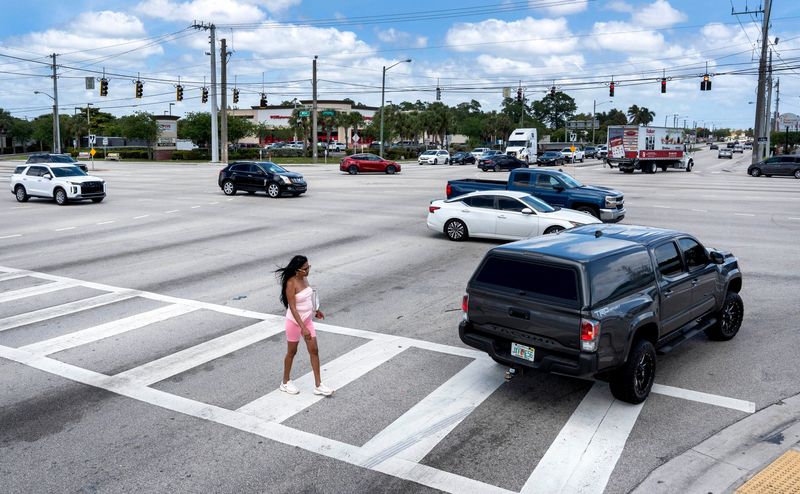
Vehicle crashes at 200 of Palm Beach County’s busiest intersections rose by nearly 36% over the five years ending in 2024 as the COVID pandemic ended, people returned to their workplaces and to car trips for leisure travel and the county’s population grew by more than 3%.
Wrecks at those 200 intersections totaled 9,246 in 2024, an average of more than 25 per day, according to figures supplied by county traffic engineers.

That’s up from the 6,813 crashes — an average of nearly 19 — the county recorded at the same locations in 2020 when the pandemic left many people working remotely.
Drivers appear to be getting hung up in relatively the same places. Intersections that have accounted for the highest number of crashes in recent years were again among the leaders in 2024, the most recent for which county data is available.
Where the crashes happen in Palm Beach County
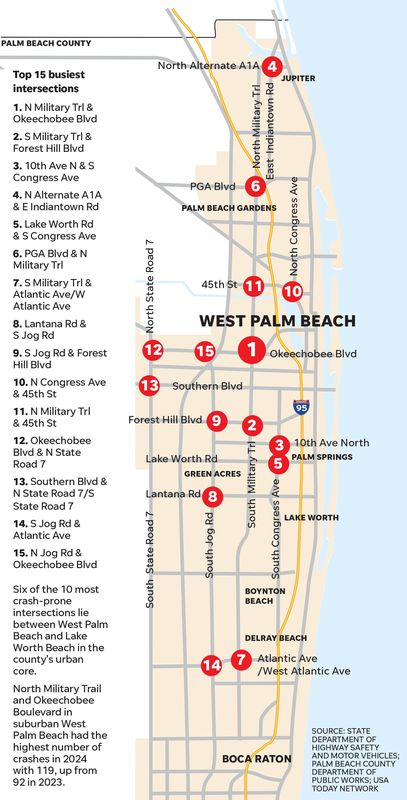
Six of the 10 most crash-prone intersections lie between West Palm Beach and Lake Worth Beach in the county’s urban core.
The West Palm Beach to Lake Worth Beach corridor
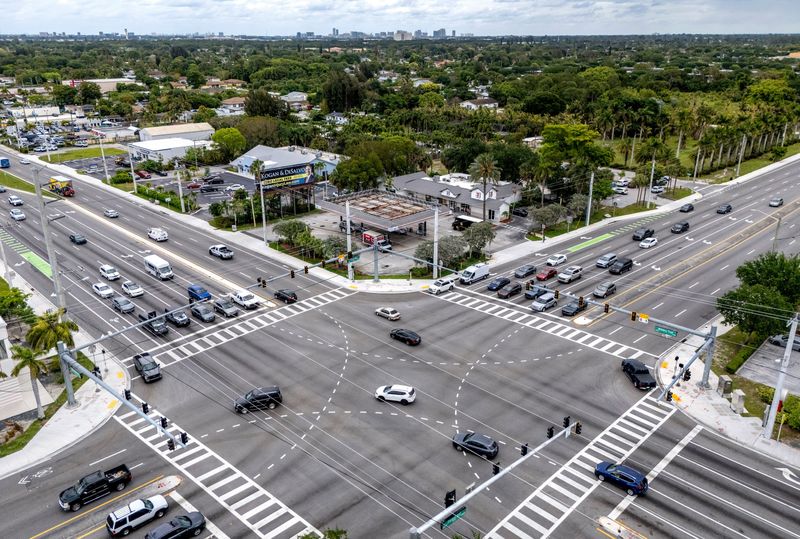
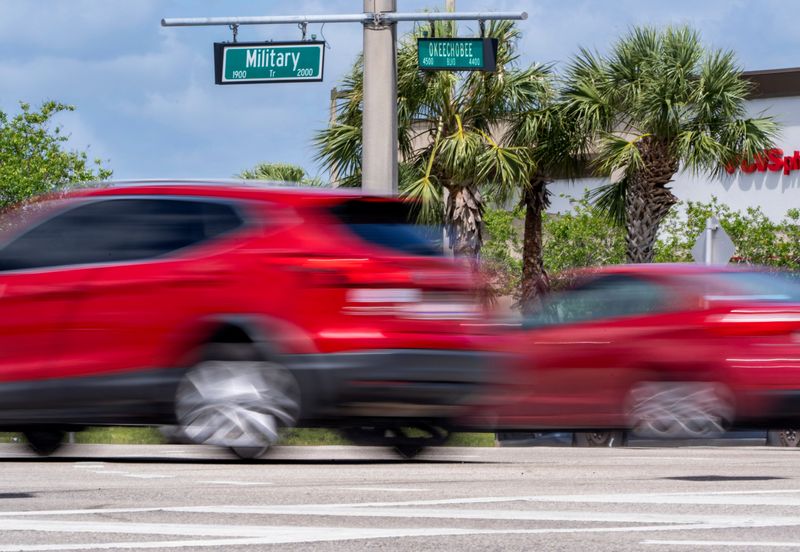
Okeechobee Boulevard at Military Trail
According to the county’s data, North Military Trail and Okeechobee Boulevard in suburban West Palm Beach had the highest number of crashes in 2024 with 119, up from 92 in 2023, when the intersection had the second-highest number of crashes.
South Military Trail and Forest Hill Boulevard
South Military Trail and Forest Hill Boulevard, about 4 miles to the south, recorded the second-highest number of crashes in 2024 with 101, matching its county-leading total from 2023.
All parts of coastal Palm Beach County saw intersections with substantial amounts of crashes.
Delray Beach
Atlantic Avenue and South Military Trail
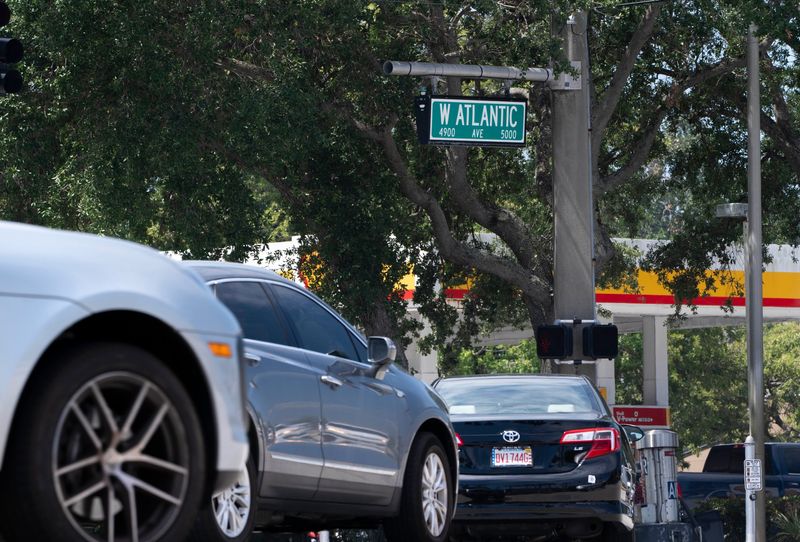
Atlantic Avenue and South Military Trail in Delray Beach had the highest crash total for the county’s southern communities in 2024 and ranked seventh overall with 89, increasing from 55 crashes in 2023.
Jupiter
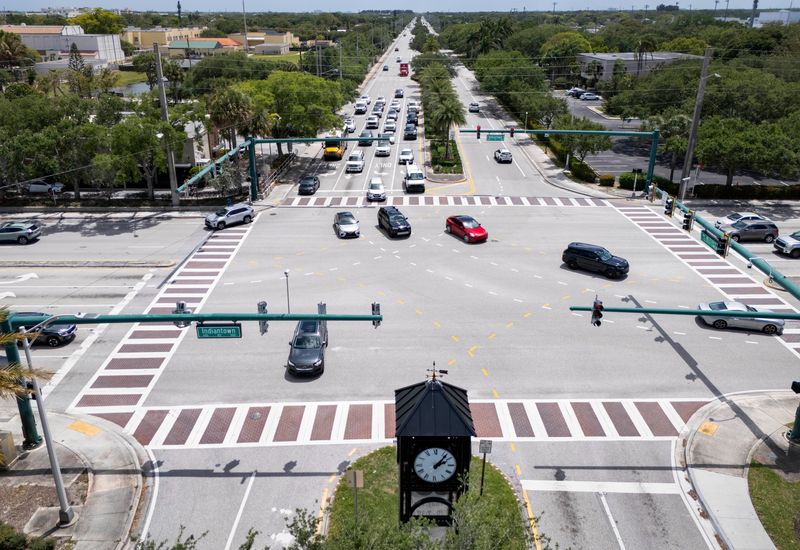
North Alt. A1A and East Indiantown Road
North Alternate A1A and East Indiantown Road in Jupiter accounted for the highest number of traffic crashes in north county and tied for fourth overall with 95.
The intersection recorded 78 in 2023. Mayor Jim Kuretski said some of the increase may be attributed to a surge in cars that traveled through it while crews closed parts of State Road A1A to rebuild the Federal Bridge.
More cars, same roads
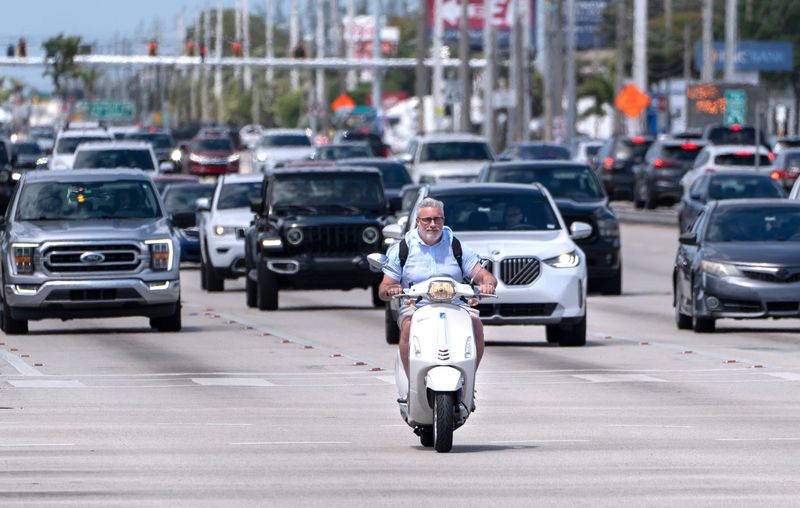
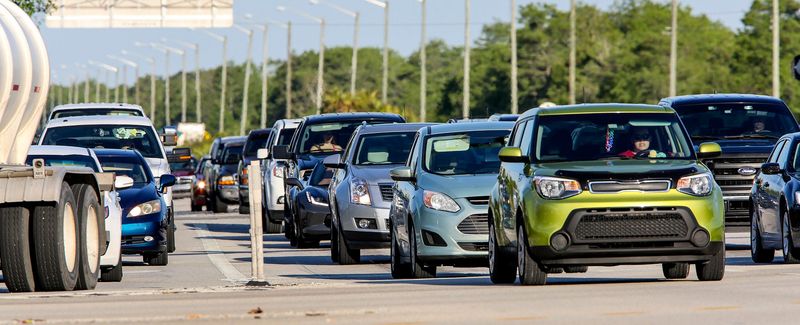
While the county’s road network didn’t change much in those five years, the number of cars and trucks on them did, helping to create what one observer calls more “conflict points” on local streets.
The county was home to about 76,000 more cars and trucks at the end of 2024 than it was in 2020, an increase of 7.2% to 1,132,958 vehicles, or nearly one for every person in the county, state figures show.
“We have to start think about moving people efficiently in other ways, providing options,” said Valerie Neilson, executive director of the Palm Beach County Transportation Planning Agency.
Palm Beach County roads see 3% more people, 6.5% more cars
Data from the University of Florida’s Bureau of Economic and Business Research showed Palm Beach County had an estimated population of 1,545,905 residents in 2024, compared to 1,492,191 residents in 2020, a 3.6% increase.
State Department of Highway Safety and Motor Vehicles records indicate the number of registered cars and pickups in the county grew at nearly double that rate.
The county had 1,132,958 cars and pickups in November 2024. It had 1,063,659 registered cars and pickups in September 2020, an increase of 6.5%.
The concentration has only increased since then. The state agency counted 1,139,982 registered vehicles in November 2025, an increase of nearly 7.2% since 2020.
Neilson said increasing congestion on local roadways and cars traveling at high speeds are some of the common concerns that local officials express as they seek ways to reduce the number of crashes.
“A lot of issues we’re seeing is really how our system has been built out, and this is an issue across all of the Sun Belt states, that were basically planned out around the car and trying to build big roads for people to be able to go where they need to go,” she said.
“That’s worked for some time, but when you drive fast and speed limits are high on a lot of roads, you have less reaction time. As we widen the roads further, you’re inclined to drive fast. … (There are) more people moving here, more people are trying to get around, more conflict points.”
The Transportation Planning Agency helps plan state and federal funding for transportation projects in the county. In February 2025, the agency hosted a Safe Street Summit in which officials from Palm Beach, Broward and Miami-Dade counties discussed ways to alleviate congested streets and provide alternate means of transportation in hopes of reducing the number of people needing to use cars.
“We have to start think about moving people efficiently in other ways, providing options,” Neilson said.
Mass transit options may be key to reducing car, truck crashes
Neilson noted that several lane-widening projects are planned for the next few years, including a project now under construction to widen a stretch of the Beeline Highway to six lanes from four between Blue Heron Boulevard in Riviera Beach and Northlake Boulevard in Palm Beach Gardens.
The Florida Department of Transportation plans to expand Atlantic Avenue in suburban Delray Beach from Florida’s Turnpike east to Cumberland Drive to six lanes from four, and to four lanes from two from west of State Road 7 to east of Lyons Road.
County traffic records show that three intersections along Atlantic were among the top 20 in terms of crashes in 2024. Neilson noted that many of the county’s most heavily traveled routes, such as Okeechobee Boulevard, have been widened to capacity.
“We look at it and we say we can’t widen this road anymore,” she said. “At a certain point, you have to start looking at certain corridors and trying to make it better to take other modes of transit. You have highways, but you also have roads that might be more multimodal in fashion.”
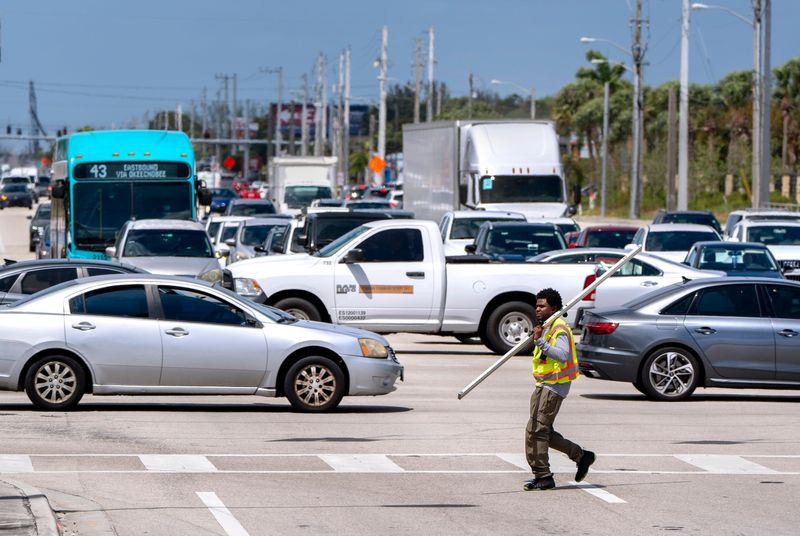
Neilson said the state is studying what it would take to offer transit options such as high-frequency bus and shuttle services for the Okeechobee Boulevard corridor, a major east-west route that connects western suburbs such as Wellington and Royal Palm Beach to downtown West Palm Beach.
“It’s a long-term project, but those are the kinds of we’re looking at,” she said. “On certain corridors, those north-south, east-west corridors, can we possibly look at creating a car-optional system? For those people who don’t want to drive, it’s more convenient for them to take this.”
Julius Whigham II covers northern Palm Beach County and public safety for The Palm Beach Post. You can reach him at jwhigham@pbpost.com and follow him on X, the platform formerly known as Twitter, at @JuliusWhigham. Help support our work: Subscribe today.
This article originally appeared on Palm Beach Post: Crashes surge at Palm Beach County’s most dangerous intersections
Reporting by Julius Whigham II, Palm Beach Post / Palm Beach Post
USA TODAY Network via Reuters Connect