Alligator Alcatraz vendors are being told to wind down operations at the immigrant detention center in the Everglades, a Florida congresswoman confirmed.
“While my office can confirm that contractors are being told to wind down operations, shuttering this cruel, costly boondoggle down is way overdue,” U.S. Rep. Debbie Wasserman-Schultz said in a statement to The News-Press & Naples Daily News Tuesday, June 23.

This comes almost a week after the U.S. Department of Homeland Security announced the relocation of all detainees at the facility, citing hurricane threats. At the time, however, the DHS didn’t clarify whether the facility would close, as operations continued after detainees were transferred.
“I saw the deplorable human and environmental conditions at this Everglades detention facility during my surprise visit there,” Wasserman-Schultz said, referring to an unannounced visit she made to the site in April. “But even before that, I raised the voices of detained people and their families, sponsored the No Cages In the Everglades Act, and stood with tribal and faith leaders, community members, and environmental defenders, to shut this abomination down.”
DHS has not clarified whether the closure is permanent. When asked Monday, June 22, a DHS spokesperson resent an unsigned statement from June 17, which maintained that detainees were moved only for “their safety during hurricane season.”
What is happening at Alligator Alcatraz?
The News-Press & Naples Daily News monitored the site starting at 10 a.m. Tuesday, June 23, and saw a consistent pattern of a large charter bus, white and black prison transport buses and white vans leaving the facility roughly every hour, only to return 15 to 20 minutes later.
Jessica Namath, founder of Floridians for Public Lands, said she’s skeptical the facility is closing and would like to see some progress.
If they’re really demolishing, Namath said, then caravans of trucks should be coming out by now because there is so much equipment on-site.
Debbie Wehking, a Miami resident who calls herself a “witness in the Everglades” said the charter bus and prison transport movement was typical for the site but noted other traffic was unusual.
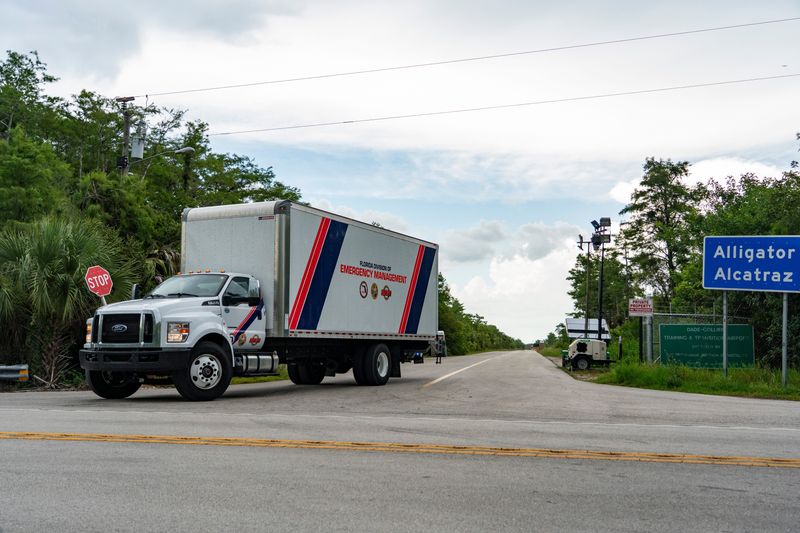
Two UTVs were towed away on a flatbed trailer, followed by a large pickup truck with blue lights towing a beige storage container branded with the Florida Department of Law Enforcement seal. Throughout the afternoon, vehicles from vendors, including Doodie Calls portable toilets, Envigo Networks, RelaDyne and FDEM, were seen entering and leaving the facility. A Sunbelt Rentals truck hauling a UTV also entered the site shortly after 3 p.m. and came out within the hour without the UTV.
Two state troopers were stationed at the facility entrance throughout the day, rotating shifts with at least one vehicle at the entrance at all times.
Is Florida’s Alligator Alcatraz shutting down permanently?
A DHS spokesperson declined Tuesday, June 23, to confirm whether the site was closing.
“Any reports that DHS is pressuring the state to cease operations at Alligator Alcatraz are false,” a DHS spokesperson said in an emailed statement. “Florida continues to be a valuable partner in advancing President Trump’s immigration agenda, and DHS appreciates their support.”
DHS said it “continuously evaluates detention needs and requirements to ensure they meet the latest operational requirements.”
Regarding reimbursement of state expenses, DHS said it reviews requests for grant funding to ensure costs are allowable and eligible before releasing funds.
In an email to the Naples Daily News June 22, the Collier County government said it was not notified of any changes to the operational status of the immigrant detention facility.
In a press conference about a different topic Monday, June 23, Florida Attorney General James Uthmeir would not confirm the shutdown, but said, “The plan has always been to protect the Everglades and take it back to a protected area where it’s not a commercial business, an airport.”
“I will say it was never expected to be a long-term thing,” he said.
On May 12, The New York Times published reports from vendors saying they were told detainees would be relocated and the facility would be broken down in the weeks after.
The indigenous community in South Florida has not had contact with officials at the state or federal level as to when the facility may shut down. The Miccosukee Tribe of Indians of Florida joined a lawsuit last year that sought to close the facility and remove the equipment, rocks, tents, pavement and people. That suit is still active, said influential Miccosukee tribal member Betty Osceola.
“If they’re shutting down, we want to see evidence,” Osceola said. “We want it shut down and things returned to how they were before this began. They need to return our tribal access but we get turned away.”
Osceola said she saw Doodie trucks entering and leaving the facility, but so far there has been no physical proof that Alligator Alcatraz is being closed. “You’d think with them shutting down you’d see tractor trailers leaving and when are the dump trucks to remove all the gravel and the tents,” Osceola said. “They still have the lights at gate and state troopers are there and we’ve expected a flurry of activity to take things down and we haven’t seen that.”
She said the lack of communication from state and federal officials is insulting to the tribe and its members as well as the general public in Florida.
How much will the Alligator Alcatraz closure cost?
In her statement, Wasserman-Shultz criticized the conditions at Alligator Alcatraz along with the waste of taxpayer funding.
“Florida taxpayers saw nearly a billion dollars in hurricane emergency funds lit on fire to pay for this monument to cruelty,” she said.
“So, this is far from over. Trump and DeSantis broke the law, violated civil rights, tore apart families and they did it on our dime, and I’ll fight non-stop to hold them to account.”
According to an October 2025 report, the Florida Division of Emergency Management projected over $46 million in mobilization and demobilization costs for Alligator Alcatraz. However, that same amount had already been spent by October, meaning the projected costs do not appear to include demobilization.
CBS News reported that each vendor had a demobilization clause in its contract, which allows them to charge a demobilization fee and marks the end of the vendor’s involvement with facility once invoked.
Details of vendor contracts were removed from public databases in July and replaced by generic summaries without detailed cost breakdowns, citing a need to remove “proprietary information.”
In August, AP News predicted shutting down the facility would cost between $15 and $20 million.
Some reports show Florida still owes vendors $603 million in unpaid fees surrounding Alligator Alcatraz and Deportation Depot, a second immigration detention facility in Baker County.
The highest unpaid bill looming over the state’s bank account is to a portable toilet company for almost $78 million, according to public records.
The original contract with Doodie Calls Inc. was for $151 million for the “establishment of staff village,” but the state had only paid $72.6 million as of June 23.
Lawmaker says state has provided little transparency
State Rep. Anna Eskamani, an Orlando Democrat, told The News-Press & Naples Daily News she has not received confirmation from state agencies that Alligator Alcatraz is permanently closing, despite repeated requests for information.
“I’ve not gotten anything from state agencies,” she said. “The state is definitely operating in shadows.”
Eskamani was among a group of lawmakers who attempted to visit the facility shortly after it opened in July 2025. She said the lack of transparency surrounding the site has remained consistent throughout its operation.
“It’s never been transparent,” she said. “From the very beginning, this project of Gov. Ron DeSantis has been shielded from the public.”
While Eskamani said she is pleased by reports that the facility is winding down, she argued that questions remain unanswered, including how taxpayer money was spent, the treatment of detainees and the facility’s environmental impacts.
“We need full transparency of what happened inside this facility, including conditions, medical care, treatment of detainees, a full accounting of every taxpayer dollar that was spent — including with these no-bid contracts — oversight of the remaining folks who are detained and then, of course, the legislative guardrails so that no governor could do this again,” she said.
Eskamani noted concern about how transferred detainees will be tracked after leaving Alligator Alcatraz.
“It is very difficult to track,” she said of the federal detention system. “My heart breaks for the family members that are impacted by this and trapped in this broken system who are trying to ensure that a loved one has a path to due process and a fighting chance.”
She said advocates and lawmakers have struggled to determine where detainees were sent after leaving Alligator Alcatraz and called for continued oversight of those who remain in federal custody.
How did immigrant advocacy groups react?
Thomas Kennedy, a spokesperson for the Florida Immigrant Coalition, described the yearlong operation as a “detention center grift” that diverted hundreds of millions of taxpayer dollars away from emergency needs such as hurricane preparedness and wildfire response.
“We’re happy that the facility is shutting down because it symbolized some of the worst excesses of the Trump administration and the DeSantis administration’s immigration crackdown,” Kennedy said. “More substantively, this was an experiment in a new model of immigration detention.”
Kennedy argued that Florida taxpayers deserve answers on how the money was spent.
“This was money that was supposed to go into hurricane response, to responding against the wildfires, for example, that are ravaging areas throughout here in South Florida, and hurting our air quality. That’s the money that could have been spent on that, and instead it was spent in this detention center grift,” he said. “I think there’s a lot better ways to spend this money than this stupid PR stunt.”
Kennedy dismissed state officials’ justification that hurricane risks contributed to the facility’s closure, noting that similar concerns did not stop the center from opening in July 2025.
“They didn’t care about that last year when they opened the detention center in July,” he said. “Infamously, the detention center opened, and they had Trump, Kristi Noam and the whole peanut gallery there, and the facility flooded.”
Afterward, there was a push for the state to release a hurricane preparedness and response plan. When the state finally did, he said, “It was 33 pages, and it was more redacted than the Epstein files — black page after black page.”
Kennedy said he was skeptical the facility could be easily revived given its remote location.
“Everything about this has been disgraceful. They sold merch around this,” he said.
While families of detainees were relieved to see the facility close, Kennedy said accountability questions remain as detainees are transferred into the broader federal immigration detention system, where, he argued, tracking individuals and obtaining information can be difficult. He described some detainees as becoming ghosts or being “administratively disappeared” within the system.
From USA Today: Track the Trump administration’s immigration enforcement
Where were detainees sent?
Detainees at Alligator Alcatraz were transferred to other detention centers across the country, according to DHS, which did not specify where exactly detainees were transferred.
The Workers Circle, a New York-based national advocacy group that has consistently called for the closure of Alligator Alcatraz and hosted weekly vigils outside the facility, credited advocates’ persistence in its closure.
“We, the people, shut it down,” a statement by The Workers Circle Director of Social Justice Noelle Damico said. “This decisive victory in the battle against Alligator Alcatraz, the ‘jewel in the crown’ of the Trump detention regime, is the result of thousands of ordinary people gathering under the banner of Constitutional Rights and common human decency.”
The Worker’s Circle partnered with Sanctuary of the South to provide legal services to detainees, and on May 28 pledged to provide all unrepresented detainees with sound legal counsel.
Sanctuary of the South represented 50 detainees at Alligator Alcatraz at the time the relocation of detainees was announced. They were reportedly transferred to other detention centers across South Florida, California, Arizona, Louisiana and Texas.
What does this mean for the Everglades?
The official closure of the facility is a major win for environmental advocacy groups like Friends of the Everglades which have long criticized the detention facility’s impacts on the fragile Everglades ecosystem.
Friends of the Everglades has launched several lawsuits against the state alleging it didn’t follow environmental laws requiring environmental impact reviews before construction starts. The group also sued the state for denying public records requests regarding state spending on the facility.
The group did not immediately respond to a request for comment regarding the closure of the facility, but sent out a press release on June 17 applauding the relocation of detainees at Alligator Alcatraz, but reiterating the environmental harm of the facility.
“We will not stop fighting until this makeshift prison permanently closes and all the harm is remediated,” Executive Director Eve Samples said. “That harm includes 20 acres of new pavement, removal of habitat for the endangered Florida panther, and high-intensity lighting installed in a renowned dark-sky area.”
Alexa Ryan is a reporter for Naples Daily News. You can reach her by emailing Alexa.Ryan@naplesnews.com.
Mickenzie Hannon is a watchdog reporter for The News-Press and Naples Daily News, covering Collier and Lee counties. Contact her at 239-435-3423 or mhannon@gannett.com.
News-Press reporter Chad Gillis contributed to this report.
This article originally appeared on Naples Daily News: CLOSING? Florida’s Alligator Alcatraz vendors told to demobilize
Reporting by Alexa Ryan and Mickenzie Hannon, Fort Myers News-Press & Naples Daily News / Naples Daily News
USA TODAY Network via Reuters Connect
By Alexa Ryan and Mickenzie Hannon, Fort Myers News-Press & Naples Daily News | USA TODAY Network