Marco Island will look into what it would cost to update the city’s wastewater treatment plant to Advanced Wastewater Treatment, or AWT.
What can it hurt to find out?, Marco Island City Council members decided.

AWT, which is used to remove a variety of contaminants from wastewater, such as heavy metals, oil and grease, pathogens, and suspended solids, along with nutrients such as nitrogen and phosphorus, is one of several ideas that city officials are considering to improve the city’s waterways.
Councilwoman Tamara Goehler, along with several residents, are pushing for the city to convert Marco Island’s wastewater treatment plant to AWT.
Jeff Poteet, the city’s water and sewer utilities general manager, says the water and sewer plant is state of the art and not the issue. He has said the city’s money would be better spent replacing the septic systems of Goodland and Isles of Capri with sewer systems like Marco Island has. All septic systems within the Marco Island city limits have been eliminated, but Marco also services the two communities to its northwest and southeast.
While most of the changeover to sewer from septic in Isles of Capri and Goodland would be paid through assessments and grants, Marco Island would bear the burden of updating its existing plant to AWT. City Council directed staff to find an engineer to estimate the cost of the changeover to AWT.
“A wild guess is $20 million until we have a consultant that would do a cost estimate on that,” said Marco Island Public Works Director Justin Martin at a July 7 workshop with the city council on the city’s water treatment history.
Comprehensive approach will resolve Marco Island’s water issues: public works director
Marco Island has been on the Florida Department of Environmental Protection’s (FDEP) water impairment list since 2019, which was after two years of higher than acceptable nitrogen levels in water that flows through city. Excess nitrogen can cause overstimulation and growth of aquatic plants and algae. Excessive growth of these organisms, in turn, can clog water intakes, use up dissolved oxygen as they decompose, and block light to deeper waters, according to United States Geological Survey.
The amount of nitrogen is declining, while phosphorous is increased, but not at unacceptable levels, Martin said during the July 7 meeting.
Most recent “water testing indicated that total phosphorus levels in Marco Island canals are slightly higher than the immediate offshore areas, but this is important, it says however canal phosphorus levels are below the FDEP threshold levels,” Martin said. “So, we’re not impaired for phosphorus; we were impaired for nitrogen. And it appears that the impairment for nitrogen may be going away after August of this year when they meet again on the subject since the nitrogen levels have been going down.”
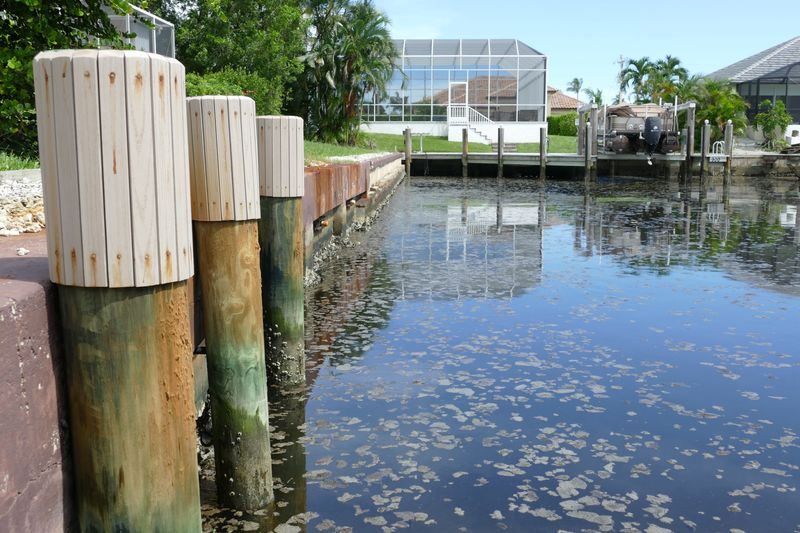
Many in the community aren’t convinced as they see gunk floating to the surface from their canals. Some canals are dead ends and others flow more freely and into The Gulf.
Marco Island’s waterways are made up of more than 100 miles of canals, four bays and Collier Creek. Large areas of the community – Capri Pass, Caxambas Pass, and Big Marco River – are not city waterways and are administered by Collier County and the U.S. Coast Guard. What’s going on in those waterways and The Gulf also could be affecting Marco Island.
City officials say the priority should be completing the plan approved by FDEP to reduce nitrogen and get off the impaired waterways list. FDEP accepted the city’s plan for lowering nitrogen levels in September 2023 and moved to the the study list for the 2022-2024 period after submitting its alternative water plan, called an FDEP 4e plan. Marco Island’s restoration plan has already begun and is scheduled for completion in 2029.
The city will remain on the U.S. Department of Environmental Protection’s impairment list – 303(d) – while Florida officials evaluate the city’s progress towards attainment of water quality standards, according to the FDEP.
Goehler and others are determined that building an Advanced Wastewater Treatment plant to replace the existing standard Reclaimed Water Production Facility will help the canals and the community. Clean Marco Waters LLC, created by a group of residents is pushing for an AWT plant, based on independent testing in 2025 that it says shows reclaimed water is an issue in the canals.
“There’s not one single thing that can be done that will improve water quality and all canals,” Martin said. “It has to be a comprehensive approach,” which has been supported by studies commissioned by previous city councils. “Dredging is just one component of it. There’s aeration, there’s prevention with the street sweeping with the inlet screens, everything else. So, it has to be a comprehensive approach in order to make a change.”
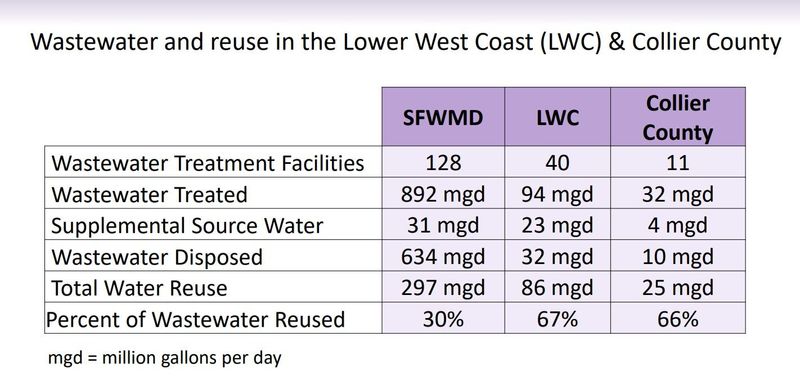
Marco Island’s wastewater treatment plant is a Reclaimed Water Production Facility, treating raw sewage for use in irrigation. About 30% of Marco’s reclaimed water goes to Marco Shores off of the island, Poteet said.
Martin said 70% of the nutrients are embedded in the canal, and “that’s the biggest 70% of the contributing source to nutrients in the water is, and that’s a result of decades of septic systems contributing to that. So, we’ve stopped the septic contributing to that, but those nutrients are still embedded.”
What are some Florida communities that have AWT facilities?
The City of Naples operates a 10-million gallon per day Advanced Wastewater Treatment facility. “This facility produces high-quality “Reclaimed Water” that is primarily used for irrigation of golf courses, residential landscaping, parks, and roadway medians. The reclaimed water system includes over 30 miles of distribution piping, supplemental water from the Golden Gate canal and aquifer storage and recovery (ASR) wells located on the facility site. The wastewater service area has approximately 9,000 accounts with an estimated population of 45,000,” according to the city’s website.
Labelle, Arcadia and Key West have AWT facilities.
Sarasota County’s Board of Commissioners in mid-2019, voted to expand the Bee Ridge Water Reclamation Facility and convert it to Advanced Wastewater Treatment. Since that time, multiple projects have begun to bring this initiative to fruition, according to the county website. A 2021 EPA loan helped finance half of the $214 million project costs.
This article originally appeared on Marco Eagle: Cleaner canals for Marco Island: Is advanced wastewater treatment the answer?
Reporting by J. Kyle Foster, Naples Daily News / Marco Eagle
USA TODAY Network via Reuters Connect