

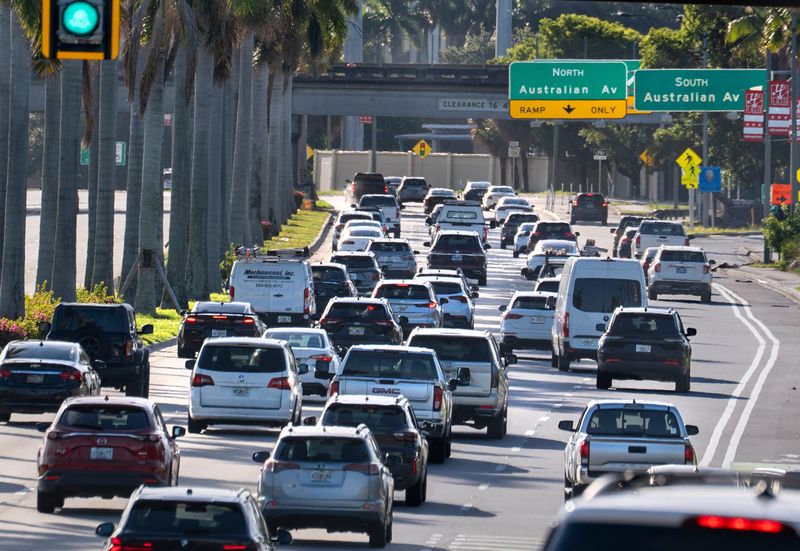
It’s a dubious consolation for motorists stuck on backed up roadways and parking lot-resembling highways to be told the traffic snarls could be worse, way worse.
But, in fact, they would be if not for a quarter century’s worth of traffic projects — new bridges, added lanes, expanded off ramps, open-road tolling — by the Florida Department of Transportation, county and cities to keep cars and trucks moving along in the face of an explosion of people living in and around Palm Beach County.

And yet it’s not been enough to overcome the ying-yang congestive and magnetic appeal of the Palm Beaches.
“I don’t think the public fully appreciates how much the population has grown in that time,” said transportation consultant Robert Poole, arguably the nation’s top traffic expert.
“Just keeping up with the growth is one of the big problems that FDOT has faced. Particularly in Southeast Florida, where, there’s such a huge population increase and the infrastructure is not hugely different than what it was 10 or 15 years ago.”
True, but a slew of infrastructure improvements, plus technology, and an advantageous funding stream could help ease some of the congestion, get motorists moving forward at a more consistent pace and certainly prevent things from getting roads and highways even more jammed up.
This is the first of a five-part, month-long series — “Moving Forward” — in which the staff of the The Palm Beach Post looks at solutions to Palm Beach County’s transportation matrix.
The traffic gridlock equation: More people plus more cars
Since the 1980s’ completion of Interstate 95 from Palm Beach Gardens north, roughly a million more people have moved to the county. The explosion hasn’t just mushroomed in places like West Palm Beach, Jupiter and Boca Raton. The growth has fueled the incorporation of three more western municipalities, Wellington in 1995, Loxahatchee Groves in 2006 and Westlake only a decade ago.
That trio of new cities alone currently count for close to 100,000 residents. And that estimate doesn’t include other sprawling developments, such as the 4,700-acre Avenir community near the Beeline Highway in Palm Beach Gardens.
All told, the county’s population has boomed in the past four decades from the 576,758 figure recorded in the 1980 U.S. Census to the 1.49 million in the most recent decennial count. And the 2020 U.S. census number doesn’t factor in the mass migration that has taken place in the aftermath of the global pandemic six years ago.
The increase in neighbors has led to a skyrocketing number of vehicles on the go — or at least attempting to move.
The county was home to about 76,000 more cars and trucks at the end of 2024 than it was in 2020, an increase of 7.2% to 1,132,958 vehicles, or nearly one for every person in the county, state figures show.
Traffic experts, planners and researchers say Palm Beach County is not a total jam, thanks in part to a series of innovations and a myriad of efforts at the state and local level to provide a funding mechanism beyond the gasoline tax to improve mobility, on streets, expressways and beyond.
On top of those measures, there have been numerous other initiatives, the incorporation of rideshare services like Uber and Lyft as well as the privately funded Brightline rail service plus upgrades to Tri-Rail, South Florida’s commuter train line.
There’s more on the way, too, some of it paid for by a bipartisan, $1.2 trillion 2022 federal transportation and infrastructure bill approved by Congress and signed into law by President Joe Biden. Florida was to receive $13.3 billion of that total.
Add also the further use of technology, including the advent of electric helicopter-like air taxis and the proposed self-driving car service along an elevated roadway between downtown West Palm Beach and the airport.
Overall, said Poole, director of transportation policy at the Reason Foundation, the state is a model for mobility despite the crushing growth.
“Florida, I think, is a showcase of good management, good policy on transportation,” he said.
Why driving some Palm Beach County roads creates anxiety, frustration
Boca Raton resident Linda Hamburger does not share that bullish assessment on transit.
Hamburger says her travels along Glades Road, a key south county roadway, are not just frustrating, but also anxiety-producing. The result, she said, of the multi-unit housing developments that have been added along a road that is also chock full of commercial development, from trendy retailers to popular grocery stores to malls.
Try exiting the University Commons plaza on Glades just east of I-95 and near Florida Atlantic University at the wrong time, Hamburger warns.
“You’re going to have a heck of a hard time taking a left because you’ll have to shoot across a few lanes of traffic. Then you’ll have to get into that left lane, but it’s already backed up. So you’re stuck again,” she said.
On top of that, sometimes the green arrows for left turns, and the green lights to proceed, are too short. Sometimes someone is on their phone and wastes precious seconds when the light changes. And sometimes she gets stuck with half of her auto in the crossing thoroughfare.
“Let’s say the wait time from all the delays is under five minutes,” Hamburger said. “It may not seem like much, but when you’re sitting there, it feels like an eternity, and you can quote me on that, because you know your car is sticking out in a thoroughfare lane.”
Hamburger said she has had similar experiences driving by Town Center at Boca Raton, the regional mall on the south side of Glades, and the Uptown Boca development west of Lyons and east of State Road 7. Stopped-up traffic, she said, is pretty standard across Glades, its side streets and intersecting roads.
“It’s kind of like everywhere in Boca,” she said. “It’s all the time. It can back up a mile or two. I’m not exaggerating.”
Hamburger understands the pressure on mobility imposed by population growth. As a child growing up in South Florida in the 1960s and 1970s, she remembers a time when there was little population growth in her communities, either because people were scared of hurricanes or were turned off by the legendary Florida land scams of the 20th century.
“It seemed nobody wanted to move to Florida then,” she said.
But Hamburger said while the population boom since is a factor in the gridlock equation, so are public policy lapses.
“You’re supposed to put the roads in before you bring the cars,” she said matter-of-factly.
Now, Hamburger said, adjustments need to be made. And like anyone stuck in maddening traffic, she has her preferred answer: pedestrian bridges.
“The best that I could come up with with the thousands and thousands of units they have built and are building is you need more pedestrian walkways,” she said. “Because then people don’t feel like they have to take their car just to go across the street.”
From bridges to highways, efforts have attempted to ease congestion
Pedestrian walkways spanning over Glades, perhaps, but a seeming laundry list of remedies will soon be in debate.
In September, a county transportation master plan is set to be unveiled. The consultants hired to draft the report surveyed residents, and analyzed both current conditions and future projections.
Among their many findings is 21 “corridors” covering more than 126 miles that will be “high needs in the future” but that also present “opportunities to enhance mobility.”
Those are only a portion of a slew of findings and recommendations that will be fodder for the public hearings that will ensue and ultimately for county commissioners to vote on adopting the plan and putting accepted proposals in place.
“People across Palm Beach County expressed their desires for a transportation system that is safer, better connected, and able to serve different types of travel,” a document listing draft ideas and concepts states.
In the meantime, other projects are underway.
There’s close to $1 billion worth of construction taking place to add lanes on Florida’s Turnpike, on a stretch between Glades in Boca Raton and the West Palm Beach Service Plaza, for example. The project includes replacing the former toll booth in Lantana with open-road tolling, where sensors charge tolls and keep vehicles moving.
These projects, expected to be done between this year and 2030, follow lane additions on I-95.
To accommodate exiting motorists on I-95, for instance, ramps at Boynton Beach Boulevard, Sixth Avenue South in Lake Worth Beach, Palm Beach Lakes Boulevard in West Palm Beach and Indiantown Road Jupiter have been or are being widened, getting extra turn lanes and new traffic signals to improve flow and alleviate bottlenecks.
Additional upgrades have been conducted, too.
In 2022, a new bridge opened on Southern Boulevard connecting West Palm Beach and the island of Palm Beach. Just last New Year’s Eve, all lanes and pedestrian walkways opened on the new U.S. 1 bridge crossing the Loxahatchee River in Jupiter.
More than $200 million was spent on those two projects.
Florida’s advantage? Toll money. But where to spend it?
Poole, the transit expert, notes Florida has an advantage many other states do not — the Sunshine State leads the country in the number of miles that generate revenue via tolls.
The state’s first tolled highway, the turnpike, opened in the early 1950s. Today, Florida counts more than 700 miles of toll roads, bridges and express lanes, which reportedly generate about $2 billion a year.
Had Florida simply sought to address transportation needs the traditional way — through its portion of gasoline taxes — the dollars, he insists, “would not have sufficed at all to provide the infrastructure” that Palm Beach County residents have.
“Given the huge population that has occurred in Florida, if we didn’t have all that toll capacity, things would be hugely worse than they are today,” said Poole, who consulted California transportation officials on establishing the first premium express lanes in Orange County in 1995.
Those additional toll lanes, derided here by critics as “Lexus lanes,” came to South Florida in the 2000s on I-95 in Miami-Dade County, and were extended into Palm Beach County this decade.
That money is what holds promise for Palm Beach County, and the rest of the state, in addressing what residents perceive and adamantly argue are transit bottlenecks and disasters.
For example, Poole said a possible answer to address frustrations like Boca Raton resident Hamburger has regarding Glades Road is to construct a flyover lane over the most clogged intersections to keep traffic flowing rather repeatedly stopping at red lights.
Those already exist, for example, on Southern Boulevard between I-95 and the turnpike, but Poole said more are needed.
“One idea would be for the east-west arterials that carry a lot of traffic. There are very few of them that have elevated grade crossings over the major north south roads,” he said. “The place to start, for sure, I think, would be on those east-west arterials that are state highways.”
Those would be pricey, but again toll monies could be used to offset costs.
“That’s an idea that could have some potential,” he said. “The tolls probably wouldn’t cover the whole cost, but if they cover a third or half of the cost, it makes it a lot more feasible.”
The toll money could also fund artificial intelligence applications to synchronize traffic lights.
“There’s definitely gains to be had from better synchronization of traffic lights on arterials,” he said. “It is very frustrating to have that situation.”
For Hamburger, the relief cannot come soon enough — a sentiment likely echoed by many other Palm Beach County commuters.
She said, when stuck in traffic, she often recalls the sparseness of South Florida of her childhood, when farms, not malls and condominiums, dotted the landscape.
“Never in a million years would I have expected this to happen,” she said of the growth and congestion.
But this is the situation the Palm Beaches have arrived at — and are stuck in, too.
Antonio Fins is a politics and business editor at The Palm Beach Post, part of the USA TODAY Florida Network. You can reach him at afins@pbpost.com. Help support our journalism. Subscribe today.
This article originally appeared on Palm Beach Post: Can tolls and tech handle Palm Beach County’s transportation future?
Reporting by Antonio Fins, Palm Beach Post / Palm Beach Post
USA TODAY Network via Reuters Connect
By Antonio Fins, Palm Beach Post | USA TODAY Network
