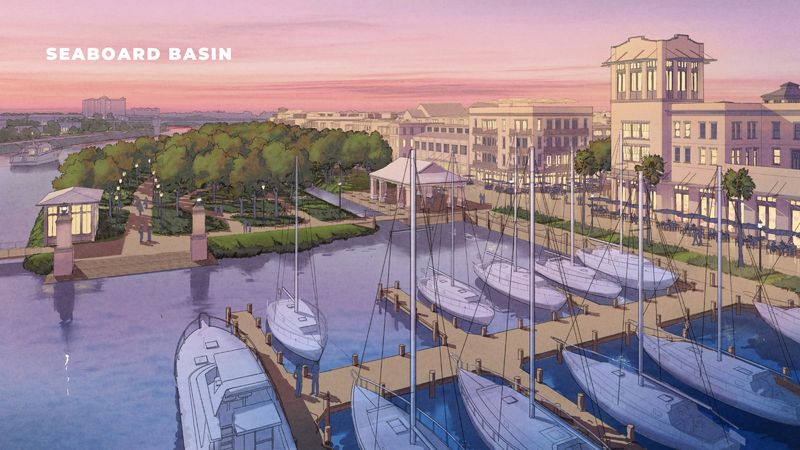
An aging industrial district in Venice is poised to become Sarasota County’s newest waterfront destination for dining, shopping and living.
The city’s purchase of a key property July 14 clears the way for Nolen Street, a critical piece of the Seaboard District master plan that envisions restaurants, shops, homes and a possible marina along the waterfront.

Consultant Josh Frank with Dover, Kohl & Partners reviewed the Seaboard Phase 1 Technical Plan, developed after several public meetings.
Much of the discussion involved development of the initial focus area, which includes land the city of Venice already owns — the former fleet maintenance facility and a former cement plant it purchased in May 2023 — that may be developed first through a public-private partnership.
That development may include a proposed marina and a rookery island along the Venetian Waterway Park, but Frank said the city’s first priority should be creating the new east-west corridor known as Nolen Street.
Nolen Street would terminate at a proposed pedestrian and cyclist swing bridge that would span the Intracoastal Waterway, roughly opposite Venice High School.
Earlier in the meeting, the council approved the purchase of a parcel at 234 Grove Street from Warfield Grove LLC for $245,000.
That purchase, combined with a vacant lot at 215 Warfield Avenue that Warfield Grove LLC donated to the city in January, gives the city a clear path to creating Nolen Street between Seaboard and Warfield avenues, the two major north-south roads in the Seaboard District.
“Instead of putting all of the energy onto Seaboard, you can take that investment in Nolen Street and really have a significant impact,” Frank said.
As documented in a presentation to the commission, once the initial portion of Nolen Street is built, the city could seek out a public-private partnership to develop the east side of the intersection of Nolen Street with Seaboard Avenue.
The land required to extend Nolen Street to the waterfront is still in private hands.
What is the long-range plan for Venice’s Seaboard District?
A drive down Miami, Venice and Tampa avenues on the island of Venice offers a general blueprint of what city officials envision occurring in the Seaboard District, which is bounded to the north by Hatchett Creek and the east by U.S. 41 Bypass.
Basically, they envision a mix of shops, residences and commercial businesses.
The southernmost portion of the Seaboard District is actually within unincorporated Sarasota County.
Sarasota County is currently not part of this planning process for creating a redevelopment vision for the area.
When John Nolen planned the city of Venice for the Brotherhood of Locomotive Engineers in 1926, the Seaboard District was envisioned as the primary industrial site for the community.
Over the decades, the railroad was replaced by the Intracoastal Waterway and many of the heavier industrial businesses were replaced, though it is still a small business hub, as well as home to the Clyde Butcher Venice Gallery and Studio.
There is no timetable for the transition, as much of it will be market-driven.
Though the city will likely enact zoning and land use changes to foster redevelopment, existing businesses will not face pressure from the city to change.
“That was our plan, do no harm here,” Venice Planning and Zoning Director Roger Clark said. “We’ve told the business owner and property owners that you can be here until the end of time.”
How did the city council vote?
In addition to approval of the purchase of the Grove Street parcel, the board voted for appropriate staff members to engage with the public about the first phase technical plan, start plans to demolish outdated structures and determine the marketability of the land.
Staff will also start preliminary discussions with the West Coast Inland Navigation District about permitting required for the marina and pedestrian swing bridge and develop a proposed code and architectural standards for the “Seaboard Core,” which at the moment is predominantly those city-owned properties.
Venice residents can also anticipate future public meetings to discuss how the first phase will unfold.
The hope is that with some aspects of the plan, such as permits for the anticipated marina, approved, it will make the development more attractive for private partners.
How may the plan evolve?
There is still much to be decided, specifically the height of new buildings in the Seaboard District, and how closely they will reflect the Northern Italian architectural theme embraced elsewhere in the city.
While the plan was being shaped, public sessions resulted in seven themes that guided the process: improve transportation and connectivity; maintain the existing fabric; preserve the local economy; create new public spaces, improve existing ones; provide a diversity of new mixed uses and destinations; improve Seaboard and Venice avenues and create connections to the waterfront.
The July 14 presentation showcased examples of mixed-use and housing types, such as row houses (think connected townhouses along a city block) that are more common in other urban areas.
Frank said the goal was for Seaboard to have its own eclectic flair and flavor.
A majority of the council members were not ready to abandon the city’s Northern Italian theme.
“We don’t need to make it a Wellen Park and so forth,” said Council Member Kevin Engelke. “For 25 years, 10 years it’s going to be glitzy and new but then it’s going to look like everything else we’re competing with.”
Still, Vice Mayor Jim Bold cautioned, imposing too many restrictions could stifle development.
“We are in a position today to make something happen,” Bold said. “If we put (up) too many restrictions, it will stop.
“This will happen significantly faster if we don’t tighten it up too much.”
Earle Kimel primarily covers local governments in Sarasota County as well as land development and environmental issues for the Herald-Tribune. Follow him on Facebook, and X. He can be reached by email at earle.kimel@heraldtribune.com. Support local journalism by subscribing.
This article originally appeared on Sarasota Herald-Tribune: Big changes are coming to a Sarasota County waterfront
Reporting by Earle Kimel, Sarasota Herald-Tribune / Sarasota Herald-Tribune
USA TODAY Network via Reuters Connect
By Earle Kimel, Sarasota Herald-Tribune | USA TODAY Network