In the wake of the uproar over the state allowing a black bear hunt this December, the fate of another creature now is inflaming environmental advocates and even some legislators.
A bipartisan group of lawmakers sent a two-page letter to Florida Fish and Wildlife Conservation Commission chair Rodney Barreto on Aug. 29, requesting an end to a special marine licensing program that authorized the capture of an endangered giant manta ray off Panama City in July for Sea World Abu Dhabi.

Video of the capture with onlookers yelling at workers for Dynasty Marine Associates, Inc., to stop as they pulled the enormous sting ray from Gulf went viral, calling attention to the Marine Special Activity license (SAL) the state offers.
Lawmakers requested the FWC to commit to a rule making process to permanently end the SAL at its November quarterly meeting in Clewiston. Barreto responded to the lawmakers’ letter Sept. 5 and said the FWC is “revisiting” the SAL and has stopped issuing them.
“We intend to initiate a formal rulemaking process, but this will require time,” Barreto wrote back with plans to hold SAL hearings in 2026.
The FWC regulates all aspects of wildlife and fish management, which includes maintaining populations and habitats, rules for hunting and fishing, and public education.
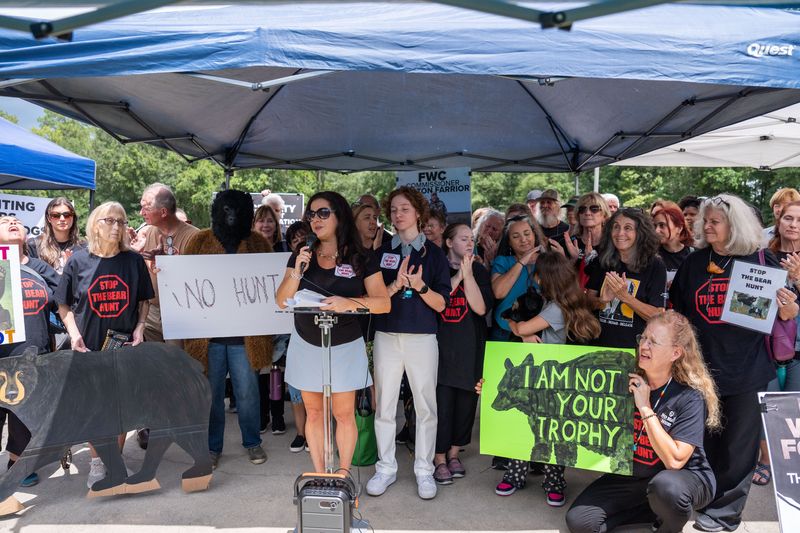
Opponents to the bear hunt and the SAL program question whether the FWC is using licensing processes to facilitate the exploitation of vulnerable wildlife for profit.
And while environmentalists, wildlife advocates, and a political scientist see the hallmarks of a “captured agency,” lawmakers request the agency commit to rule changes, and more public outreach beginning with its November meeting.
“Captured agency” is an economic term for when a special interest dominates a regulatory agency and ideological, economical or political interests outweigh that of the public.
“When you read the definition of a captive agency it is the FWC up, down, forwards, and backwards. It’s kind of perverse. The very agency that is to protect wildlife is destroying what it was intended to protect,” said Katrina Shaddix, executive director of Bear Warriors United.
When asked about the allegations FWC executive director Roger Young said the FWC has never been a captured agency.
“Florida’s invaluable natural resources are at the heart of the FWC’s mission. We are committed to managing these fish and wildlife resources for their long-term well-being and the benefit of people. This commitment is a result of the collective efforts of policymakers, conservation professionals, highly trained law enforcement, and dedicated staff. Our policy is guided by Commissioners who, as volunteers and trustees of fish and wildlife resources, bring a personal commitment and responsibility to their roles. We are proud of the dedicated staff and highly trained scientists who work tirelessly to support the FWC’s mission and bring forth conservation-driven recommendations for the Commissioners’ input and direction,” Young wrote in an email exchange.
Gov. Ron DeSantis has appointed all seven members of the FWC board. A request for comment also is pending with his office.
FWC to conserve, protect natural resources, state constitution says
The FWC was created by a 1998 constitutional amendment known as Revision 5 and written by the Constitutional Revision Commission “for the conservation and protection of natural resources.”
By a 72% margin, voters approved revising Article II, section 7 of the Constitution to read, “it shall be the policy of the state to conserve and protect its natural resources and scenic beauty,” and granted regulatory powers to the Commission to implement the policy.
None of the current seven board members who steer FWC have a background in wildlife management, biology, or conservation. The board now is a mix of business, management, and public relations professionals that includes an automobile dealer and a health care executive.
Wildlife advocates and environmentalists say the board lacks expertise in conservation.
“In any other setting it would be considered obvious that a board overseeing an area of Florida’s economy, population, or resources would in part be led by experts in that field,” Joe Murphy wrote in a commentary for “The Invading Sea,” a climate-focused, non-partisan news site. The column was later picked up by several Florida newspapers.
Bear hunt opponents argue the rules adopted for an annual bear season among other things, violate the FWC charter to include scientific data in wildlife management, and depart from the values and principles that have guided Florida wildlife management.
Lawmakers request the FWC engage independent scientists and conservation organizations to assess the status of protected marine species and to make “science-based” management recommendations. And they want the FWC to explain how shipping an endangered species to the mid-east aligns with the FWC’s vision of a Florida “where natural resources are valued and safely enjoyed by all.”
The letter was signed by GOP U.S. Rep. Brian Mast of Stuart and Florida state Reps. Peggy Gossett-Seidman, R-Highland Beach, Meg Weinberger, R-Palm Beach Gardens, and Lindsay Cross, D-St. Petersburg, along with South Florida Sen. Jason Pizzo, who is no-party-affiliated. They want the seven-member FWC board to change how it does business.
They requested more record keeping, more outreach to outside experts, and a firmer commitment to FWC’s tradition.
Expert on FWC appointments: ‘This is the governor’s choice’
Cross, who has worked for two decades as an environmental scientist, said the public needs to appreciate there’s a difference between the FWC staff and the appointed board of commissioners. “I know that the staff are committed to protecting fish and wildlife. I don’t know if that’s always consistent with what’s happening at the board level,” Cross said.
Cross said she appreciated Barreto’s response to the letter but does not want the FWC to wait until next year to begin to reform itself. When asked whether the FWC is a captured agency, she declined to answer and said she would be watching the FWC’s November meeting.
University of Central Florida political scientist Aubrey Jewett said a more diverse commission with commissioners having a background in wildlife conservation would allow better decision-making, but from a good government perspective, having the hunting and development community represented on the board is not necessarily bad.
“This is the governor’s choice. It is his prerogative, and it seems he has stacked the commission with people whose first priorities are not the conservation of these wildlife resources and animals,” Jewett said.
Meantime, Bear Warriors United wants to go to court to halt the bear hunt and run out the clock, or in other words, have the courts block the issuance of permits so that a December bear hunt can’t happen.
Time is wasting: The FWC announced that bear “harvest” permit applications for the 2025 hunt will open at 10 a.m. on Sept. 12 “and can be submitted through Sept. 22 at 11:59 p.m. A bear harvest permit is required to harvest a bear in one of the four selected Bear Harvest Zones from Dec. 6-28. A hunting license is also required to hunt bears, unless exempt.”
Raquel Levy, attorney for Bear Warriors United, said if the group is “able to secure an injunction, we’re good because the FWC will have to go back to the drawing board and get science and studies … there’s not time. So, there is no hunt this year.”
Levy said the delay would provide time for data to be collected to support a permanent court order blocking bear hunting in Florida.
When asked what the Legislature can do to quell the controversies raised by a bear hunt and the capture of a giant manta ray, Cross said, “I’m going to look at what happens at this board meeting in November and see what the next steps have to be. That could be legislation.”
What that legislation would look like is unclear. The constitutional amendment to create the FWC granted all regulatory power over wildlife to the FWC and actually prohibited the Legislature from enacting any “special law or general law of local application to hunting and fishing.”
And Floridians have since passed another constitutional amendment that enshrines hunting and fishing in the Florida constitution, “preserved forever as a public right,” and establishes that they are the preferred means for “responsibly managing and controlling fish and wildlife.”
As for the bear hunt, Levy said she still intends to seek an emergency court order prohibiting the state from issuing permits for the 23-day hunt. But when and where the petition will be filed is as yet undetermined.
The petition will outline wildlife advocates’ argument that the FWC violated the public’s trust and state law in how it developed and adopted rules to regulate an annual bear season – which Florida ended in 1994. The black bear was delisted as a threatened species in 2012.
James Call is a member of the USA TODAY NETWORK-Florida Capital Bureau. He can be reached at jcall@tallahassee.com and is on X as @CallTallahassee.
This article originally appeared on Tallahassee Democrat: Bear hunt, capture of giant manta ray spark wildlife policy backlash in Florida
Reporting by James Call, USA TODAY NETWORK – Florida / Tallahassee Democrat
USA TODAY Network via Reuters Connect