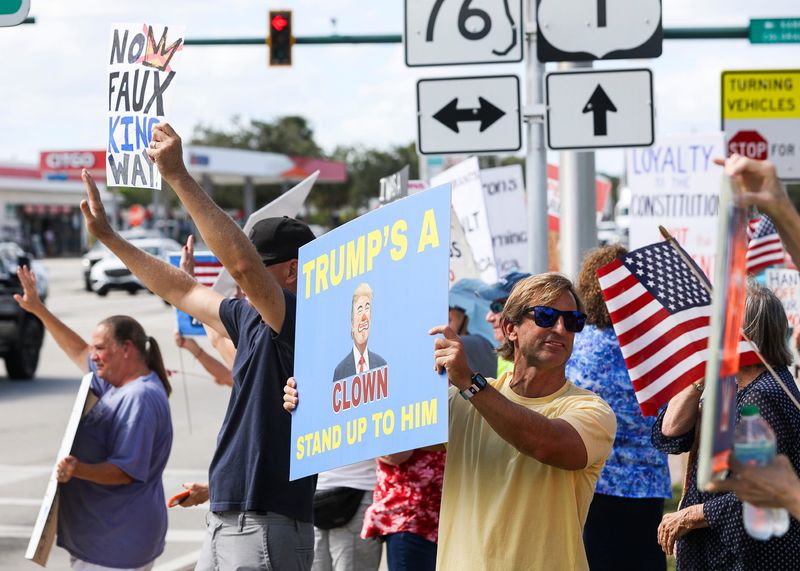
The national No Kings protest on Oct. 18 flooded social media with images of retirees wielding signs, Statue of Liberty impersonators and many frog costumes.
Organizers said these protests focused on President Donald Trump’s so-called “crackdowns on First Amendment rights,” which attracted over 7 million people throughout 2,700 communities, big and small. That would make it the second-largest single-day protest in the United States.

The Oct. 18 protests exceeded the turnout from the previous June 14 turnout by about 2 million, but No Kings still didn’t come close to beating the largest single-day protest in the United States.
The Black Lives Matter protests in 2020 would have been No. 1, at 26 million, but they were continuous from June to August, not on a single day.
Here are the top five largest single-day protests in the United States:
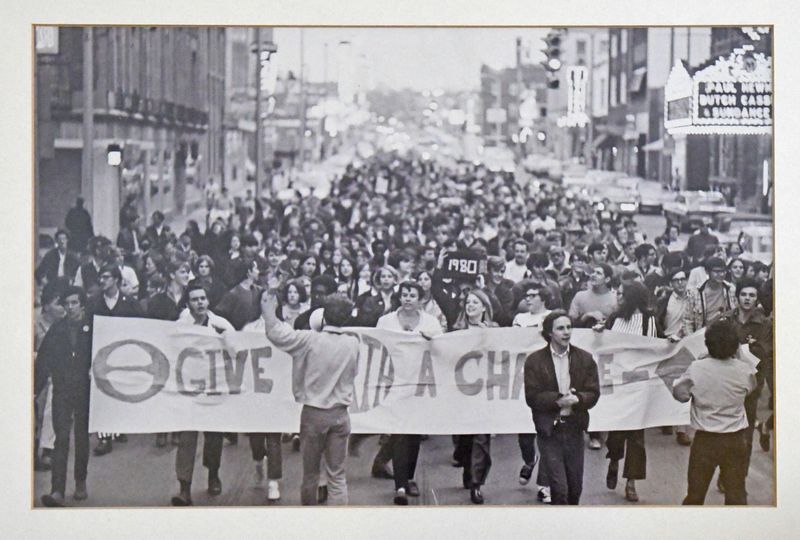
The first Earth Day
Before modern regulations on industry and car manufacturing, air quality had been deteriorating to deadly levels.
Inefficient automobiles belched out black smoke; industry dumped harmful byproducts into the air and water; and scientists were starting to uncover the catastrophic side effects of lead in paint and gasoline on the human brain.
For decades, many Americans accepted this as the price of progress. It wasn’t until events such as the publication of Rachel Carson’s 1962 New York Times bestseller “Silent Spring” and the 1969 oil spill in Santa Barbara, California, that the narrative began to change.
Wisconsin Sen. Gaylord Nelson sought to channel the energy of the anti-war movement into environmental action, culminating in the first Earth Day in 1970.
Roughly 20 million people — 10% of the U.S. population at the time — took to the streets to decry the effects of big industry on the planet and human health.
No Kings protests on Oct. 18, 2025
The No Kings protests have been gaining in popularity as the lead organizer continues to include smaller communities around the country.
The movement is run by 50501, a progressive grassroots organization that stands for 50 protests, 50 states, 1 movement. 50501 started on Reddit and organized its first protests Feb. 5 in response to “anti-democratic and illegal actions of the Trump administration and its plutocratic allies.”
The Trump administration called the Oct. 18 demonstrations “anti-American” and violent, though no incidents were reported.
Many attendees wore inflatable animal costumes poking fun at the Trump administration’s labeling of protesters as agitators or “antifa.”
In all, the nationwide protests were the second largest in history with 7 million attendees, organizers said.
Hands Across America
Hands Across America was a fundraiser that attempted to create a continuous chain of people holding hands across the continental United States on Memorial Day weekend, May 25, 1986.
The chain stretched 4,125 miles from New York to Los Angeles, but broke in various places, according to newspaper archives.
Each participant was asked to donate $10. The event raised $20 million for soup kitchens and shelters, though $17 million went toward production costs.
Despite ABC News calling it “one of the noblest failures in American popular culture,” it raised broad awareness about poverty and homelessness.
Estimates range from 5-7 million participants, though totals are uncertain because some cities formed parallel chains of people.
No Kings protests on June 14, 2025
No Kings clings to the leaderboard as the fourth largest protest in U.S. history, garnering nearly 5 million attendees, organizers said.
Like the Oct. 18 protests, the June 14 protests were held in every state in over 2,000 locations to oppose what organizers called the Trump administration’s “authoritarian policies.”
However, the June protests avoided Washington, D.C., to avoid confrontation with law enforcement present at the Army’s 250th Anniversary Parade and Trump’s 79th birthday.
Women’s March
The fifth-largest protest, like No Kings, also centered around Trump.
The Women’s March occurred the day after Trump’s inauguration on Jan. 21, 2017, and denounced his policies and remarks toward women, most notably the 2005 hot-mic video where he bragged about grabbing women by the genitals.
The march was widely seen as an anti-Trump protest, but organizers framed it as a call for social change, such as pay equality and reproductive freedom.
It originally was scheduled to take place only in Washington, D.C., but over 670 “sister marches” arose around the United States and other countries.
While the movement reached seven continents, the total attendance in the United States was about 4.6 million.
The Women’s March organizers led another protest before Trump’s second inauguration Jan. 18, dubbed the People’s March on Washington, but it attracted a smaller crowd of about 50,000 participants.
Jack Lemnus is a TCPalm enterprise reporter. Contact him at jack.lemnus@tcpalm.com, 772-409-1345, or follow him on X @JackLemnus.
This article originally appeared on Treasure Coast Newspapers: 5 biggest single-day protests in US history and where No Kings ranks in turnout
Reporting by Jack Lemnus, Treasure Coast Newspapers / Treasure Coast Newspapers
USA TODAY Network via Reuters Connect