Here in the antique business, we often use words to describe an era or style that we’re actually hard-pressed to define ourselves. So, what is rococo anyway? How about beaux-arts? Rationalism? And just take, for example, art glass. Annealing, slumping, flameworking … what do those mean? While unraveling those mysteries will have to wait for another column, today let’s talk about a glass term that pops up all the time: millefiori (or millie, for short). It’s an adjective that describes a lot of paperweights and ashtrays where the designs are internal to the glass, but what is it exactly? Today we find out.
First of all, the term millefiori is a mash-up of the Italian words for “thousand” (mille) and “flowers” (fiori). Making a glass millie is a multi-step process not unlike the manner in which candy canes and other swirling types of confections are formed. They are made by hand and not the stuff of amateur glassblowers. Basically, their creation involves taking a number of thin rods of colored glass, heating and then weaving or stacking them together much like a manila rope. That creates an unfocused design in the glass that can be brought into sharper detail by stretching the still-heated cane. Once the cane is cooled, it is typically sliced into thin wafers where it can be incorporated into larger pieces.

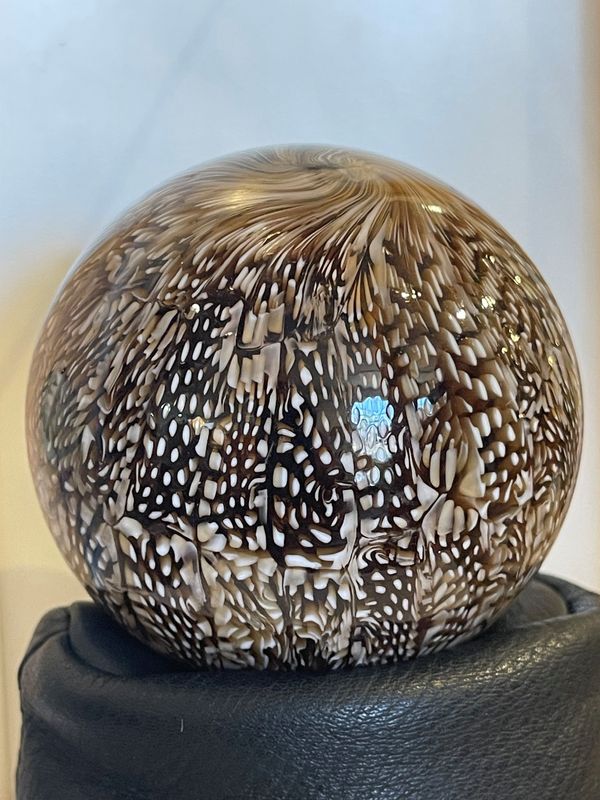
Mass market products that incorporate millie designs include marbles, jewelry and vases. However, there are some artists that specialize in highly complicated millie art that bring high prices from collectors around the world. One example is pictured here: a Murrine Venini ball by the Italian artist Ludovico Diaz de Santillana. Murrine art is something of a subset of millefiori: best-of-breed pieces that require unusually large amounts of skill and patience. Among the finest pieces made come from the Venini glass factory located on the island of Murano in Venice. Founded in 1921, it’s still around today and produces unique and limited-edition art glass in collaboration with some of the world’s most famous designers.
As it happens, we acquired this item accidentally some time ago and originally took it to be just another piece of art glass. However, we had a recent customer come through who was an advanced glassblower and his eyes nearly left his head when he saw it. He described the process of making something like this as extremely complex: each small glass noodle that make up the whole has to be precisely placed in order to avoid overlap and achieve a sense of movement — and all done while the glass remains superheated. Suffice it to say that if it looks like just another glass ball that you can find anywhere, it is most decidedly not.
So now you know. We have a number of other millefiori items here in our gallery and most sell for well under $100. All the same, when you compare those with this one, you can recognize that the others include fewer canes of less delicacy and the patterns they create have less depth and artistry. They’re lovely to be sure, but not like this 1960s example. Further, it turns out that Ludovico was married to the Venini founder’s daughter and ran the firm following the patriarch’s death. And that encapsulates one of the great beauties of this business. Sometimes things turn out to be a lot more than what they seem.
Mike Rivkin and his wife, Linda, are long-time residents of Rancho Mirage. For many years, he was an award-winning catalogue publisher and has authored seven books, along with countless articles. Now, he’s the owner of Antique Galleries of Palm Springs. His antiques column appears Sundays in The Desert Sun. Want to send Mike a question about antiques? Drop him a line at silverfishpress@gmail.com.
This article originally appeared on Palm Springs Desert Sun: Why is Murrine Venini the Cadillac of art glass?
Reporting by Mike Rivkin, Special to The Desert Sun / Palm Springs Desert Sun
USA TODAY Network via Reuters Connect