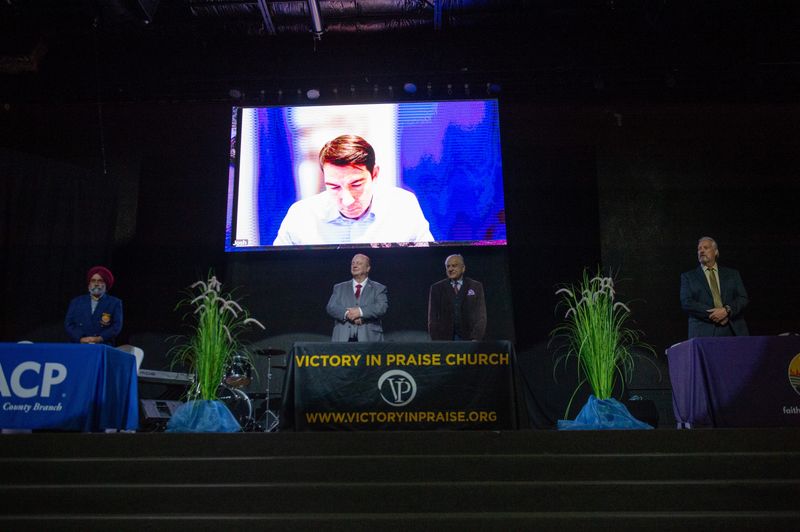
Five candidates for California’s 9th Congressional District outlined their positions on healthcare affordability and access, the racial wealth gap and economic opportunity during a forum at Victory In Praise Church ahead of the June 2 primary election.
The forum on May 4 was organized by the Stockton branch of the NAACP, Black Women Organized for Political Action, Faith in the Valley and Victory in Praise Church.

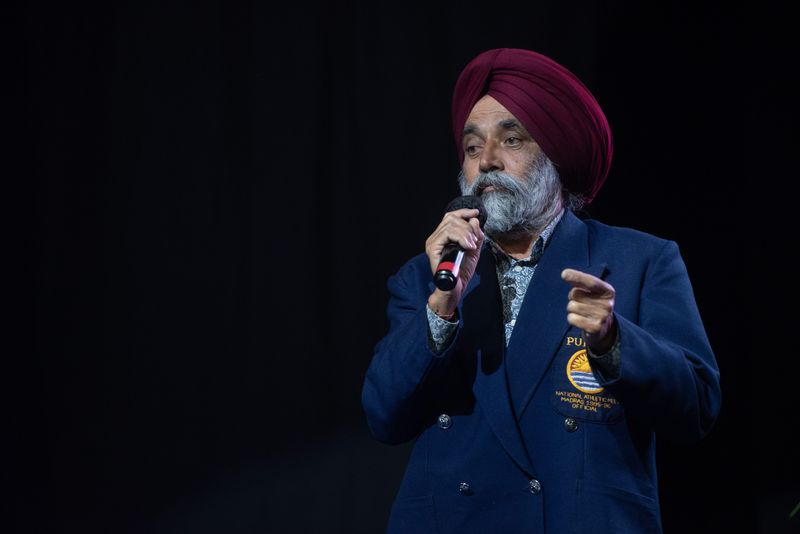
The forum featured incumbent Josh Harder, a Democrat who lives in Tracy and has held the seat since 2022, and Republican challengers John McBride, an athletic performance coach who lives in Lodi; Khalid Jeffrey Jafri, an engineer, businessman and farmer who lives in Tracy; Martin Veprauskas, a retired Navy manager who lists California as his location on his campaign website; and Parminder Singh, a salesperson and father who lists Sacramento as his location on his LinkedIn profile.
The district is primarily in San Joaquin County and extends into parts of Contra Costa County.
Healthcare affordability
Candidates were asked how they would ensure affordable and accessible health care for patients across all ages, from newborns to seniors, and what specific reforms they would prioritize.
Harder said his interest in health care policy was shaped by his family’s experience after his brother was born prematurely and spent years in the hospital. He argued that federal Medicaid cuts have worsened access and raised costs, particularly in San Joaquin County, where he said 50,000 people are estimated to lose health insurance and 1,000 nurses and doctors will be laid off.
“Last year we saw the biggest cut to healthcare in our nation’s recent history, a trillion-dollar cut to Medicaid, also to folks that are getting insurance on the Affordable Care Act exchanges. Just in San Joaquin County, that has led to our uninsured rate already skyrocketing. Certain hospitals have closed to new patients already and, unfortunately, the worst is yet to come,” Harder said. “We need to reverse those cuts.”
Veprauskas said access to care should account for the distance patients must travel for both routine and specialized treatment, citing his own perspective as he has gotten older. He questioned whether Americans are able to reasonably access care across rural and suburban regions.
“I’m a senior, and I’ve got all these doctor’s appointments. How far do I have to go if I just have a normal doctor’s appointment? How far do I go if I need some kind of heart transplant or something?” Veprauskas said. “There’s got to be a better way that Americans can take care of Americans. Americans first, as far as I’m concerned. And then we should be able to take care of everybody else if they deserve to be here.”
McBride said healthcare begins with individuals and said that if the ingredients list for a food product in America is compared with one in Europe, it would be entirely different.
“If you want to improve healthcare, you need to start with our food supply,” McBride said. “You have to start with getting the chemicals out of our water and out of our food.”
Singh said insurance costs remain unaffordable and criticized government spending priorities, arguing that funds are not being used to reduce premiums or improve access.
“Medical insurance is very expensive. It’s hard to afford,” Singh said. “The government in California already collects so much in tax dollars. They are not using it in the right place to bring the price of insurance down, and they are just using it for some kind of luxury things, and giving bonuses.”
Jafri proposed a tiered system of care in which basic clinics would treat common illnesses, while hospitals would focus on specialized procedures. He also criticized U.S. foreign aid to Israel, arguing resources should be redirected domestically.
“My plan is to give basic healthcare to everybody, like we have 150 diseases that are the basic diseases, like a throat infection or a fever,” Jafri said. “For that, we have outdoor clinics. This is already being done in Canada and other countries. Basic diseases are treated by outdoor clinics. If you get sick and need specialization, then you go to the hospital. What is happening now is that most people who get sick are not taken care of. They end up in emergency rooms, where it becomes very expensive to treat them.”
Racial wealth gap
Candidates were also asked how they would address the racial wealth gap between white and Black families, which now exceeds $240,000, and what federal policies they would support in areas such as homeownership, lending, workforce development and investment.
Veprauskas said economic mobility depends on adapting to technological change and expanding opportunity across sectors.
“I am middle class, and I believe it’s coming back with all the innovations and high-tech jobs that people brought back to America, but it needs to be brought back also to this area. Technology is going to be the one to save us. It’s going to make life a lot better for everybody,” Veprauskas said. “There’s going to be opportunities for everybody, but if you’re the type of person that sits down, plays Nintendo all day or whatever and you want everything handed to you, well, those days are coming to an end. You’re going to have to stand up for yourself and go out there and make something of yourself. This is America. You can be anything you want to be.”
Jafri said discrimination in housing and lending remains a barrier to economic progress and called for stronger enforcement of existing anti-discrimination laws.
“We should be providing loans and opportunities for Black people, and they should become on par with white people, because this gap is growing,” Jafri said. “I’ve seen in our county that in many neighborhoods, people refuse to sell houses to Black people. Discrimination laws are already there, but they are not implemented properly. I have championed for some people in our Muslim community who have faced discrimination. I have seen that there is a lot of discrimination, and it’s growing.”
McBride said education and family structure are the most important factors in reducing poverty and called for expanded school choice and trade education programs.
“The two biggest factors in poverty are a lack of education and having children before you get married,” McBride said. “They need that high school education. Then the next thing is to encourage trade school. Everybody mentions technology. IT is going to take over all their technology jobs. We need welders, we need plumbers, we need HVAC people. We need carpenters. Those are the people we’re going to need. So they need to be educated and trained.”
Harder pointed to the expanded child tax credit and housing policy as key tools to close the gap, arguing that early childhood support and homeownership are the strongest drivers of long-term wealth.
“When families can’t actually build wealth, the entire economy is weaker,” Harder said. “We were able to accomplish the child tax credit, which helps support every single kid to make sure that you could start building that wealth, which compounds over time, as early as possible. That cut the child poverty rate in San Joaquin County in half. Unfortunately, when it ended, the child poverty rate doubled, and that’s where it has continued today. We have to be able to make sure that we’re bringing that back so no matter where you start from, no matter the color of your skin, the zip code that you were born into, you can actually achieve your real potential.”
Singh said Black Americans and minority communities are central to building the country and should be given greater economic opportunity.
“There’s a big, big gap right now between white and Black communities, and those families are suffering,” Singh said. “They are hardworking, they are good students, and they are good players. The government has to work closely with these communities so they can have good jobs, good homes and a better life. When the backbone is strong, the country is strong. The government has to take care of that.”
Closing statements
Candidates closed the forum by emphasizing different visions for the 9th Congressional District, touching on government accountability, economic change, immigration and national priorities.
Harder framed the race around affordability, utility costs and restoring public trust in government, while also criticizing political corruption in Washington, D.C.
“We have to stop this war immediately and lower prices for our community. We also have to make sure that we’re attacking prices everywhere else we see them. We have to build more homes and increase homeownership. We have to make sure that we’re fighting against the increase on our PG&E bills,” Harder said. “It’s not just affordability. This race is also about accountability. Making sure that at a time when folks are cynical and frustrated with our political system, we have a plan to clean up our politics. I think we’ve seen, frankly, the most corrupt administration in American history in Washington, D.C. at the moment.”
Singh defended Republican leadership and argued that California’s economic and social challenges stem from mismanagement at the state and federal level.
“The Republican Party is cleaning up the big mess made by Democrats because they brought in criminal gangs and opened the border, and it made a big mess,” Singh said. “That’s what we’re cleaning up. This is our time and things will come back to normal. Right now, in other states, gas and diesel prices are about half of what they are in California. And the same thing with housing, education, all kinds of industries — they’ve made a big mess in the trucking industry, farming and small business. They’ve destroyed everything in California.”
Veprauskas criticized career politicians and argued voters should support change at the ballot box.
“Somebody said to me when I was campaigning, ‘I don’t care if you’re a Democrat, I don’t care if you’re Republican, I don’t care if you’re independent. If you’re American, you should be able to vote. If you’re American, you should be able to run for office,'” Veprauskas said. “I always stuck that in the back of my mind. The only time we see these career politicians is when it’s election time. After that, they disappear. They get us to fight each other, take our money and disappear again. I’m tired of it, and I’m voting for change. This is our time to vote out these incumbents and make America great again.”
Jafri focused on immigration enforcement, Social Security solvency and expanding access to basic services such as health care and education.
“We have very important issues I want to point out,” Jafri said. “Some people are being detained, and I know of farmworkers who have been taken into detention even though they were working legally and contributing in the farming and restaurant communities. Social Security is going bankrupt, and we have to put more people to work to contribute to the system as people are living longer. We also need to provide basic healthcare for everybody and make education free so no one is left uneducated. Education will help reduce discrimination and make people more sensible and tolerant.”
McBride called for major political change and argued that elected officials too often divide voters and fail to deliver results.
“I am a constitutional conservative,” McBride said. “I am running to represent we the people, and that’s all the people. In college athletics, I was a strength and conditioning coach. We had athletes — white, Black, Asian, you name it. It didn’t matter. You had to work with all of them, get the most out of them and be successful as a team. That’s how I look at it: we’re a team. We’re all fighting for the same things, and that is greater freedom, greater affordability, being able to pay your bills, raise your children safely and have good health. All of those things are what we’re fighting for.”
Record reporter Hannah Workman covers news in Stockton and San Joaquin County. She can be reached at hworkman@recordnet.com or on Twitter @byhannahworkman. Support local news, subscribe to The Stockton Record at https://www.recordnet.com/subscribenow.
This article originally appeared on The Record: What House District 9 candidates said about healthcare, economy
Reporting by Hannah Workman, The Stockton Record / The Record
USA TODAY Network via Reuters Connect