Residents urged the Stockton City Council to rebuild public trust through greater transparency and stronger ethics reforms, while several speakers questioned the San Joaquin County District Attorney’s Office decision not to pursue criminal action against former Interim City Manager Steve Colangelo and criticized some councilmembers’ continued association with 209 Times.
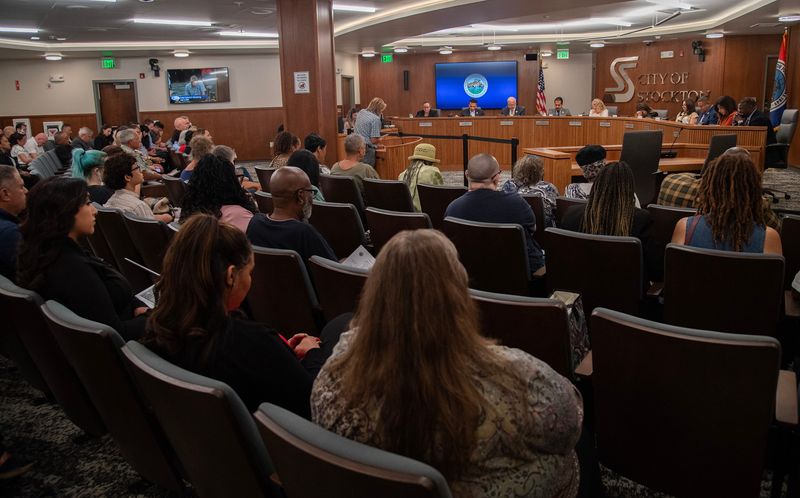
Eight residents spoke during public comment at the July 7 council meeting as council members discussed the June 25 San Joaquin County Civil Grand Jury report, “Governance in Turmoil,” plans to publicly account for the $770,508 spent on council-initiated investigations, and Mayor Christina Fugazi’s proposed 100-day governance reform plan, “Stockton Governance Reset.”

The latest civil grand jury report describes the council as plagued by internal conflict, leadership instability and governance failures that the panel said have eroded public trust and disrupted city operations.
In total, the grand jury issued nine findings related to council conflicts, violations of City Charter Section 408, fiscal procedures, ethics compliance and campaign finance transparency. It also issued eight recommendations, including mandatory conduct training, development of an ethics commission, revisions to the city’s code of ethics, adoption of social media guidelines, restrictions on disparaging public statements and consideration of local campaign contribution limits.
The city must submit its formal response to the grand jury within 90 days of the report’s release.
The proposal calls for creating a public tracking matrix for each grand jury finding and recommendation, including the city’s response, the department responsible for implementation and the status of each item.
Among the reforms, Fugazi is asking the council to adopt new standards for meeting decorum, professional conduct, treatment of city staff and public statements by elected officials through the Council Conduct Reset Resolution. The plan also would establish operating protocols for agenda coordination, misconduct referrals, staff requests and disputes among councilmembers.
The proposal includes expanded Brown Act and closed-session compliance measures, including updated training, confidentiality acknowledgments and procedures for responding to leaks.
Fugazi also proposed strengthening protections for city employees by reinforcing the city’s council-manager form of government and requiring council requests to staff to be routed through the appropriate charter officers.
The plan would impose new requirements before the council authorizes outside investigations, including written scopes of work, legal authority, budget limits, timelines, conflict reviews and findings that investigations serve the public interest.
Additional proposals would increase procurement transparency by requiring disclosure of staff evaluation scores, written explanations when the council departs from staff recommendations, conflict certifications, applicant and vendor contract disclosures and public benefit findings for major awards.
Beyond the initial 100-day period, Fugazi said she plans to pursue longer-term reforms, including updating the council’s code of conduct, developing options for an independent ethics commission or ethics officer, reviewing campaign finance and lobbying disclosure rules, publishing quarterly implementation reports and considering voter-approved charter amendments if necessary.
Public urges transparency and follow-through
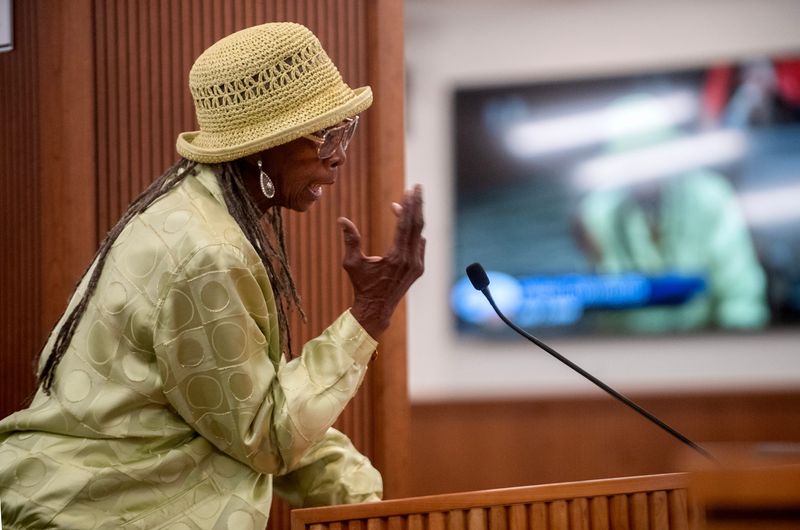
Several speakers said the council’s willingness to discuss the grand jury’s recommendations publicly was a positive step, but cautioned that meaningful change would depend on whether officials followed through.
David Sengthay, president of Stockton Democrats Together, said Fugazi’s proposed reform plan appeared promising but urged the council to fully implement the grand jury’s recommendations, provide a detailed accounting of investigation spending and establish an independent ethics commission.
Regarding the investigation costs, Sengthay said taxpayers deserved a complete breakdown of how the money was spent.
“We’re investigating the investigations at this point,” Sengthay said. “It seems that, at the end of the day, most of these investigations were coming from the fact that there were personalities and egos that were bruised on the dais.”
Mary Elizabeth, a Stockton resident, welcomed the council’s decision to prepare an itemized accounting of investigation costs but said the report should also include staff time devoted to the investigations, arguing those resources could have been used to address other city priorities.
“Those costs need to also be broken down between consultants and staff because there’s a considerable amount of staff time that has taken away from concerns about equitable access to infrastructure,” Elizabeth said.
Julie Dunning, a Stockton resident, said she was encouraged to see the council discussing the grand jury report after what she described as “a lack of respect” for the previous grand jury report’s findings. She argued that accountability extends beyond determining whether officials violated the law.
Dunning said she was less concerned about the cost of the investigations than their findings and criticized the San Joaquin County District Attorney’s Office’s conclusion that former Interim City Manager Steve Colangelo’s actions did not warrant criminal action.
In November 2025, the council voted to refer potential misconduct by Colangelo to prosecutors to determine whether a criminal investigation was warranted. The referral centered on allegations that Colangelo pledged more money than city managers are authorized to allocate to the nonprofit Service First of Northern California in support of its bid for $8.2 million in Behavioral Health Continuum Infrastructure Program funding.
Assistant District Attorney Richard Price signed the one-page letter, which was addressed to City Attorney Marci Arredondo. At Fugazi’s request, Arredondo read the letter aloud during the council meeting.
In the letter, Price criticized the council’s requests for prosecutors to determine whether city officials should face criminal investigations. The district attorney’s office has a public integrity unit that investigates and prosecutes alleged criminal misconduct by elected, appointed and hired public officials.
“I’m highly concerned that we have a county DA that doesn’t think that there’s anything wrong going on here,” Dunning said. “There’s a moral compass here that needs to be followed, whether you can find legal loopholes or not. That’s what we’re looking for. That’s what accountability is. That’s what transparency is.”
Residents press council on 209 Times ties
Several residents also criticized some councilmembers’ continued association with 209 Times, the social media platform cited in the 2024 civil grand jury report as contributing to what grand jurors described as a toxic and fearful work environment within Stockton City Hall.
This year’s report criticized the council for what it described as incomplete and delayed responses to prior grand jury findings, citing requirements under California Penal Code Sections 933 and 933.05 for timely and substantive replies to investigative reports. It said the council had not fully complied with response requirements for the 2024 report at the time of its release and that prior responses had failed to fully address all recommendations.
One of the recommendations in the 2024 grand jury report was that the city council “should stop enabling the [social media platform] from interfering with effective city government through their continued association and/or support of individuals associated with the [social media platform].”
Ashley Hampton, a Stockton resident, said the latest grand jury report was “no surprise” and urged councilmembers to publicly distance themselves from the social media platform, as recommended by the grand jury. She emphasized that doing so was important because some residents may not be media literate or realize that 209 Times is not a news outlet.
“It is disheartening and sickening to see the games that have been played, the manipulation that has taken course by each and every one of you in some shape, form or fashion, whether you placate like you are for the community, whether you sit in silence as a leader,” Hampton said. “It is damning to our community.”
Pat Barrett, a Stockton resident, urged the council to address the 2024 grand jury report’s recommendations related to 209 Times before asking residents to trust its latest reform efforts.
“I was reading this media release and I was laughing,” Barrett said, referring to the news release announcing Fugazi’s proposed 100-day governance reform plan. “Here you have a statement talking about the 2026 grand jury report, and we never finished the last grand jury report that specifically said to keep specific people away from city hall, and you gave one of them a recognition.”
On March 3, Fugazi presented 209 Times founder Motecuzoma Sanchez, a Stockton political consultant known for using his website to lambaste certain elected officials and show support for others, with a proclamation for intervening in March 2025 when a person armed with a large knife threatened people downtown.
The proclamation came nearly a year after the incident and a month after Sanchez, who chairs the city’s Salary Setting Commission, advocated for increasing councilmembers’ salaries to $40,000 a year, or $3,333.33 a month.
During Fugazi’s tenure as mayor, it has been uncommon for the city to issue a proclamation honoring an individual. The only other such proclamation honored disability rights advocate Douglas Vigil after his death in August 2025. Most proclamations have recognized groups or observances, including Black History Month, Hispanic Heritage Month, Autism Awareness Month and LGBTQ+ Pride Month.
After hearing public comments, Fugazi did not indicate whether she would publicly distance herself from the social media platform, as recommended by the grand jury. She said she did not agree with all of the criticism voiced during public comment.
“I appreciate all the comments up here at the dais,” Fugazi said. “Do I appreciate all of the comments at the podium? Not necessarily. We talk about a fresh, new start, but there are some people that still … I don’t know, just bitter, what it might be, ignorance, I don’t know. But people want to say what they want to say, and it is your right.”
Record reporter Hannah Workman covers news in Stockton and San Joaquin County. She can be reached at hworkman@recordnet.com or on Twitter @byhannahworkman. Support local news, subscribe to The Stockton Record at https://www.recordnet.com/subscribenow.
This article originally appeared on The Record: Residents urge ethics reforms after grand jury report on Stockton council
Reporting by Hannah Workman, The Stockton Record / The Record
USA TODAY Network via Reuters Connect
By Hannah Workman, The Stockton Record | USA TODAY Network