When two devastating earthquakes struck Venezuela in June, six teams of search dogs and handlers were on the ground within 48 hours.
Deployed as part of the Los Angeles County Fire Department, the teams searched around the clock and in blistering heat for survivors buried under rubble.

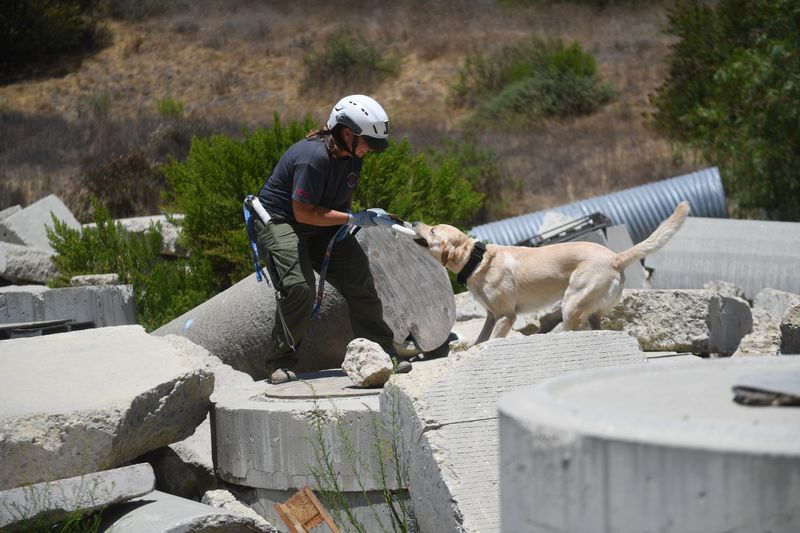
Thousands of miles away in Santa Paula, Marlin, a search dog in training, scampers across different piles of rubble, his nose guiding him to a trainer hidden among the debris. Wagging his tail and letting out a few sharp barks signaling that he’s found the source of the scent, the Labrador is quickly rewarded with his favorite toy and praise from adoring trainers.
Every dog deployed to Venezuela, just like Marlin, started at the National Disaster Search Dog Foundation’s National Training Center in Santa Paula. Marlin and around 40 other dogs train year round to become search-and-rescue certified and save lives.
“There is no piece of equipment or technology or human that can do what they do,” said Denise Sanders, foundation senior director of communications and search team operations.
Foundation-trained teams also recently deployed for flash floods in Texas in July and are now preparing for Tropical Storm Bertha.
Currently, the foundation works with 104 active teams across 15 federal and state task forces and has participated in 302 deployments worldwide since its founding in 1996. According to the its website, an estimated 450 canine teams are needed to adequately respond to disasters in America but only around half that are actively certified.
Sanders explained that while deployed, dogs assist in finding people buried under rubble before human rescuers decide on the best course of action. She emphasized that a large part of a dog’s job is often to determine if an area is clear of survivors.
“We as humans, we think we know what’s happening a lot of times and we want to tell everybody about it,” Sanders said. “But that’s not necessarily the best way when the dog’s nose knows.”
The foundation only trains search teams, meaning a fire department, law enforcement agency or other organization must request assistance for teams to be deployed. Sanders said that teams debrief deployments with the foundation so that they can continue to improve.
Wilma Melville, a retired school teacher, created the foundation in 1996 after being deployed as a canine search specialist to the Oklahoma City Federal Building Bombing. She set a goal of certifying 168 search dog teams, one for every life lost in the bombings, which the foundation surpassed in 2020.
The roughly 145-acre training center in Santa Paula opened in 2017 and features lodging for handlers, a doghouse, a veterinary clinic and multiple simulated debris piles, including a train wreck, among other things. The foundation previously trained canines out of a kennel in Gilroy.
According to its website, the foundation is a nonprofit and does not receive government funding. Sanders said it costs, on average, $130,000 to identify, train and house a single canine before it’s ready to be deployed.
The process begins with recruiting dogs, many of whom come from shelters and rescues. The foundation mainly looks for Labrador retrievers, golden retrievers and border collies.
Sanders said the traits that they look for, such as high energy and an obsession with toys, are often the same traits that make the dogs unsuitable pets.
“They’re not really doing it out of the goodness of their heart,” Sanders said. “They’re doing it because that toy is their reward with their favorite person.”
Once at the center, dogs train for nine to 12 months to build the skills and strength needed to traverse disaster zones and sniff out survivors.
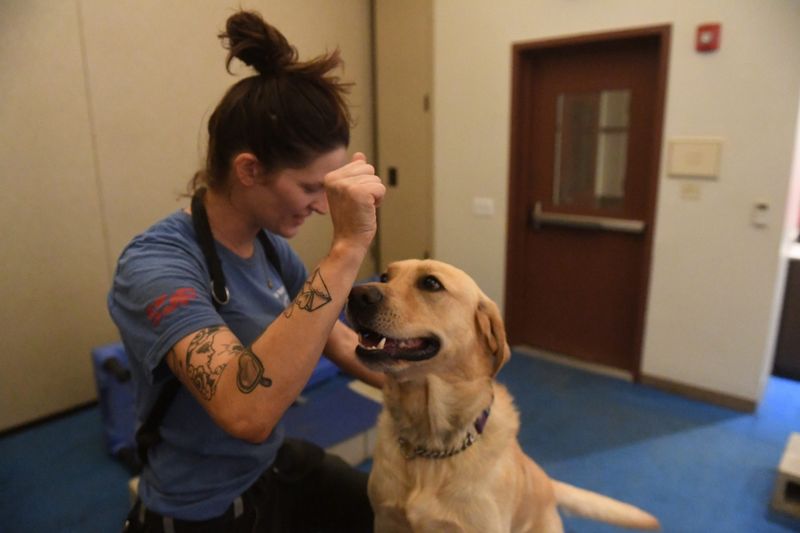
When trainers feel a dog is ready, they are officially paired based on compatibility with a handler who they will live with the rest of their lives. Most handlers come from firefighting and first-responder backgrounds.
Teams are then handed over to a taskforce where they will continue to train and acquire certification from the Federal Emergency Management Agency or State Urban Search and Rescue Alliance. According to Sanders, dogs work between eight and 10 years and are recertified every three years.
Dogs taken in that are later determined not to be suited to work are still taken care of until a permanent home can be found for them.
With the foundation celebrating its 30 year anniversary, Sanders said they are already looking for ways to improve and save more lives over the next 30 years.
Levi Kauffman is a summer intern for the Ventura County Star. He can be reached at lkauffman@gannett.com.
This article originally appeared on Ventura County Star: In Venezuela or Texas, Santa Paula search dog center key in disasters
Reporting by Levi Kauffman, Ventura County Star / Ventura County Star
USA TODAY Network via Reuters Connect
By Levi Kauffman, Ventura County Star | USA TODAY Network