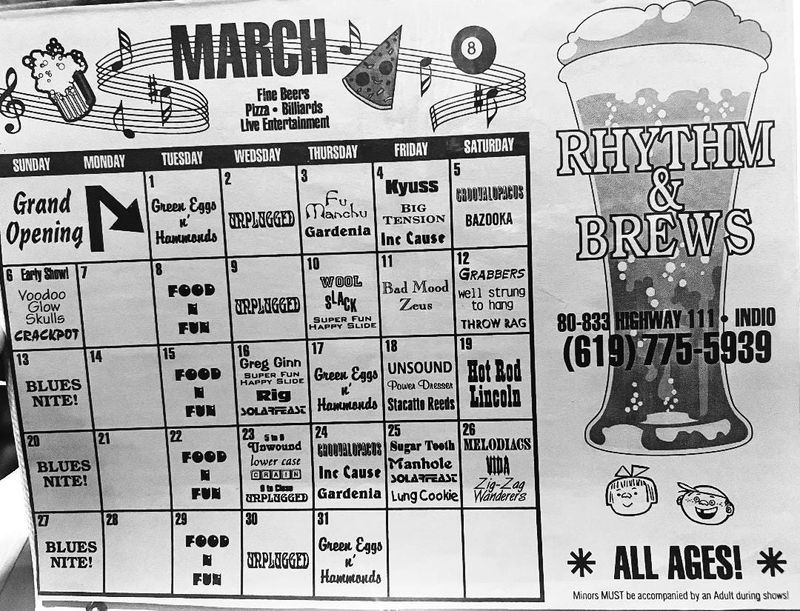
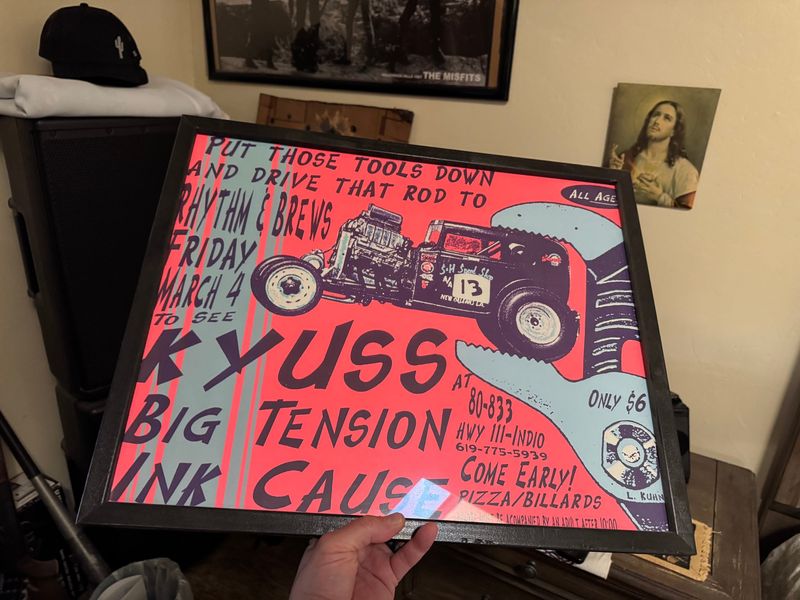
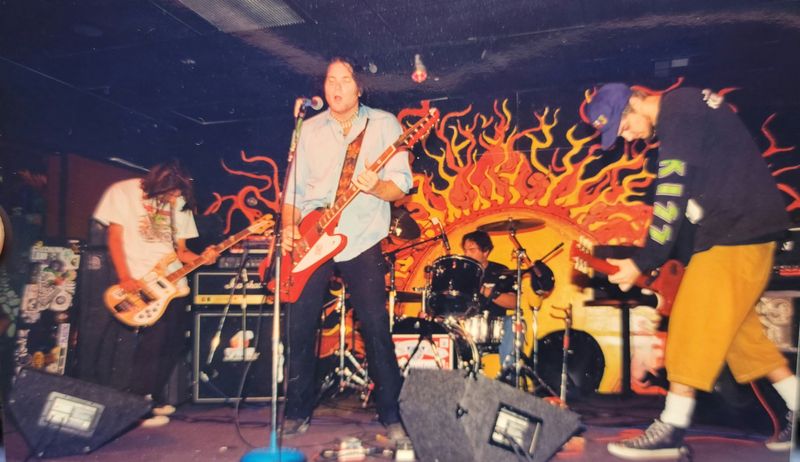
For almost two years in Indio during the mid-’90s, a venue at the city’s entrance along Highway 111 was the only place in the Coachella Valley where teenagers and other local music fans who couldn’t go to Los Angeles could see bands such as Kyuss, the Melvins and Rancid play on a real stage, with real lighting and an actual PA system.
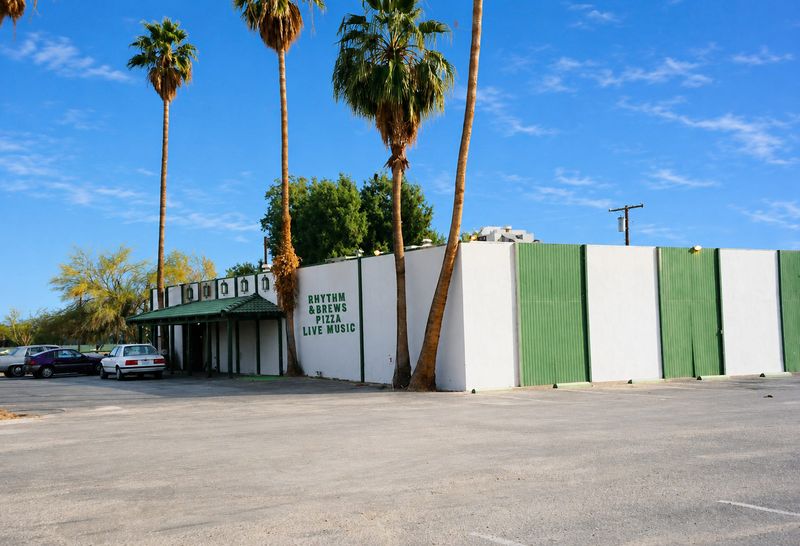
That place was Rhythm and Brews, owned by Fatso Jetson frontman Mario Lalli. If you drive along Highway 111 looking for the site you’ll find that it has since been torn down and is now an empty field. Memories of the venue live on through several complete recorded sets on YouTube.

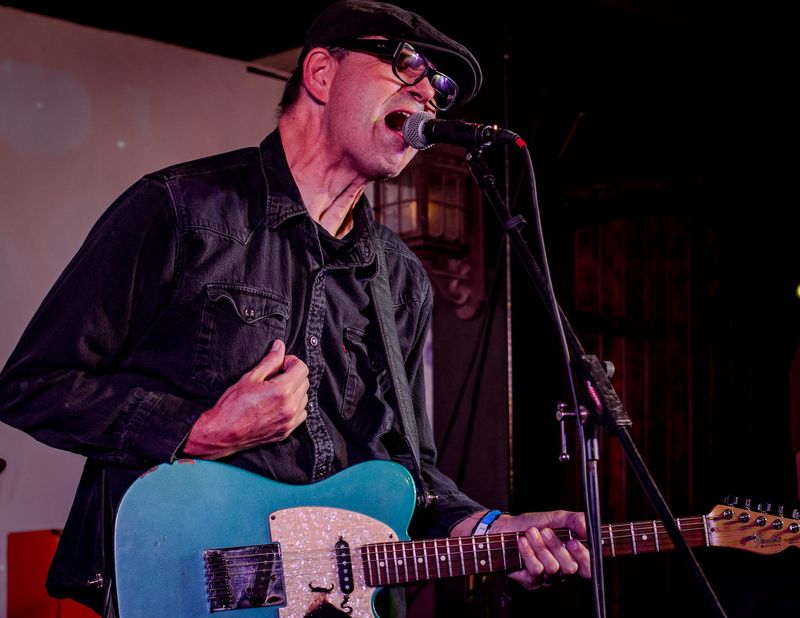
Lalli talks about attending a show at the former Little Street Music Hall, now The Dune Room, a new Indio venue that opened last December and where he’ll perform with Fatso Jetson on Friday, Aug. 21. There were no phones out, kids were pogoing and moshing up front, girls were gossiping in the corners, and lots of teenagers were losing their minds over bands they probably hadn’t heard of a week earlier, he said during a recent interview. It reminded him of what he built and lost in the city more than 30 years ago.
“It wasn’t packed, but it was full of people. The bands were everything from hardcore punk to thrash metal to a kind of funky So-Cal music. I left almost emotional about it, because it had been a long time since I saw that,” Lalli said.
It all started with generator parties
Lalli’s path to becoming a venue owner began when he promoted underground and do-it-yourself shows during the ’80s. There were few venues in the area for original rock ’n’ roll music, especially punk rock. Those shows took place at backyard parties, Mexican restaurants after hours, billiards halls, and generator parties in various parts of the local desert and were featured in the documentaries “Lo-Sound Desert” and “Desert Age.”
But Lalli was arrested after a crowd of more than 1,000 people showed up at a generator party known as the “Road to Mecca” during the early ’90s in the Painted Canyons of Thermal. The party became more than he and his crew — which included some current employees of Los Angeles promoter Goldenvoice — could handle.
“We weren’t prepared for that amount of people, so somebody got hurt,” Lalli said. “Some people’s cars got stuck, there were no bathrooms, there was no water, and it became dangerous. The California Highway Patrol came out with a helicopter, found the location, and sent the ground forces in to shut us down. They asked, ‘Whose generator is this?’ I raised my hand, and I was arrested. After that experience, I got really fed up, and my family had to help me with my legal expenses.”
Lalli’s father, Mario Sr., a restaurant and bar owner who moved the family to Palm Springs from Denver in 1970 after purchasing the historic Chi-Chi Club on Palm Canyon Drive, asked why Lalli continued to promote illegal shows when he had the resources to do it legally. Other family members also encouraged him, and they offered to support him in opening a bar.
Rhythm and Brews was once a diner
According to Lalli, the building was owned by the Jensen family, which owned Jensen’s Date Gardens, and had once been a diner. It was not where he originally intended to open; he wanted to be in Palm Springs, Cathedral City or Palm Desert, but he couldn’t find anything affordable. He said, “You can’t just grab any retail space” for a live music venue.
But Lalli said it was “absolutely perfect.”
“It had a big kitchen with a walk-in refrigerator, plenty of room for a pizza oven, a big open dining room with a big rectangular layout, and the rent was super cheap,” Lalli said. “We had zero money and a credit card for 86 Lumber. I bought all the lumber, nails, paint and everything we needed on that credit card, and my friends helped me do all that work.”
To operate as an all-ages venue, Lalli pursued a restaurant license instead of a bar license. He had to prove that food was the primary business by maintaining defined food-service hours, tables with salt and pepper shakers, and menus, while still being able to sell alcohol on the premises. The venue charged $5 admission for those over 21. Admission was $7 for those under 21, but they also got a slice of pizza and a soft drink.
The bar and restaurant had two rooms, and the music venue side featured a wall with murals painted by Lalli’s friends. “There was always a cool vibe about Rhythm and Brews,” especially when you stepped into the music side, said Bruce Fessier, former Desert Sun Arts and Entertainment reporter.
“It felt like there was something that had never existed in the Coachella Valley before. It was vibrant, and you were optimistic that you were going to hear good music, and to hear good alternative rock was just so refreshing at that time.”
John Garcia, frontman of Kyuss, which included Queens of the Stone Age frontman and Palm Desert native Josh Homme, remembered the venue’s former location near Neil’s Lounge on Highway 111.
“It was the place to be for live music in the east valley. Finally, a legit spot to play. The generator parties were becoming a thing of the past, but music was still a necessity, alive and well in the desert,” Garcia said. “Mario Lalli is largely responsible for that. I built my music career partly because of him. We played there more than once; always a good time, filled with memorable and not-so-memorable nights. I was still young, almost didn’t know any better. Again, necessity.”
The venue faced opposition from the city at the time
Rhythm and Brews faced resistance from a conservative Indio City Council, which was wary of Lalli’s business model after problems with nightclubs featuring banda, ranchera and hip-hop music had prompted multiple police calls and incidents. He pitched the venue as a jazz and blues club to get approval, but said Indio police later visited for ID checks, including some undercover checks.
“There was a gang problem in Indio at that time,” Fessier said. “I remember they had all these restrictions on going to the Date Festival. You couldn’t wear baggy jeans because they thought you were part of a gang. They locked up the fax machine in the post office because they were afraid people would steal it.”
Still, the venue’s mix of music was successful.
Although the crowd did not support jazz and blues, there was an audience for the Tejano bands Lalli brought in, along with a DJ who played classic hip-hop and oldies that drew the lowrider crowd on some Friday nights. The rock, hardcore and punk shows came through his connections to Los Angeles’ underground music scene, particularly through friends associated with the former Jabberjaw coffeehouse and labels such as Amphetamine Reptile, Touch & Go and Man’s Ruin.
At the time, Lalli was also receiving demo tapes from bands such as Sublime and No Doubt who were not yet on the radar of the major labels, and did not even have booking agents (they never played the venue). But Lalli said “the best thing about it” was providing a stage and a proper venue for local bands, many of whom were teenagers.
“I can’t tell you how many parents used to come up to me and thank me for giving their sons and daughters a place to really do it, like really do it right. I’ve been thanked, overpaid by thanks and the gratitude from local musicians that went there, enjoyed it, and got the experience of a real rock ‘n’ roll club, not some weird pool hall, not some Mexican restaurant with the tables pushed to the side, which is a beautiful thing,” Lalli said.
‘I wanted to be a rock ‘n’ roll club’
When asked why Rhythm and Brews closed, Lalli said it was because of his own resistance to diversifying the business and leaning more into the pizzeria and restaurant side to pay the bills. “The last six months shouldn’t have happened,” he said of late 1996, when he fell behind on rent before selling it to a successor, who turned it into a family pizzeria with video games.
“I didn’t want to be a restaurant; I wanted to be a rock ‘n’ roll club. I wanted to be a rock ‘n’ roll club that maybe would struggle to survive in Hollywood or Orange County, and I’m trying to do it in Indio,” Lalli said.
But Fessier believes the outside forces played a bigger part in Lalli’s downfall. He said that after Rhythm and Brews closed, the local music scene was dead until Goldenvoice put on the Coachella Valley Music and Arts Festival in 1999 at the Empire Polo Club in Indio.
“Indio clearly did not want to have a bunch of young rock ‘n’ rollers partying in their town, and (Lalli) was harassed a great deal. They were harassed out of business. That’s what I remember about it,” Fessier said.
Lalli later opened Cafe 322, a jazz club and restaurant in Los Angeles that remained open for seven years, until 2012. It featured live music six nights a week and a well-received menu of steaks and pasta, but balancing live music with the restaurant eventually became difficult.
“You’ve got to have the clientele, you got to have badass programming, and you got to be ruthless with your dollars. I wasn’t the guy,” Lalli said.
Looking ahead to the Aug. 21 show at The Dune Room, Lalli said that, after owning a business in the city more than 30 years ago, he has “always loved the Indio work ethic” in the community, especially among silkscreen shop owners and artists in the eastern Coachella Valley, such as The Date Farmers. He also mentioned the recent closure of the Academy of Musical Performance, which is next door to The Dune Room.
“Many of the instructors were musicians who used to play at Rhythm and Brews and in our local underground rock ‘n’ roll scene, and most of those guys who ran that place I grew up playing music with. I’m sad to see the school go, but I understand the challenges of these kinds of things, especially in Indio,” Lalli said.
Even though there are many comparisons to The Dune Room’s programming of up-and-coming bands and supporting a local music scene, Fessier said Rhythm and Brews happened at a time when it was a “(music) scene unto itself” when the only other option was a bar in Palm Desert called the Thirsty Bull that hosted local alternative bands such as Unsound and Masters of Reality on select nights.
“I think The Dune Room is more part of a scene. Rhythm and Brews was on Highway 111 out in the middle of nowhere, whereas at The Dune Room, you can walk down the street and see other bars, The Indio Taphouse, and people hanging out.
Lalli said he was excited by the connection between his experience attending a show at Little Street Music Hall, which operated from 2023 to 2025, and The Dune Room. He pointed especially to the all-ages coffeehouse atmosphere of the former venue, which The Dune Room and owner Ron Mesh have continued.
“I will support The Dune Room no matter what. I’m a promoter and set up little shows, and when I see stuff happening there, I share The Dune Room’s calendar just to support because that’s the kind of place it is,” Lalli said.
If you go
What: Fatso Jetson concert with Softsun, Mighty Jack, and Ryan Güt The Shastafarian.
When: 7 p.m., Friday, Aug. 21.
Where: The Dune Room, 82-707 Miles Ave., Indio.
How much: $15 in advance, $20 at the door
More information: duneroomindio.com
Brian Blueskye covers arts and entertainment for the Desert Sun. He can be reached at brian.blueskye@desertsun.com
This article originally appeared on Palm Springs Desert Sun: How Mario Lalli legitimized the desert’s notorious generator parties
Reporting by Brian Blueskye, Palm Springs Desert Sun / Palm Springs Desert Sun
USA TODAY Network via Reuters Connect
By Brian Blueskye, Palm Springs Desert Sun | USA TODAY Network