Ventura County may be headed toward a long fire season as experts say the area could see its second dry winter in a row.
Local cities recorded around 5 to 9 inches of rainfall in the 2024-25 water year, which runs from October through September. That is less than half of normal rainfall totals, according to preliminary figures from the Ventura County Watershed Protection District.

Vegetation has reached close to critically dry levels, and experts say La Niña conditions are expected to return for a second straight winter. The cooler waters at the equator typically mean drier-than-normal conditions for the region.
“Not every La Niña is dry in Southern California, but it definitely tilts the odds,” said climatologist William Patzert.
Without early rainfall, there is little to blunt the effect of dry, gusty Santa Ana winds. When those winds kick up in the fall, flames can burn faster and farther in the dry vegetation.
“It is always the race between whether the rains come first or the Santa Anas come first,” Patzert said.
With a better-than-average chance of a dry winter, the area could see a longer fire season, said Chief Dustin Gardner, of the Ventura County Fire Department. That could mean big fires when the winds blow, until the area sees an inch or 2 of rainfall.
Little rainfall was recorded between May and mid-January last year. The bone-dry conditions and fierce Santa Anas led to a long, busy fire season. During the deadly and destructive Los Angeles fires in January, authorities reported 80 to 100 mph winds.
Is Ventura County in a drought?
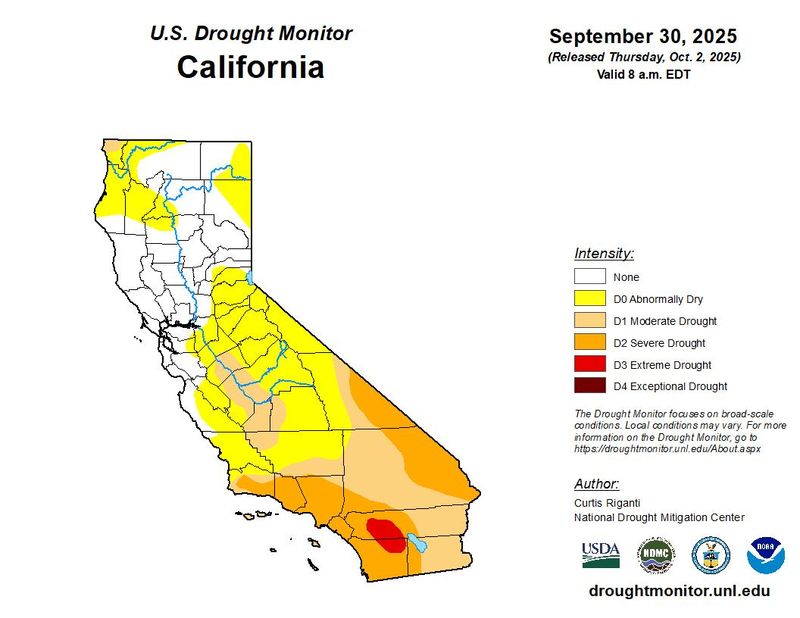
Nearly all of the county has been classified in severe drought, according to the latest maps from the U.S. Drought Monitor. That is the third most severe designation among the five federal drought classifications.
Three years ago, a string of dry years had extended drought conditions and shrunk water supplies. The county recorded below-average rainfall in 2021-22 and experienced one of its driest seasons on record a year earlier.
Then, conditions flipped.
Storms drenched the county in back-to-back years of higher-than-normal rainfall. Local spots reached more than double that of a normal season in 2022-23, helping to boost local reservoirs.
Lake Casitas, which gets no imported water, exceeded half-full for the first time since 2015. After a second wet winter, the reservoir that provides water to the Ojai Valley and parts of Ventura reached capacity for the first time in a quarter century.
But then, things dried up again. A weak to moderate La Niña was reported last winter, and now La Niña is building again, Patzert said.
What is the wildfire forecast?
One dry winter alone didn’t appear to cause big changes for the vegetation.
Ventura County Fire Department’s latest vegetation samples from early October showed moisture levels in most local areas slightly above critically dry levels. Every two weeks, the department measures the moisture levels, which experts say are a good predictor of fire danger.
When the moisture levels drop below the 60% mark – considered critical – firefighters expect large, uncontrolled fire growth, Gardner said. Typically, that happens in late August or early September. Then, the moisture levels stay low until the area gets an inch or more of rainfall.
Samples showed the latest moisture levels just over 60%, slightly above those at the same time last year, the department reported.
But that is also around those recorded when the Mountain Fire ignited near Somis last year. On Nov. 6, the fire quickly spread as Santa Ana winds gusted up to 80 mph, later spotting more than 2.5 miles ahead of itself.
In all, the fire burned 31 square miles, destroyed some 243 structures and threatened thousands more in communities from Camarillo to Fillmore.
To sign up for emergency alerts in Ventura County, go to readyventuracounty.org/vc-alert. For more information about emergencies or disaster preparedness, go to vcemergency.com or fire.venturacounty.gov.
Cheri Carlson covers the environment and county government for the Ventura County Star. Reach her at cheri.carlson@vcstar.com or 805-437-0260.
This article originally appeared on Ventura County Star: Here’s what a second straight year of La Niña means for Ventura County’s fire season
Reporting by Cheri Carlson, Ventura County Star / Ventura County Star
USA TODAY Network via Reuters Connect