Editor’s note: This report from The Munro Review, a nonprofit website covering arts and culture in California’s San Joaquin Valley, is a condensed version of a longer investigation into how College of the Sequoias’ policies allow its theater and film instructors to earn unusually high salaries. To read the complete report, go to MunroReview.com
At College of the Sequoias in Visalia, a city in California’s San Joaquin Valley — in what may be unique for California or even the nation — a theater arts instructor who teaches costuming, makeup, and other classes has earned nearly $3 million in total pay since 2012, including $367,152 in 2023. With benefits included, his compensation totals $3.6 million.

During the same period, his theater department colleague earned $2 million in total pay, including a reported $314,272 in 2023. With benefits, he received $2.6 million.
The startling salaries aren’t the result of fraud or hidden bonuses but contract provisions that allow the two instructors to teach twice the standard course load — collecting extra pay for every extra course, including popular film appreciation courses that attract hundreds of students.
James McDonnell and Christopher Mangels have legally turned this workload loophole into paychecks that some experts say are unheard of in American theater education, all funded for years by local taxpayers.
Both McDonnell and Mangels appear on track to keep earning large paychecks in the 2025-26 academic year, which began on Aug. 11.
Massive teaching loads and huge classes boost salaries
McDonnell, who teaches costuming, makeup, and directs productions, has been COS’s highest-paid employee in seven of the past 12 years, according to Transparent California, a public salary database. Mangels, who also directs and teaches, ranks third on the college’s payroll behind McDonnell and Superintendent/President Brent Calvin. (Salary figures for 2024 are not yet available.)
McDonnell’s 2023 total with benefits reached $445,120, while Mangels’ was $393,475. The two are COS’s only full-time theater instructors. The Visalia-based college serves about 14,000 students and employs more than 700 people.
“Our approach makes business sense on several fronts,” Calvin said. “It would take four or five full-time faculty to do what these two do. Chris and James are two of the best professors in the business and a real asset to our community.”
Calvin acknowledged that the salaries stand out. “I mean, we all get the optics,” he said.
High pay, big results
Supporters point to COS’s success on the national stage. McDonnell and Mangels direct and design four shows a year, and their students have won dozens of Kennedy Center American College Theater Festival awards.
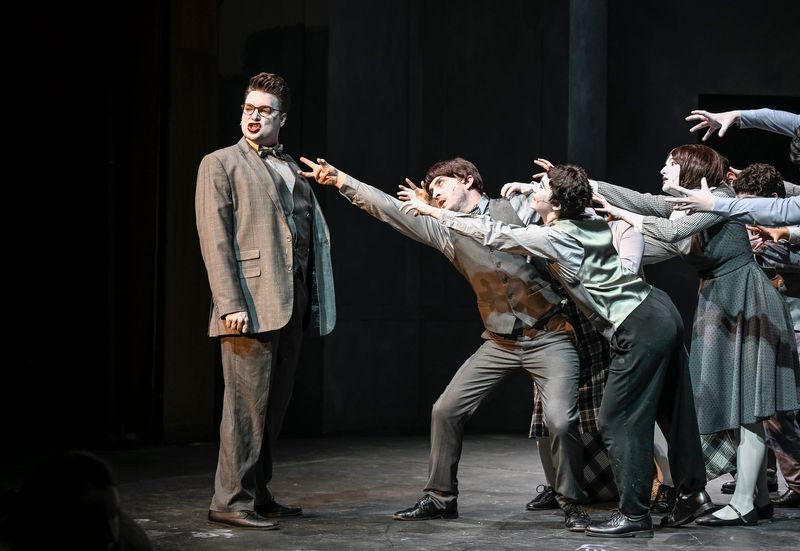
In 2025, COS’s “Reefer Madness: The Musical” production won 17 honors, including national fellowships for two students. “Not bad for a community college,” Mangels said.
Still, the pay is significantly higher than at other California schools. bree valle, an award-winning theater instructor at Cuesta College in San Luis Obispo, earned $159,880 last year, or about $195,000 with benefits. Fresno State’s highest-paid theater professor earned $122,524. (valle doesn’t capitalize her first and last names.)
“My head blew off my shoulders,” valle said when told about McDonnell’s pay. “I don’t know how anyone can do that much work. Is it quantity or is it quality?”
COS spent $1.1 million on its theater department salaries and benefits in 2023 — including McDonnell, Mangels, and two theater technicians — about three times Cuesta’s total theater payroll. President Calvin said the college saves money by paying two people extra rather than hiring additional full-time faculty.
When contacted by The Munro Review, six people in Valley theater circles — who support the arts but asked not to be identified for the sake of candor — were shocked by the COS salaries.
They emphasized that theater professors and others involved in the arts often work long hours, particularly when preparing for a show, concert, or recital. But as one person said of McDonnell and Mangels: “If you’re looking for wrongdoing, you aren’t going to find it. But if you’re looking for opportunism, you’ve found it.”
Some in the arts community question whether the heavy workload is sustainable. To that end, Mangels has pushed for a third full-time theater faculty position, but the college has not funded it. He said his current pace cannot continue forever.
“I love what I do, but it’s not something I can sustain at this level for a whole lot longer,” Mangels said.
COS student Brittney Martorana, who received a national fellowship from the Kennedy Center under the mentorship of Mangels, told The Munro Review that her accomplishments at COS — winning three national awards as a student director and choreographer, attending master classes in Washington D.C., and securing a summer internship at the prestigious Eugene O’Neill Theater Center — would not have been possible without the guidance of McDonnell and Mangels.
Martorana added: “Chris and James both have created a home for young artists in our Valley to expand their potential, and I believe myself to be proof of that.”
How the faculty contract at College of the Sequoias works
Under COS’s faculty contract, instructors can teach beyond the standard 15 units a semester. McDonnell and Mangels often teach twice that load. They also earn extra for large lecture courses. In fall 2025, Mangels is scheduled for 31 units and McDonnell for 36. By comparison, most community college instructors teach about 15.
COS pays instructors about $75 extra per student for large lecture classes with more than 40 students. Film appreciation, which both instructors teach, can attract hundreds of students per class. One fall 2022 class had a cap of 425 students.
COS began offering larger film classes online during the COVID-19 pandemic, and demand stayed high. Under the union contract, full-time instructors pick their classes before any courses can be assigned to part-time faculty. That means McDonnell and Mangels keep the large film classes for themselves.
Asked if COS had considered hiring adjunct instructors to teach film, Calvin said it is more cost-effective for McDonnell and Mangels to do it. “There’s very little reason to ask that question, really, from a cost standpoint,” he said.
‘I Earn Every Penny’: Instructors defend their pay
Both instructors say they put in the hours to earn the pay. Mangels estimated he works 60 to 70 hours a week. McDonnell said he works seven days a week, often 12 to 14 hours a day.
“I’m not better compensated,” Mangels said. “I’m compensated for the work I do, and I do an exceptional amount of work.”
McDonnell said he has devoted his life to his students. “Did I earn every dollar of that money legally, the hard way, and deservingly? Yes, every penny,” he said.
The COS faculty union supports McDonnell and Mangels. “Chris and James are members of our association and are very hard workers dedicated to the theater department, COS, and the community,” said Tracy Redden, president of the College of the Sequoias Teachers Association.
A commitment to students and the COS theater program
McDonnell often attributes his capacity for long hours to having no spouse or children. “I’m unmarried. I do not have children. I lost my parents many years ago,” he said in an interview.
McDonnell said he stands by his choices. “Other professors could do the same,” he said. “They choose other things to do.”
Mangels said he is committed to his students and the program. “I don’t ever want to sound like I’m not glad to have this money,” he said. “But I’m not doing this just for the money.”
Donald Munro is the editor and publisher of the Munro Review, a nonprofit website that covers arts and culture in the San Joaquin Valley. He is a current faculty member in the mass communication and journalism department at Fresno State. Doug Hoagland is a journalist with over four decades of experience covering the Central Valley for several news organizations.
(This story was updated to fix a typo in a photo cutline.)
This article originally appeared on Palm Springs Desert Sun: Here’s how two College of the Sequoias instructors legally made millions
Reporting by Doug Hoagland and Donald Munro / Palm Springs Desert Sun
USA TODAY Network via Reuters Connect