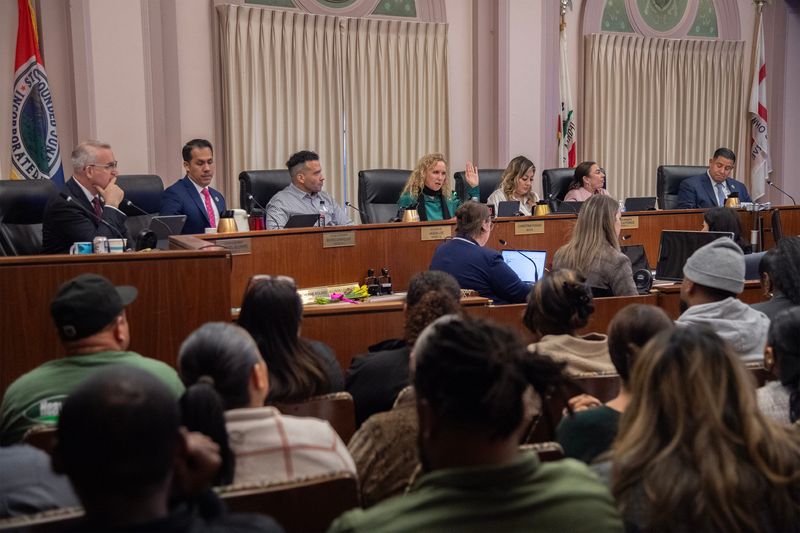
A San Joaquin County Civil Grand Jury report released June 25 portrays the Stockton City Council as mired in internal conflict, leadership instability and governance breakdowns that the panel said have undermined public trust and disrupted city operations.
The 2025-26 civil grand jury said its investigation, initially prompted by complaints of potential Ralph M. Brown Act violations, expanded into a broader review of council conduct, decision-making and administrative oversight. The 24-page report, “Governance in Turmoil,” concludes that persistent infighting, a consistent 4-3 voting split and repeated public disputes have weakened the council’s effectiveness.

“What began as an investigation … revealed far deeper problems with the business of city governance,” the report said. “A pattern of repeated conflicts between councilmembers emerged over time, suggesting a power struggle within the council. Key members of the council appeared to put their personal and political interests ahead of their duty to make sound business and policy decisions for the residents of Stockton. The absence of a permanent full-time city manager for most of the 2025 calendar year resulted in a lack of checks and balances that typically define the city council-city manager system of governance.”
The civil grand jury is composed of 19 citizens impaneled annually to review concerns about the integrity and operations of city and county government and to investigate potential misconduct by public officials.
The panel said its review included document analysis, interviews with current and former city staff and councilmembers and observation of public meetings. Two councilmembers and several current and former city staff declined to be interviewed, denying the civil grand jury crucial firsthand information, according to the report.
The report did not identify those individuals by name.
In total, the civil grand jury issued nine findings related to council conflicts, violations of City Charter Section 408, fiscal procedures, ethics compliance and campaign finance transparency. It also issued eight recommendations, including mandatory conduct training, development of an ethics commission, revisions to the city’s code of ethics, adoption of social media guidelines, restrictions on disparaging public statements and consideration of local campaign contribution limits.
“The citizens of Stockton are ultimately the ones who suffer from these actions by the Stockton City Council,” the report concluded. “As the Stockton City Council seems unable or unwilling to enforce decorum and civility on themselves, there appears to be little that the people of Stockton can do to stop this unfortunate momentum. At the end of the day, the ballot box is the final arbiter.”
Colangelo’s appointment and tenure draw scrutiny
The report attributed many of the council’s governance problems to the resignation of former City Manager Harry Black in lieu of termination without cause in January 2025 following the 2024 election and the series of interim and acting appointments that followed.
Following Black’s departure, Stockton lacked a permanent city manager for much of the year, and the report said the leadership turnover contributed to inconsistent direction, strained staff morale and the erosion of established lines of authority.
The report also criticized the February 2025 appointment of former Interim City Manager Steve Colangelo, citing concerns about political influence. According to the report, multiple people interviewed said Colangelo was “hand-picked by Mayor (Christina) Fugazi” despite having no prior municipal management experience.
Colangelo, a local small business owner who worked for four decades as an event producer and event supply retailer, was chief executive officer of the San Joaquin County Fairgrounds when a state audit found evidence of financial mismanagement. He was appointed by the council in a 4-3 vote, with multiple councilmembers saying they did not know enough about his qualifications to hire him for the role and that his resume was not shared with the council.
A resume later made publicly available listed that he attended Cosumnes River College for business law and Sacramento City College for business administration, but it did not state what years he attended the schools or whether he completed any degrees.
Colangelo came under fire in May 2025 after news reports revealed that the interim city manager had hired Lathrop City Manager Stephen Salvatore as a consultant without council approval or competitive bidding at $11,000 a month, using public funds originally earmarked for diversity, equity and inclusion programs. Colangelo also was being paid more than $20,000 a month in salary at the time. The city announced the termination of Salvatore’s contract weeks later.
The report noted that Stockton operates under a council-manager form of government, with a seven-member elected city council that sets policy and an appointed professional city manager who oversees day-to-day operations and city departments.
In the civil grand jury’s report, the Stockton City Council is referred to as SCC and the civil grand jury as CGJ.
“In order for this system to function properly, it requires the city manager to be experienced in city government leadership and conversant in directing its various departments,” the report said. “The interim city manager had no experience in city government and did not fulfill the requirements the SCC established when it hired a search firm to find candidates to fill the city manager position full-time.”
Breakdown in decorum among mayor, councilmembers
The report said the breakdown of decorum and conduct within the council is directly related to a series of questionable decisions and resulting actions by Fugazi and councilmembers. It said those decisions were made in the absence of an experienced city manager who would normally provide guidance and advice.
“The councilmembers’ unreserved and sometimes derogatory and verbally offensive comments in council meetings and on social media contributed greatly to the polarization of the SCC,” the report said. “Ultimately, the loss of trust and respect amongst councilmembers has resulted in the current dysfunction.”
Decisions to appoint acting and interim city managers quickly sparked disagreements among some councilmembers, according to the report.
One such instance, the report noted, occurred when Fugazi appointed Vice Mayor Jason Lee and District 4 Councilmember Mario Enríquez to serve with her on the Ad Hoc Committee for City Manager Selection, which was tasked with recommending a recruitment firm, screening applicants and narrowing the candidate pool for the council’s consideration.
The committee completed half its mission before Fugazi disbanded it in May 2025 after accusing Enríquez of violating the Brown Act without detailing the allegations, providing evidence or responding to media requests for more information. Enríquez denied the claim.
Concurrent with city manager issues, the report said Fugazi raised questions about Lee’s motives in promoting certain projects and activities. It said several official investigations of the vice mayor were launched at the direction of the council. Some ultimately concluded there was no violation of law, while others were still pending at the time of the report.
After a $50,000 taxpayer-funded independent investigation, a law firm concluded that Lee committed no legal violations related to his involvement in the Wild ’N Out live show at Adventist Health Arena in May 2025.
Despite that finding, Fugazi moved in November 2025 to open her own investigation into Lee, with the help of District 1 Councilmember Michele Padilla, whom she said would serve on an informal ad hoc committee with her.
Fugazi said “informal” meant the committee would not hold agendized meetings or be open to the public. At the time, she did not disclose a limit on taxpayer funds the committee could spend on the investigation, which she said could last up to a year. No activity from the committee has been publicly disclosed by Fugazi or Padilla.
“The SCC budgets $500,000 yearly to fund all city investigations, including those initiated by the SCC itself,” the report said. “In a typical year, $200,000 to $300,000 of this budgeted amount is used. The entire $500,000 was exhausted by the first half of the fiscal year (FY) 2025-2026. It is important to note that not all of this budgeted amount was spent on SCC investigations. As of the date of the release of this report, the 25-26 CGJ has been unable to verify the amount spent on SCC investigations.”
Poor decorum and conduct were most evident in Fugazi’s behavior during council meetings and in Lee’s social media posts, the report said. It said Lee often “vented his arguments and complaints through social media, which also included inflammatory personal attacks on the mayor’s conduct and family.”
The report also said Fugazi, in what the civil grand jury described as a retaliatory action at a November 2025 council meeting, played a video Lee had posted on social media that “made disparaging and lewd remarks about the mayor.”
“The behavior of the mayor and the vice mayor reflects badly on themselves, the SCC and city government in general,” the report said. “More importantly, there is a loss of confidence and trust in city government by its residents.”
Repeated charter violations by councilmembers and impact on staff
The report said councilmembers repeatedly violated Section 408 of the city charter by directly contacting city staff about city business rather than routing communications through the city manager. The charter requires that councilmembers and the mayor direct such matters through the city manager, city attorney, city clerk or city auditor, except for informational inquiries.
It said the circumvention of that charter section, combined with the absence of experienced executive leadership, weakened staff confidence in city management and contributed to increased turnover, lower morale and difficulties in recruiting and retaining qualified employees.
The report said the instability was compounded by the resignation of the city manager and the terminations of the chief financial officer and assistant chief financial officer in early 2025. It said those departures created a leadership vacuum and left staff operating under shifting priorities, inconsistent direction and heightened political scrutiny.
According to interviews cited by the civil grand jury, Colangelo instructed councilmembers to contact city staff directly regarding district issues, a practice the report said bypassed established administrative procedures.
The report said these conditions contributed to what it described as a toxic work environment and increased the city’s exposure to legal and financial risk, including potential open meeting law violations, budget challenges and added costs associated with internal investigations and consulting services.
It said the city has lost a significant number of experienced employees in the past year, resulting in severance costs and additional expenses tied to hiring and training replacements.
The report also said city staff are trained to evaluate contracts and grant applications based on legal, financial and operational criteria, and that their recommendations should be carefully considered even if not binding on the council.
Regarding the Notice of Funding Availability (NOFA) process, the report said staff evaluated eight applicants for city housing funds after a November 2025 posting and submitted rankings that were then reviewed using an artificial intelligence-based evaluation tool, which confirmed staff assessments.
The report said the economic development department presented the results to the council, which later awarded funding to lower-ranked applicants in a 4-3 vote at its April 14 meeting. The report said that while the council is not required to follow staff recommendations, the decision raised questions about why councilmembers ignored their own staff’s work.
Campaign contribution rules flagged as policy gap
One area in which current Stockton policies fall short is addressing campaign contributions, the report said.
According to the Fair Political Practices Commission and Assembly Bill 571, cities without a statutory campaign contribution limit default to the state limit of $5,900 per candidate per election. The report said Stockton does not impose any additional local contribution limits.
It identified an issue of concern as the ability of council members or candidates for city council to contribute to other council members or candidates, which could create the appearance of coordinated voting blocs intended to influence city policy.
The report did not identify any councilmembers by name. Campaign finance records show Lee contributed $5,500 to the campaign of District 1 candidate Tamica Small and another $5,500 to District 5 candidate Desiree Lynch during this year’s primary election. He also contributed to Fugazi’s mayoral campaign in 2024.
The report said the public should be assured that council members are voting in the best interests of Stockton residents rather than narrow interests.
It said one possible solution would be establishing local contribution limits similar to those in other cities, including San Francisco’s $500 limit and Oakland’s $600 limit.
Chronic pattern of ethics and code of conduct violations
The report recommended creating an independent ethics commission to oversee compliance with ethics rules, the Brown Act, conflict-of-interest laws, and the city’s code of conduct.
It said the commission should be independent of the council and have the authority and resources to receive complaints, conduct investigations and enforce corrective actions.
The report said the council has demonstrated a chronic pattern of ethics and code of conduct violations over several years, indicating current policies have not been implemented effectively. It also recommended additional training for council members on the Political Reform Act, Government Code Section 1090, common law conflicts of interest, Assembly Bill 571, the Levine Act, the Brown Act, and the Public Records Act.
As an example, the report pointed to the Sacramento Ethics Commission, established in 2017, and said most large California cities have ethics commissions or similar oversight bodies. It said such commissions provide greater authority to investigate alleged violations and would help strengthen public trust in council decisions while addressing recurring allegations of Brown Act violations.
Civil grand jury cites compliance issues under state law
A 2024 civil grand jury report, “City of Stockton: Crisis in Government,” found that the social media platform 209 Times, founded by political consultant Motecuzoma Sanchez, contributed to what it described as a toxic and fearful work environment within Stockton City Hall. The report cited allegations of harassment, intimidation and potential Brown Act violations that it said disrupted the city’s orderly operations.
This year’s report criticized the council for what it described as incomplete and delayed responses to prior grand jury findings, citing requirements under California Penal Code Sections 933 and 933.05 for timely and substantive replies to investigative reports. It said the council had not fully complied with response requirements for the 2023-24 and 2024-25 reports at the time of its release, and that prior responses had failed to fully address all recommendations.
According to the report, the 2024-25 civil grand jury found that five of 11 original findings and recommendations had been satisfactorily addressed by the council, but six required further follow-up. It said the council’s most recent response, submitted in September, addressed only three of those remaining six recommendations.
Since taking office, Fugazi has honored Sanchez with a proclamation at city hall. Under her leadership, the council has also been criticized by the civil grand jury for failing to respond to reports in a timely or appropriate manner under California law.
The Record requested comment from Fugazi on this year’s civil grand jury report through mayoral spokesperson Jason Teramoto and asked whether the mayor and council intend to respond to the report in a timely and appropriate manner as required under California Penal Code Section 933.05.
“The mayor is reviewing the report and is expected to respond within the statutory limit,” Teramoto said.
In California, governing bodies must respond to civil grand jury findings within 90 days.
Read the full 2025-26 grand jury report
Record reporter Hannah Workman covers news in Stockton and San Joaquin County. She can be reached at hworkman@recordnet.com or on Twitter @byhannahworkman. Support local news, subscribe to The Stockton Record at https://www.recordnet.com/subscribenow.
This article originally appeared on The Record: Grand jury: Stockton City Council dysfunction undermines public trust
Reporting by Hannah Workman, The Stockton Record / The Record
USA TODAY Network via Reuters Connect
By Hannah Workman, The Stockton Record | USA TODAY Network