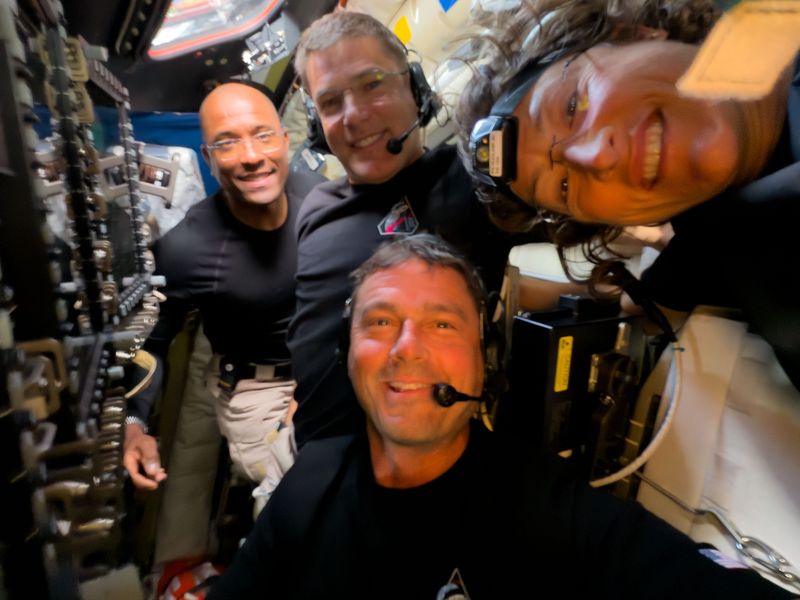
The Artemis II astronauts are due to speak with members of the media as they continue their journey back home following a trailblazing close encounter with the moon.
The second under NASA’s multibillion-dollar Artemis program, the mission marks the first time humans have ventured near the moon since the Apollo era of missions came to an end in 1972. Artemis II, which follows an uncrewed Artemis I test flight in 2022, also serves as a critical step in the U.S. space agency’s plan of returning humans to the moon as early as 2028.

But the Artemis campaign is far from a reprise of the Apollo program. This time, NASA is aiming for astronauts to live and work long-term on the moon following the construction of a lunar base, which itself will pave the way for the first human missions to Mars.
Now, as they prepare for a California water landing eight days into the mission, the crew members of Artemis II will take questions from reporters for the first time since they reached space.
Here’s how to watch the event live.
Artemis II crew to appear for media call
As the Artemis II astronauts continue their journey toward Earth, Reid Wiseman, Victor Glover and Christina Koch of NASA, as well as the Canadian Space Agency’s Jeremy Hansen, will take time April 8 to speak with media.
The planned news conference, which will be beamed to Earth as the astronauts fly aboard the Orion capsule, comes about two days after the Artemis II crew made a trailblazing flyby of the moon.
Time, how to watch NASA live stream
The 20-minute virtual news conference will begin at 9:45 p.m. ET Wednesday, April 8, according to NASA.
NASA will provide a live stream of the call on its YouTube channel. The event is not listed on the schedule for NASA+, the agency’s online streaming service.
Live stream: Watch NASA’s Artemis II moon mission
See Earthset, solar eclipse photos from moon flyby
The April 6 close approach of the moon marked humanity’s first return to the vicinity of the moon in more than 50 years, simultaneously flying the Artemis II crew farther in space that any humans in history. Ultimately, the astronauts traveled 252,756 from Earth, surpassing a record set in 1970 during the Apollo 13 mission.
During the lunar rendezvous, the astronauts came no closer than 4,067 miles above the moon’s surface. The higher altitude allowed the crew members to see the celestial body’s entire disk and sights of the far side that no human had previously laid eyes upon, according to NASA.
They also witnessed the sight of a dazzling solar eclipse not visible on Earth as the moon blocked the sun’s light from the perspective of the Orion spacecraft.
See the galleries below for some of the incredible images captured during the historic moment.
When does Artemis II return to Earth? California Splashdown time
The astronauts are in the middle of a four-day journey back to Earth, using our planet’s gravity to naturally “slingshot,” or pull Orion back home, negating the need for propulsion or much fuel.
The Orion capsule is due Friday, April 10, to reenter Earth’s atmosphere to make a water landing around 5:07 p.m. ET in the Pacific Ocean off the coast of San Diego, California.
When reentry occurs, Orion’s service module responsible for propelling and maneuvering the vehicle through space will separate and burn up, exposing the crew module’s heat shield that protects the astronauts from the 3,000-degree Fahrenheit conditions the vehicle will endure.
Once Orion blazes through Earth’s atmosphere, the protective heat shield will be cast off to make way for parachutes to deploy and slow the vehicle down.
The capsule will then splashdown in the ocean, after which five orange airbags will inflate around the top of the spacecraft and flip the capsule into an upright position. After the landing, the crew would exit the vehicle onto a U.S. Navy recovery vessel within about two hours.
Eric Lagatta is the Space Connect reporter for the USA TODAY Network. Reach him at elagatta@usatodayco.com
This article originally appeared on Palm Springs Desert Sun: Artemis II crew to speak about moon flyby before San Diego landing
Reporting by Eric Lagatta, USA TODAY NETWORK / Palm Springs Desert Sun
USA TODAY Network via Reuters Connect