

By Jim Bloch

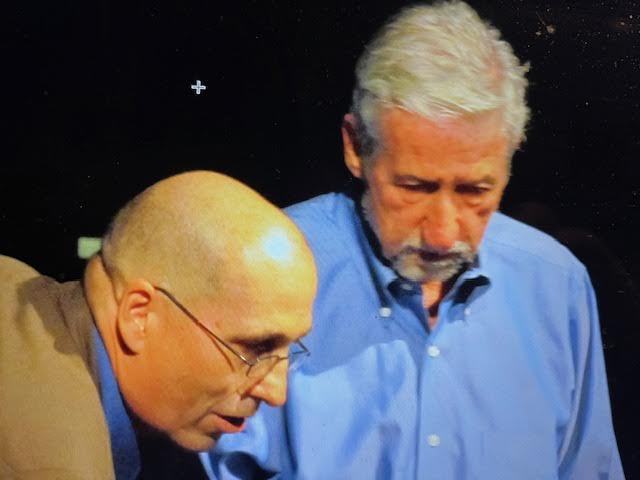
When Tom Hayden visited the campus of St. Clair County Community College in 2012 to mark the 50th anniversary of the Port Huron Statement, he suggested that a historical marker be placed at the site where the Students for a Democratic Society hashed out the specifics of their radical vision for America.
The site was an old labor camp on the banks of Lake Huron in what now is the day use area of Lakeport State Park. Hayden, who graduated from Royal Oak Dondero High School and the University of Michigan with a degree in sociology, was the principal author of the document.

“The history of our lives ought to be written into our landscape,” Hayden said.
Keeping the history of social movements alive through story-telling and physical memorials is important to the future, he said, echoing George Orwell’s warning in 1984 that “who controls the past controls the future.”
In the aftermath of great reform movements, the powers-that-be attempt to contain, compress or erase the memory of the movements, making their achievements seem like the inevitable outcome of progress, not victories won through struggle — or disappearing them altogether, argued Hayden, one of the most visible radicals of the 1960s.
Hayden died at 76 two weeks before Trump’s first election, but the president has personified his fears, especially in his second term, eliminating the names of public places that honor civil rights figures or Native Americans, such a changing Denali, the tallest mountain on the continent — “the high one” in the Athabascan language — back to Mount McKinley; pushing for changes in public schools to eliminate references to social movements; canceling museum exhibits at the Smithsonian that resonated “improper partisan ideology”; prohibiting the sale of books like The 1619 Project at giftshops in National Parks and museums; scrubbing Federal websites of words like “Tribal,” “race and ethnicity,” “women” and “climate change”; and attempting to reinterpret, pardon and largely erase his coup d’etat Jan. 6, 2021 — among many other efforts.
Jim Soto, who teaches philosophy at SC4, took up Hayden’s challenge, and began raising funds for a historical marker in honor of the Port Huron Statement.
Soto has said that fundraising is not his strong suit. Thirteen years and about $4,500 later, on Oct. 9, the marker became a reality. With the sun shining, Soto and a handful of others – including Al Haber, the first president of SDS, and member Daniel Millstone — unveiled the plaque.
Participatory democracy
The 35-page Port Huron Statement contains sections on values, the role of students, American politics, the economic system, racism, communism, foreign policy and the nuclear issue. With a few exceptions, it retains its power and relevance today.
In the wake of its drafting, the SDS mimeographed 20,000 copies of the Statement, selling each for 35 cents. After the 1965 march against the Vietnam War in Washington, D.C., organized by the SDS, demand for the document skyrocketed. Over the next five years, SDS and its 400 chapters produced hundreds of thousands of copies of the manifesto.
By any yardstick, the impact of the SDS far exceeded its size or longevity.
“SDS was like a shooting star,” Hayden said in an interview with me in 2002 for the 40th anniversary of the statement. “Most radical organizations of the Sixties had a life span of three to seven years. So, you can’t make too much of a judgment of the organization itself. But SDS was a catalyst for tens of thousands of people participating in the movement.”
“We were so successful that the movement didn’t so much break down as it just broke out in a thousand directions,” Haber told me in 2002.
Hayden said that the concept of participatory democracy was the defining contribution of the Port Huron Statement to American political discourse.
According to the opening page of the Statement, “We seek a democracy of individual participation governed by two central aims: that the individual share in those social decisions determining the quality and direction of his life; that society be organized to encourage independence in men and provide the media for their common participation…”
The sexist language notwithstanding, Americans live in a constitutional democracy with a representational form of government, but the system is broken, Hayden said. Participatory democracy is not opposed to representational democracy; instead, it must be seen as a supplement to it, one that grows out of social movements.
“It comes from experience, not theory,” he said.
Given the proper constellation of events, citizens take direct action outside of the central institutions of their society when their political, economic or social needs are not being met. During that action, people learn how to make decisions, fend for themselves and organize in their own interest. They begin to participate directly in the political process – in determining who wields power and how – and not waiting for their so-called representatives to represent them.
That was not all.
Impact of the Port Huron Statement and SDS
In 2012 at SC4, Hayden ticked off the accomplishments of the aggregation of organizations that came to be called The Movement: Voting rights for blacks; the enfranchisement of 18-21 year olds; the end of the Vietnam War, which killed two
million Asians and 58,000 Americans; the end of the military draft; ending the political careers of LBJ and Nixon; taking the Presidential primary process out of backrooms and putting it into the hands of voters, which led to George McGovern’s nomination in 1972; Congressional checks on the FBI and CIA, which infiltrated and sabotaged many peace and civil rights groups in the Sixties, including SDS; the War Powers Act; the Freedom of Information Act; Roe v. Wade; environmental laws, including the Endangered Species Act; farm worker protection; the right of public employees to organize; university curriculum reform; and the liberation of sexual desire.
On a lighter note, the Port Huron Statement even made cinematic history. The Dude, played by Jeff Bridges in the Coen brothers’ 1998 movie “The Big Lebowski,” claims to be one of the authors of the “original” Port Huron Statement, “not the compromised second draft.”
Jim Bloch is a freelance writer based in St. Clair, Michigan. Contact him at bloch.jim@gmail.com.
