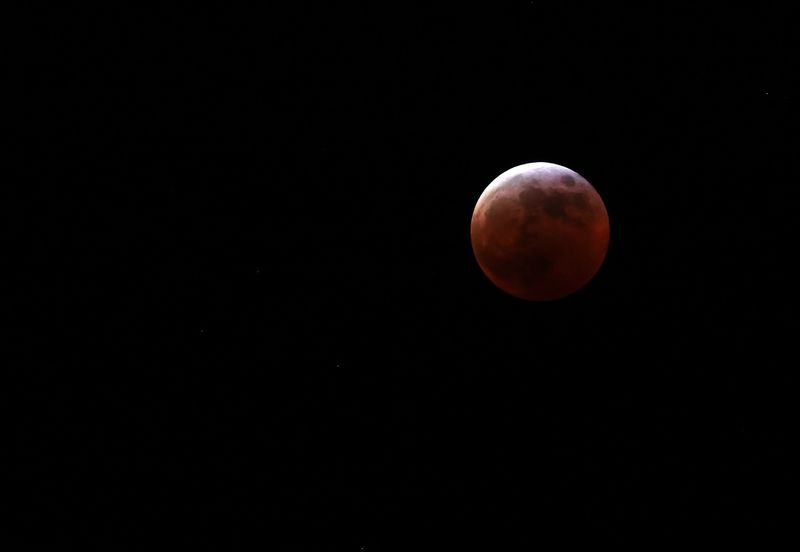
September will feature a “blood moon” eclipse, but you’ll need to travel long distance or view it on your computer screen this weekend.
A total lunar eclipse will occur Sunday, Sept. 7, though it won’t be visible in Michigan skies — or even in the U.S., according to Space.com.

Prime viewing is expected in Asia, east Africa and western Australia, along with a chance to glimpse the eclipse in Europe, eastern Australia and New Zealand, the BBC Sky at Night Magazine and Space.com said.
Michigan will, however, see a full moon this weekend under fall-like weather conditions.
Here’s what to know about the upcoming eclipse and full moon.
When is the full moon and total lunar eclipse in September 2025?
The total lunar eclipse will take place Sept. 7, 2025, during September’s full moon, according to Space.com.
September’s full moon is the corn moon, according to the Old Farmer’s Almanac.
Can you watch the eclipse from Michigan?
The total lunar eclipse won’t appear in Michigan skies, but you’ll still have a chance to see the eclipse online.
If you’d like to follow the eclipse, check out Time and Date’s online livestream on Sept 7.
What is a total lunar eclipse?
A total lunar eclipse is when the sun, Earth and moon align so the moon is covered by the Earth’s shadow, or umbra, NASA said.
Where will the total lunar eclipse be visible?
The total lunar eclipse will be visible across parts of Europe, Asia, Africa, Australia and New Zealand, according to the BBC Sky at Night Magazine and Space.com.
Why does the moon appear red during a total lunar eclipse?
You can expect the moon to take on a dramatic shade of red or orange in the night sky during the total lunar eclipse, leading it to be known as a “blood moon.” That’s because of how sunlight strikes the moon’s surface after passing through the atmosphere, NASA said.
As the moon is covered by the inner part of Earth’s shadow during the eclipse, sunlight not blocked by Earth is filtered through a thick slice of Earth’s atmosphere before reaching the moon’s surface, NASA explained.
Colors with shorter wavelengths, such as blues and violets, scatter more easily than colors with longer wavelengths, which include red and orange.
When is the next total lunar eclipse?
The next total lunar eclipse visible in the Americas will occur March 3, 2026, NASA said. A second, partial, eclipse visible in the Americas takes place in August 2026.
August 2026 also will feature a total solar eclipse visible in Greenland, Iceland, Spain, Russia, and a small area of Portugal, while a partial eclipse will be visible in Europe, Africa, North America, the Atlantic Ocean, Arctic Ocean, and Pacific Ocean.
Contact Jenna Prestininzi: jprestininzi@freepress.com.
This article originally appeared on Detroit Free Press: Will Michigan see a ‘blood moon’ this weekend? Where you need to be to view lunar eclipse
Reporting by Jenna Prestininzi, Detroit Free Press / Detroit Free Press
USA TODAY Network via Reuters Connect