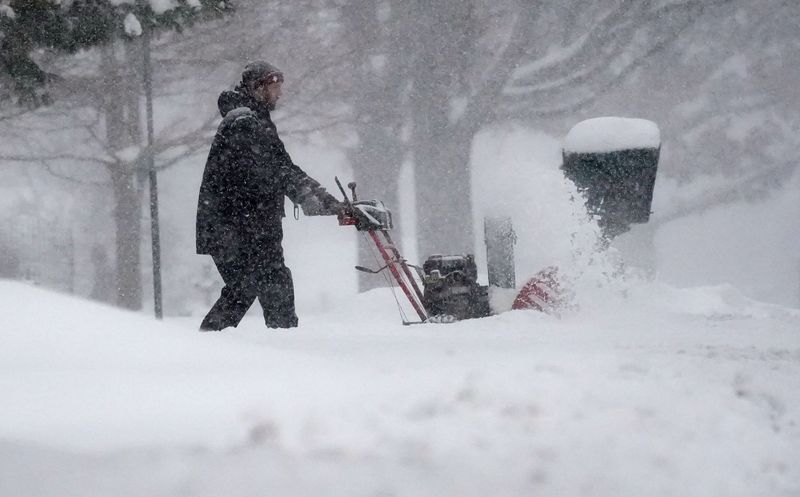
As Michigan prepares for a major snow storm and cold weather settles over Michigan, where to set your thermostat to balance comfort and energy savings may become a matter of debate in your household.
Statewide, residents are in for below-freezing temperatures, and a snowy, rainy, windy holiday week. Northern areas of the Lower Peninsula and the Upper Peninsula expected to see blizzard-like conditions as temperatures plunge below freezing.

“Heating and cooling expenses make up about 43 percent of a home’s total energy costs — a major opportunity for savings. Improving insulation, sealing air leaks, replacing HVAC filters every three months, and getting your HVAC system serviced twice per year can significantly reduce your energy usage,” Michigan Saves, a nonprofit “green bank,” said.
The U.S. Department of Energy says heating your home uses more energy and costs more money than any other system in your home — typically making up about 29% of your utility bill, but homeowners can save as much as 10% a year on heating and cooling by simply turning their thermostat back 7 to 10 degrees for eight hours a day from its normal setting.
“A common misconception associated with thermostats is that a furnace works harder than normal to warm the space back to a comfortable temperature after the thermostat has been set back, resulting in little or no savings,” the DOE said. “In fact, as soon as your house drops below its normal temperature, it will lose energy to the surrounding environment more slowly.”
In addition, there are tricks to keep heat indoors that may help get the most out of your furnace, for instance, setting your ceiling fan to rotate clockwise to circulate warm air; hanging up thermal curtains; or adding a layer of clear plastic or vinyl sheeting to your windows.
Here how to stay warm while reduce heating expenses:
What should I set my thermostat at?
The magic number that the U.S. Department of Energy says is optimal for home heating in the winter: 68 degrees when you’re awake, and a little lower than that when you’re asleep or away from home. And that sweet spot, says Energy.gov, will help save energy and money while keeping your house comfortably warm.
“The smaller the difference between the indoor and outdoor temperatures, the lower your overall cooling bill will be. You can easily save energy in the winter by setting the thermostat to around 68-70 while you’re awake, and setting it lower while you’re asleep or away from home,” Energy.gov says.
Will fuel prices be more expensive this winter?
According to the U.S. Energy Information Administration Winter Fuels Outlook on Nov. 4, homeowners will see reduced costs for most types of fuel.
Propane is expected to cost 9% less than last year, heating oil 8% less and natural gas 1% less.
“Only households heating with electricity are expected to pay more this winter — at 4% or $1,130 under the base case — compared to last winter,” LP Gas Magazine reported.
What are some energy saving tips?
A typical American family spends nearly $2,000 per year on their home energy bills, the DOE said, much of that money is wasted through leaky windows or ducts, old appliances, or inefficient heating and cooling systems.
According to Consumers Energy, the power company that serves 1.8 million residents in Michigan’s Lower Peninsula, there are ways to lower heating bills, such as:
How can I insulate my home without major construction?
Poorly insulated attics, outer walls, doors, windows and floors over basements or crawl spaces allows are common leaks for warm air to escape.
“EPA estimates that homeowners can save an average of 15% on heating and cooling costs (or an average of 11% on total energy costs) by air sealing their homes and adding insulation in attics, floors over crawl spaces and basements,” according to Energy Star.
While it may be too late this year to seal those leaks there are simple items that will help, according to Family Handyman, including:
How much electricity do space heaters use?
A space heater typically uses 1,500 watts of electricity, according to Energysage, though it depends on how often a space heater is used and the type of heater.
Contact Sarah Moore @ smoore@lsj.com
This article originally appeared on Lansing State Journal: What’s the best temperature for my thermostat? Energy-saving tips
Reporting by Sarah Moore, Lansing State Journal / Lansing State Journal
USA TODAY Network via Reuters Connect