Most Americans have never heard of Åland.
That is understandable. The autonomous archipelago sits between Sweden and Finland in the Baltic. It has about 30,000 residents, a small capital and no obvious reason to attract international attention.

Yet, in an era defined by Russian aggression and growing separatist movements across Europe, these islands may offer one of Europe’s most important political lessons.
Åland belongs to Finland. Yet it is not Finnish. Swedish is the language. The islands have their own parliament, flag, and even their own post office. While Helsinki handles defense, foreign affairs and taxation, daily life is governed locally.
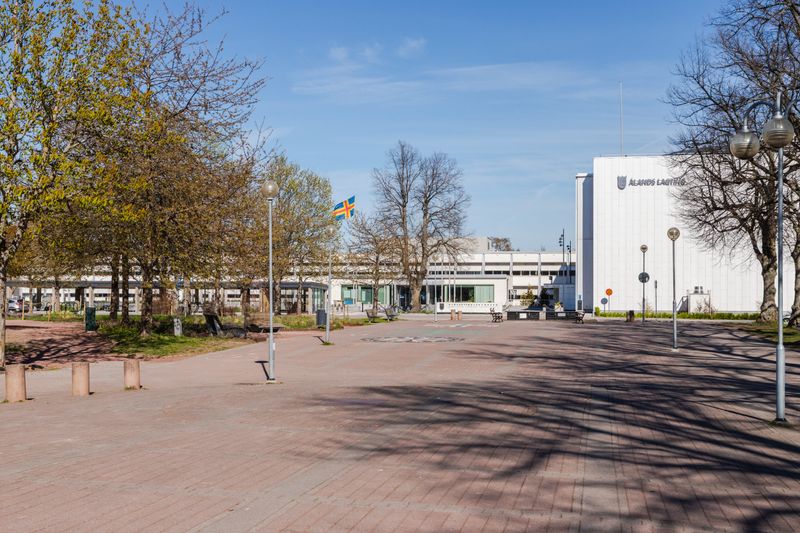
The speaker of the Aland Parliament, the Lagting in Swedish, was somewhat reluctant to describe the islands as a country. Officially, they are not. But the reality is more complicated.
If Scotland and Wales can be viewed as countries within the United Kingdom, then Åland often feels like one of two countries within the Finnish Republic. The islands possess a distinct culture, language, history and political identity that set them apart from the mainland.
The difference is that, unlike Scotland, Wales or Quebec, there is virtually no serious independence movement.
The reason becomes obvious after spending time here: Åland enjoys the benefits of independence without the costs.
“The most visible definition of Åland is we are the islands of peace,” Jorgen Pettersson, the speaker of Parliament, told me. “Starting in 1856, because of this Russian fortress that was almost built for the Russians to control the Baltic, we have been defined by that forever. Everyone — Brits, French, Russians — agreed there can be no military presence in the islands and should there be a war in this area, you can’t use these islands.”
The fortress he referenced was Bomarsund, built by Imperial Russia after Sweden lost Finland and Åland in 1809. During the Crimean War, British and French forces destroyed it. The resulting treaty demilitarized the islands, a status that remains in effect today.
That status has become particularly notable since Russia’s war against Ukraine.
Finland has joined NATO and emerged as one of America’s strongest allies in Europe. Across the Baltic, military planners increasingly focus on Russian threats and regional security. Yet Åland remains largely removed from that turmoil.
Pettersson takes considerable pride in that distinction.
A former journalist, he serves as both speaker of Parliament and, in many respects, Mr. Åland — a tireless ambassador for the islands. When I arrived at Parliament, he personally came downstairs to greet me. There were no handlers, communications staff or choreographed photo opportunities. When he wanted a picture together, he simply set up his own camera on a tripod and triggered it remotely.
The modern autonomy arrangement emerged after Finland declared independence from Russia in 1917. Most Ålanders wanted reunification with Sweden. The dispute was eventually referred to the short-lived League of Nations, which ruled that the islands would remain under Finnish sovereignty while receiving extensive self-government, and guarantees protecting the language and culture. More than a century later, the arrangement continues to evolve.
“We know we can test the ice,” Pettersson said with a smile. “We, as an autonomous region, want to test the ice sometimes [to see if Helsinki approves].”
One challenge is language. Although Finland is bilingual, Swedish speakers represent a shrinking share of the population.
“We force Finland to speak Swedish,” Pettersson said.
Still, the system works. That may explain why separatism has never gained meaningful traction.
The islands enjoy the advantages that independent states seek while benefiting from Finland.
“We come from a rules-based world order,” Pettersson said. “Our autonomy feels pretty safe. We are happy.”
That sentiment stands in sharp contrast to the political turbulence visible elsewhere.
Of course, the conversation drifts toward the United States.
Pettersson told me he has long admired America but struggles to understand the current political climate. I hear versions of that concern regularly from friends across Europe. They remain deeply pro-American, supportive of NATO and grateful for the security guarantees Washington has provided.
“For me, the United States has always been the best and the worst,” he said. “You have always been the best at doing everything, literally — going to the Moon, coming up with Nobel Prize laureates, sorting out wars, doing good stuff. Now, we see the other side.”
It was an observation offered not with hostility but disappointment.
Perhaps that is another lesson from Åland.
Dennis Lennox writes a travel column for The Christian Post and is a Republican political commentator and public affairs consultant.
This article originally appeared on The Detroit News: What Åland can teach the world about autonomy | Opinion
Reporting by Dennis Lennox / The Detroit News
USA TODAY Network via Reuters Connect
By Dennis Lennox | USA TODAY Network