Here’s an idea for a screenplay. The first scene is of a screenwriter who is heartbroken over the collapse of a TV movie that was going to be his big break. Then a friend who’ll win an Oscar someday gives him a piece of advice that will change his life.
Cut to more than 30 years later. That same screenwriter now has several film credits and is being honored for a teaching side gig that evolved into a renowned program for a major university. At the packed event, his former students share stories of how he changed their lives for the better.

You could pitch it to a studio chief as “Mr. Holland’s Opus” mixed with “Dead Poet’s Society” and “To Sir, With Love.”
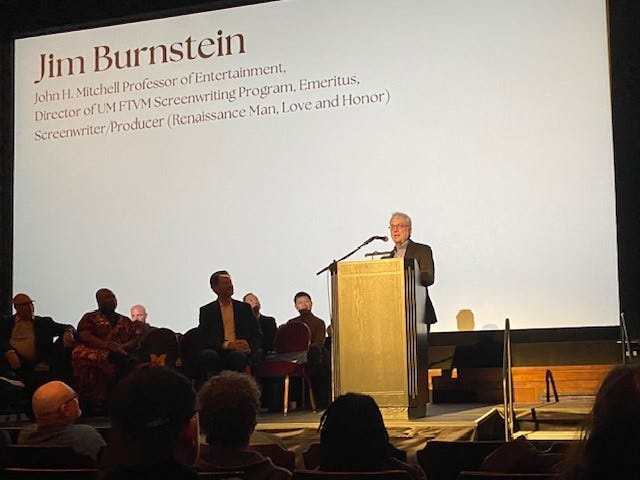
Only this is real life, not a script. On April 10, about 200 people gathered at the Michigan Theater in Ann Arbor to celebrate Jim Burnstein and the 30th anniversary of the University of Michigan screenwriting program that he has directed since 1995.
“He believed in me before I believed in myself,” said Kelci Parker, vice president of comedy and adult animation at Hulu and a former student of Burnstein’s.
“Jim doesn’t have a DeLorean, but he’s definitely our Doc Brown,” another former student, screenwriter Tian Jun Gu (Netflix’s “House of Cards,” FX on Hulu’s “Y: The Last Man”) told the crowd, referring to the visionary scientist who made Marty McFly’s adventures possible in the “Back to the Future” franchise
The movie and TV industry is dotted with people who took Burnstein’s classes and left with the tools to create a career and the confidence to be true to themselves. Now, after three decades of teaching and successfully developing a nationally recognized screenwriting program, Burnstein is retiring at the end of 2026.
And he is looking back on a journey that often sounds worthy of its own script.
Burnstein, 75, is the John H. Mitchell Professor of Entertainment in the University of Michigan’s Department of Film, Television and Media. For short, you can just call him a man who beat the odds. Instead of moving to the West Coast to pursue screenwriting, he stayed in the Detroit suburb of Plymouth and raised three children with his wife, Cindy, an educator.
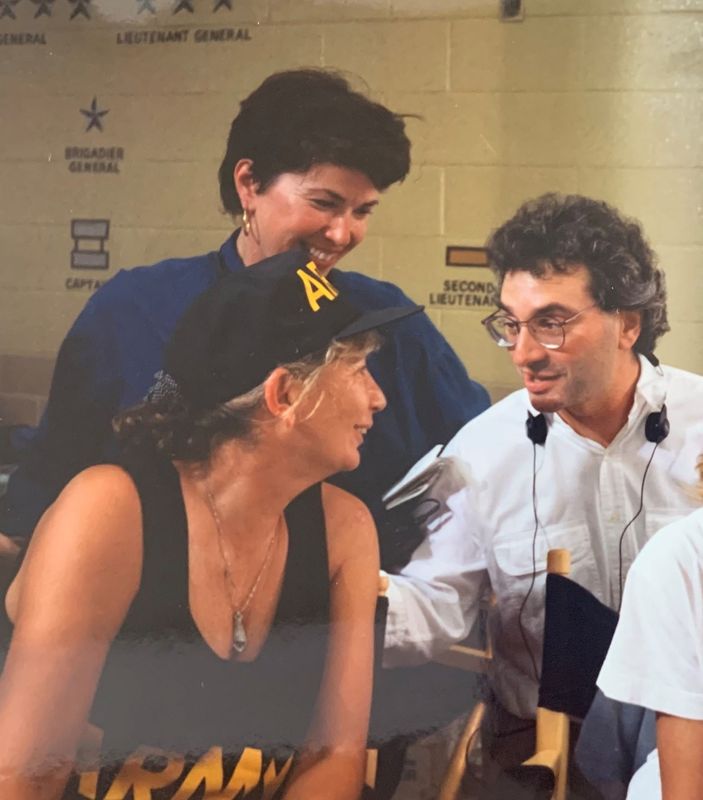
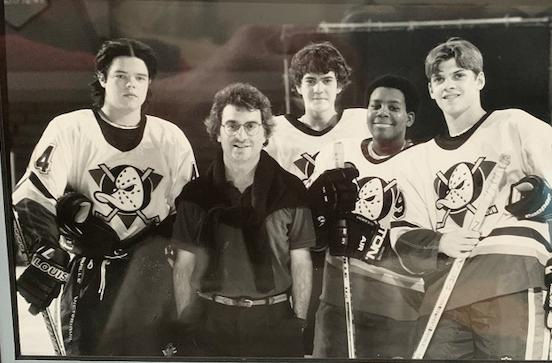
He has an enviable IMDb page that includes screenplay credits for 1994’s “Renaissance Man” starring Danny DeVito and directed by Penny Marshall and 1996’s “D3: The Mighty Ducks” featuring Emilio Estevez and Joshua Jackson (“Dawson’s Creek”) and Kenan Thompson (“Saturday Night Live”) back when they were teen actors.
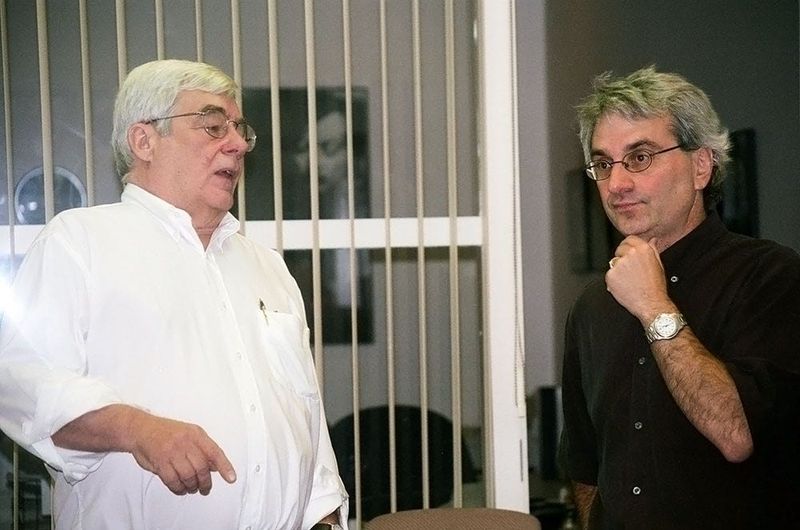
Burnstein also has collaborated on several projects with Garrett K. Schiff, his cousin and screenplay partner who has helped him maintain his dual writing and teaching schedules. They have teamed up on a 2004 ABC TV movie, “Naughty or Nice” with George Lopez; a 2007 ESPN cable movie, “Ruffian,” with Sam Shepard; and the 2013 Liam Hemsworth romantic drama “Love and Honor,” filmed in Ann Arbor and directed by Danny Mooney and executive-produced by Eddie Rubin, who met in one of Burnstein’s classes.
Hollywood hopes and hard knocks
The details of Burnstein’s life are impressive. But it’s in conversation that his journey comes alive with stories of unexpected U-turns, off-the-cuff remarks that changed his world and the joy he has experienced from sharing what he has learned with young people
One of his earliest stories is about how he became a screenwriter. Burnstein, who grew up in Detroit and was an undergrad at the University of Michigan, vividly describes how one of his English professors, Robert Hayden, the first Black poet to become America’s poet laureate, asked him after class whether he’d ever thought of becoming a writer. On another occasion, professor Russell Fraser, a noted Shakespeare scholar, said a throwaway line in class that resonated with Burnstein.
As he recalls, Fraser quipped, “If Shakespeare were alive today, he would be a screenwriter.”
After graduating and getting married, Burnstein drove off to attend the University of Wisconsin Law School in Madison with Fraser’s comment rattling around in his mind. After one semester, he returned to Michigan, earned a master’s degree in English and pursued a new dream of screenwriting while supporting himself with freelance advertising work.
Another Burnstein story? Just as he seemed poised for a chance at the big time, the floor collapsed underneath him. He had written a script for a TV movie that was about to go into production, “Learn to Fall.” It was inspired by a longtime friend, the late Howard Buten, who had dropped out of U-M to study at Ringling Bros. clown college and used those skills while volunteering to work with a severely autistic child.
Hollywood legend Ray Stark was producing and Buzz Kulik of “Brian’s Song” fame was going to direct. Timothy Hutton, fresh off his Oscar-winning performance in “Ordinary People,” was set to star. Then, according to Burnstein, Hutton’s representative at the time, super-agent Sue Mengers, wanted him out of the project.
“CBS was pissed and they pulled the plug. … You talk about the roller-coaster of Hollywood. That was it. And I didn’t see it coming,” he remembers.
That was followed by the story of Burnstein meeting and becoming friends with Kurt Luedtke, the Free Press executive editor who became a screenwriter and went on to earn an Oscar nomination for 1981’s “Absence of Malice” with Paul Newman and Sally Field and to win the Oscar for 1985’s “Out of Africa” with Robert Redford and Meryl Streep.
“He’s getting nominated for an Academy Award. I’m going down the toilet,” says Burnstein, recalling a pivotal conversation with Luedtke about his dashed hopes at a party. “And he said to me, ‘As long as you’re not going to get paid, why don’t you not get paid more?’ And I was so drunk, I understood him!”
As Burnstein elaborates, this was Luedtke’s way of steering him toward writing a feature film instead of another TV movie. According to Burnstein, Luedtke asked whether he had ever considered writing about his part-time job teaching Shakespeare to service members at Selfridge Air National Guard Base in Harrison Township. Recounts Burnstein, “He said, ‘Well, come up with a treatment, and if I like it, I’ll option it and give you some money so you can write it.’ And I said: ‘Kurt, we’re friends. I don’t want your charity.’ And he said, ‘Well, you’re an idiot,’ as Kurt was wont to do.”
In the end, Burnstein would receive invaluable advice from Luedtke , who didn’t suffer fools gladly, but who saw the younger man’s talent and became a mentor through the early drafts of “Renaissance Man.” Burnstein remembers how he spent a weekend at Luedtke’s summer home on Lake Michigan as the veteran writer took apart his script and basically taught him the rewriting process. Later, when Burnstein finished his third draft, “Kurt gave me the best compliment I’ve ever received. … He said, ‘This isn’t all bad.’ That’s as good as it gets.” After a total of 10 years and about five more drafts, “Renaissance Man” was made and released in theaters.
As a side note, Burnstein discovered years later that “Renaissance Man” was among former U-M football coach Jim Harbaugh’s favorite movies. After meeting Burnstein at an event, Harbaugh asked him to speak at a Campus Inn screening of the film for the football team before the season’s opening game. There, Burnstein learned that Harbaugh knew the St. Crispin’s speech from Shakespeare’s “Henry V” by heart, the one recited by a military private in “Renaissance Man.”
The tale of how Burnstein joined the U-M faculty came after “Renaissance Man” was out and “D3: The Mightly Ducks” was filming. Burnstein was contacted by two revered professors, Ira Konigsberg and Frank Beaver, from what was then the film and video studies program about teaching a screenwriting class.
Reluctant to take on a job when he was finally able to focus full time on doing screenplays, but grateful to his alma mater, he laid out his necessary terms. One, the course would have to be at night, to leave his days free for writing. Two, he insisted on never attending a faculty meeting “because I had seen as a graduate student it was civil war in the English department and I’m not going there.” Three, it would be only once a week in order to fulfill the promise to his agent, Stu Robinson, that he’d be ready to get on a plane and fly to Los Angeles immediately if he was needed there.
Burnstein got the OK for all three.
A U-M program takes shape
During the April 10 tribute event for Burnstein, a number of U-M alums spoke appreciatively of how his screenwriting class, launched in 1995 and held 6-9 p.m. Mondays, had impacted them. Screenwriter Dan Shere (2013’s animated adventure “Epic”), now a professor in the U-M screenwriting program, said: “Jim Burnstein has saved more undergrads from going to law school than anyone I know. I know this because I was one of those kids he saved.”
Another former student, award-winning author and illustrator of children’s books and screenwriter Supria Kelker, spoke movingly about Burnstein’s impact on her work. “I never touched the brown Crayola crayon except to draw trees and dogs. I didn’t write a story about anyone who looks like me until I was 19 years old at the U of M, when I wrote a screenplay with an Indian American protoganist. … Jim taught me the importance of writing my story,” she said.
“His influence can be seen in so many screenplays and movies around the world, including the Bolllywood ones I worked on.”
Burnstein credits Gaylyn Studlar, who headed what was then the Film and Media Studies Program from 1995 to 2005, with enlisting him to create a screenwriting program that she imagined as a key part of a future full-fledged film department. Studlar asked him to take a blank sheet of paper and put down what he would need. Burnstein’s list included a rewrite class, a world-class screenplay library and a visiting artists series.
At Studlar’s request, Burnstein sought out and secured important donations for the project. In 1998, Robert Shaye, the Detroiter and U-M alum who founded New Line Cinema (the company behind “Nightmare on Elm Street” and the “Lord of the Rings” trilogy), donated the $1 million that launched the huge Donald Hall Collection of thousands of screenplays and the James Gindin visiting artists and master classes program. They were named for two of Shaye’s favorite English professors.
Burnstein also reached out to Peter Benedek, a Michigan alum and cofounder of the global United Talent Agency. In 2006, Benedek gave $1 million to U-M, most of which went to what by then had evolved into the Department of Screen Arts and Cultures. Benedek’s gift funded annual awards for the best film and TV screenplays and artists-in-residence for the screenwriting program.
And in 2019 came a $5 million endowment from the Patricia W. Mitchell Trusts honoring Columbia Pictures Television founder John H. Mitchell for the Department of Film, Television and Media (still its current name) to support scholarships, internships, speakers and community outreach efforts.
Looking back on his contributions to a screenwriting program that has grown from his initial class into an entire sub-major with its own staff and carefully crafted curriculum, Burnstein tends to understate things. He would rather talk about his students and the joy of watching them hone their talent.
“I have every one of their names, everything they wrote. They will tell me when something happens or I’ll read about them.
“I just wanted to teach one class and go home” he says. His former students would beg to differ.
“In Hollywood, adults go decades never even finishing one script, and here he is asking kids to finish what might as well be three scripts in three years, while taking a full course load and even juggling a job or two,” said Tian Jun Gu at Burnstein’s big night, referring to his screenwriting and rewrite courses. “To believe that’s even possible, you’ve got to be kind of crazy.”
Noting that some of the nation’s top undergrad screenwriting programs only require “an outline and a first act,” he added that when he tells colleagues about what Burnstein’s courses required: “They look at me the way Coppola and Scorsese must have looked at Lucas after watching ‘Star Wars.’ Like I’m, you know, crazy.”
Then he thanked Burnstein for believing so much in his students. “How groundbreaking that [is] and how desperately we need that now, to care so deeply and wildly. You’ve got to be the right kind of crazy and, luckily for all of us, Jim is that right kind.”
Contact Detroit Free Press pop culture critic Julie Hinds at jhinds@freepress.com.
This article originally appeared on Detroit Free Press: U-M professor’s life story is set partly in Ann Arbor, partly in Hollywood
Reporting by Julie Hinds, Detroit Free Press / Detroit Free Press
USA TODAY Network via Reuters Connect