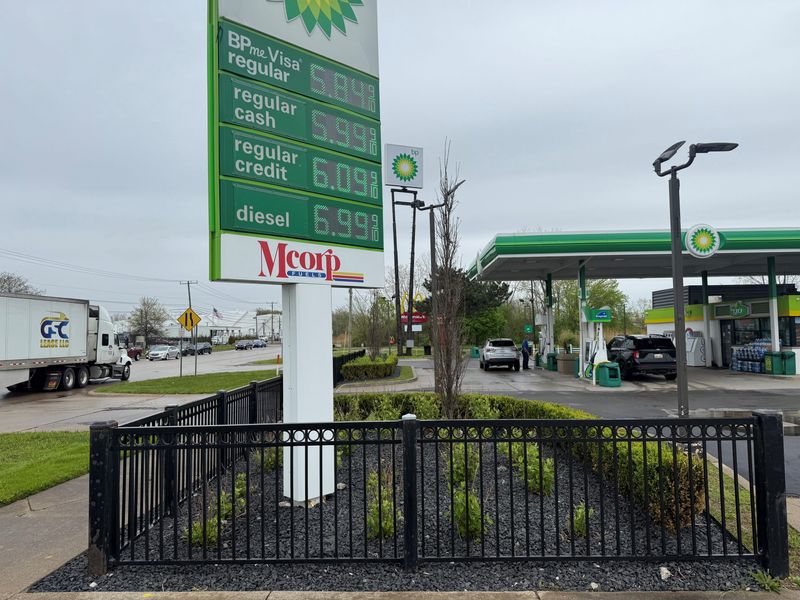
With gas prices surging in Michigan, Troy Grey made the calculation to stop at half a tank when the pump hit $25. It is a sign of what is now happening with the economy and the woes that may be coming this summer.
The part-time warehouse worker likely will have to pay more overall when he fills up again, with prices rising every day. But Grey decided that $50 was too much to pay and he was attempting to budget his money.

If prices went to $5 a gallon, he joked, he would ditch his Chevy to “ride a bike.”
“It’s going up right now,” Grey, 34, of Romulus, said on Wednesday, April 29, at the Mobil station in Taylor, where the price was $4.39 a gallon. It would be, he guessed, “a year or two” before prices came down to what they were a few months ago.
By Thursday, April 30, Michigan’s average was $4.58 a gallon.
Despite Grey’s good-natured remark, gas prices and other economic concerns are moving to the front of Michiganders’ minds. And in reality, a few metro Detroit stations are close to or have already broken the psychological $5-a-gallon threshold.
In addition, on the same day Grey was filling his tank, Defense Secretary Pete Hegseth was on Capitol Hill defending the cost of the conflict with Iran, which, so far, is $25 billion and eventually will have to be paid.
Hegseth was also advocating for a proposed $1.45 trillion military budget.
The Pentagon will need to replenish the stockpile of munitions it has burned through. About half of them have been spent, according to the Center for Strategic and International Studies.
And at the Federal Reserve Board of Governors headquarters, also in Washington, D.C., members met Wednesday, deciding to hold the federal funds target interest range at 3.50% to 3.75%, noting that job gains are low and inflation worries are rising.
When will gas prices come down?
That’s not all.
Tuesday, the Conference Board, a nonprofit think tank, published a survey showing that higher gas prices are a source of concern for consumers, with many planning fewer vacations over the summer and intend to drive less.
It’s easy to see why.
From Sunday to Monday, the average gas price in Michigan went up two cents, from $4.02 a gallon; the next day, it shot up 15 cents. The day after that, it climbed 7 cents, landing at $4.26 a gallon, and then jumped 32 cents on Thursday, for a five-day increase of 56 cents.
Forecasts are calling for averages to continue rising.
Some people have argued in emails to the Free Press that a few cents a gallon — or even an increase of $1.50 a gallon or so — for gas was a small price to pay to hopefully rid Iran of the capability of making a nuclear weapon.
Although an analysis by the Joint Economic Committee’s Democratic minority shows those pennies are adding up. Since the U.S. airstrikes started in late February, by the committee’s count, the increased cost of gas alone is more than $16 billion.
Of that, $465 million was paid by Michiganders.
On Wednesday, the Shell station in Ferndale was selling regular gas for $4.89 a gallon, but for customers who paid with credit, the price was more: $4.99 a gallon.
And the BP station in Romulus near the airport is already at $6.10 a gallon for credit card purchases. That station, however, tends to be higher than average because it is near the airport and cashes in on car rental customers.
While President Trump initially claimed that increased prices were temporary, it seems unlikely that they will come down significantly anytime soon, and even he has acknowledged they may remain high all year. Additionally, Energy Secretary Chris Wright has said national average gas prices may not drop below $3 per gallon until next year.
Elevated gas prices may also be a problem for northern Michigan communities that rely on summer tourism, with folks thinking twice about taking that getaway, and then, even if they do, perhaps deciding to spend less on lodging, dining and shopping.
Michigan has seen $5 a gallon gas before. It hit $5.22 a gallon in 2022.
This time, there is no stimulus money and savings from being homebound.
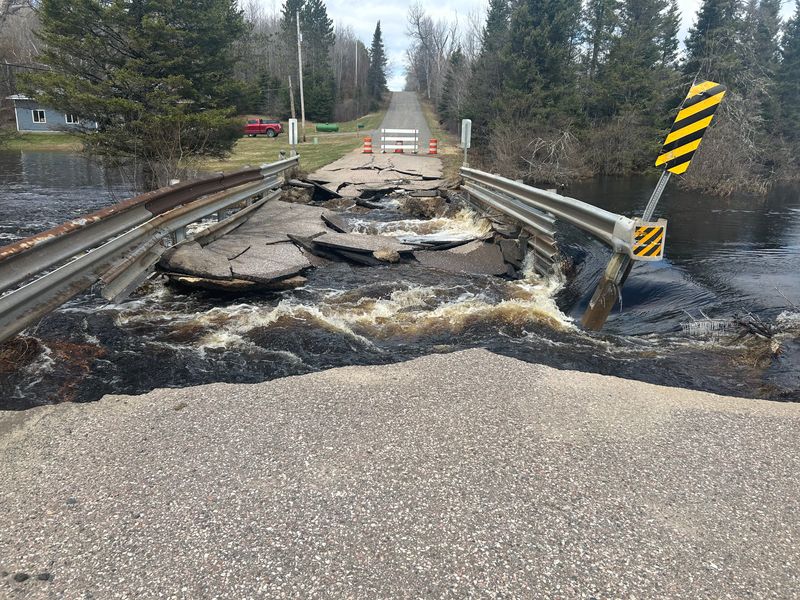
The gas price increase in Michigan also comes on top of two weeks of flooding caused by rain and unusually heavy snowmelt, and the costs of evacuations, generators to pump away water — and home repairs.
The waters, in some places, are still receding.
On Tuesday, Gov. Gretchen Whitmer expanded the state of emergency to include Tuscola County and the Village of Holly in Oakland County, bringing the total number of counties to 41, nearly half the state.
Whitmer called the devastation “unprecedented,” and while the repair cost is still being calculated, it no doubt will be expensive. Rebuilding all the roads, bridges and dams that were damaged could take years.
Why is gas so high in Michigan?
Petroleum experts add that gasoline prices in the Midwest are going up even faster and above the national average of $4.30 a gallon because refineries in Illinois and Indiana are out of commission, pinching supplies.
The state already has suspended environmental regulations to help bring prices down, and there has been talk of temporarily rolling back taxes, which a few other states have done.
If that were to happen, Michigan would also collect less revenue.
And the longer the war goes on, the more it will cost taxpayers, who have gotten only a sense of the total bill from the last two months through increased gas prices.
Still, turning away from the Mideast fight now, after starting a war that some contend hasn’t solved the problem, could be a challenge and may even embolden Iran, which launched its own attacks.
Perhaps the biggest question that emerged from Wednesday’s hearing with Hegseth was: What is the administration’s endgame? The defense secretary lashed out at legislators who were critical of the war.
But when pressed about how he sees it ending, he offered few answers.
Across Michigan, drivers have become more deliberate about where and when they get gas, shopping for low prices, putting in less than a full tank and trying to drive less.
Some may start to use credit cards more and dip into savings.
But even if folks stopped driving entirely, they would be paying something.
Diesel fuel in Michigan is averaging $5.13 a gallon, which may not seem like a concern to some because most passenger cars don’t use it. But trucks shipping goods do.
The increased cost of diesel fuel will inevitablybe passed along to consumers through what will become higher prices for food, manufactured goods, and even energy.
In metro Detroit, utility costs — electricity, natural gas, and water rates — also have been rising in the past few years, and likely will continue to do so. DTE, for instance, just said it plans to file a new, $474.3 million electric rate increase.
On Wednesday, Jerome Powell told reporters that after the Fed’s 8-4 vote leaves interest rates unchanged, the longer the war goes on, the greater the risk it could push gas prices and inflation higher.
Powell is stepping down from his chairman’s role but is staying on the board.
The U.S. economy has “powered through shock after shock, and consumers are still spending,” a Yahoo Finance report quoted Powell saying. But he also concluded that consumers are starting to feel the consequences.
And as gas prices rise, many will have less money to fuel the economy.
Contact Frank Witsil: 313-222-5022 or fwitsil@freepress.com
This article originally appeared on Detroit Free Press: Michigan may get walloped with $5 a gallon gas as prices climb fast
Reporting by Frank Witsil, Detroit Free Press / Detroit Free Press
USA TODAY Network via Reuters Connect