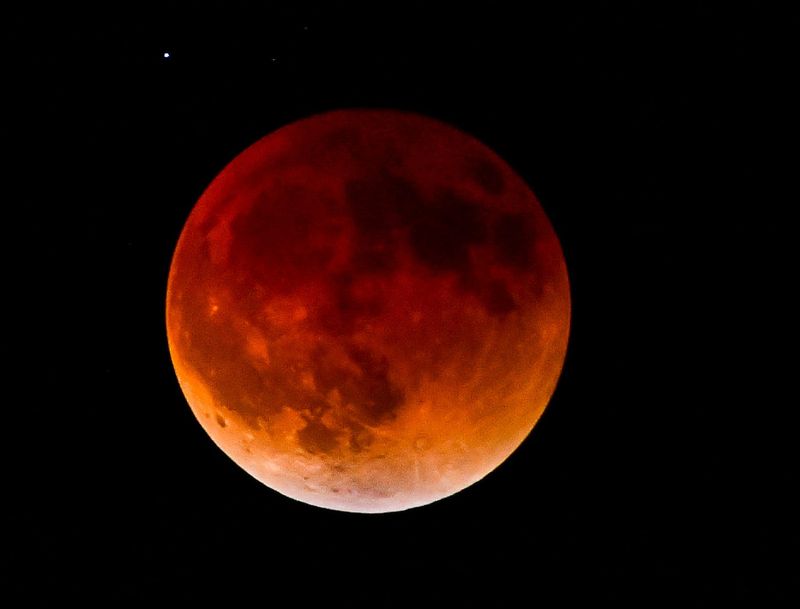
The first full moon of May may occur in the afternoon May 1, but you can still get an amazing view of the “full” moon April 30 and May 2.
The flower moon May 1 will be the first of two full moons this month, with the second happening May 31. A “blue moon” — the second full moon in a month — only happens every two to three years.

Also happening in early May will be the arrival of the Eta Aquarids meteor shower.
Later in the year will be a partial lunar eclipse and a total solar eclipse.
When is the next full moon?
The next full moon of the year will be the flower moon, which occurs at 1:23 p.m. EDT on May 1.
How long will May 1 moon appear full?
It’ll be tough to spot the full moon at the exact time since it’ll be 1:23 p.m. EDT.
But that’s OK.
“Although a full moon occurs each month at a specific date and time, the moon’s disk may appear to be full for several nights in a row if it is clear,” according to the U.S. Navy Astronomical Applications Department.
“This is because the percentage of the moon’s disk that appears illuminated changes very slowly around the time of full moon. The moon appears 100% illuminated on the night closest to the time of exact full moon.
“On the night before and night after, (the moon) will appear 97-99% illuminated. Most people would not notice the difference. Even two days from full moon the moon’s disk is 93-97% illuminated,” the agency said.
So you’ll be able to get a great view of the moon — weather permitting — April 30 through May 2.
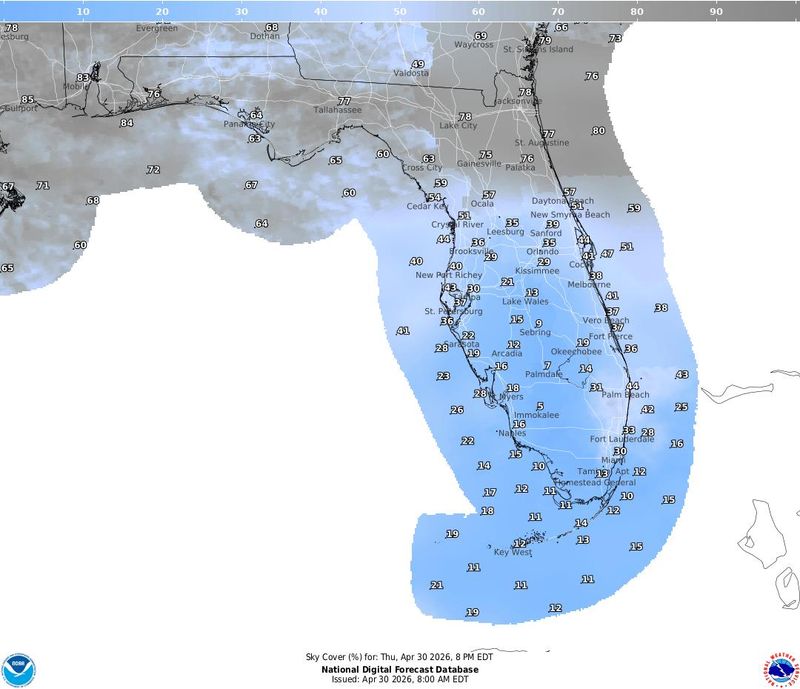
Will clouds block view of May 1 flower moon in Florida?
The view of the flower moon at 8 p.m. April 30 looks good for most of the Florida peninsula, but clouds could block the view for those in North Florida and the Panhandle.
May 2026 will have two full moons
May will bring two full moons, not only the flower moon on May 1, but also a “blue moon” on May 31.
What is a blue moon?
A blue moon is the second full moon in a single calendar month, according to space.com.
“The moon’s cycle is 29.5 days, so just a bit shorter than the average length of a calendar month,” according to NASA.
“Eventually that gap results in a full moon happening at the beginning of a month with enough days still remaining for another full cycle ― so a second full moon in the same month. In other words, a full moon that happens on the first or second of a month will probably be followed by a second full moon on the 30th or 31st.”
How common is a blue moon?
According to NASA, a blue moon happens every two to three years.
When are full moons in 2026?
Here’s when to see remaining full moons of 2026:
Why is the May full moon called the flower moon?
Moon names come from Native American, colonial American, or other traditional North American sources passed down through generations, according to the Old Farmer’s Almanac.
“May is the month when hundreds of native flowers, sedges, bushes and trees blossom throughout North America bloom,” according to farmersalmanac.com.
Watch Eta Aquarids meteor shower in May
The Eta Aquarids meteor shower will peak May 4 during the predawn hours skimming the surface of the Earth at the horizon.
➤ Eta Aquarids kick off as Lyrids meteor shower hits peak.
The Eta Aquarid meteors are known for their speed, with the meteors traveling at about 40.7 miles per second into Earth’s atmosphere, according to NASA.
The moon will be just four days past full so it may be difficult to see the dimmer meteors.
“Fast meteors can leave glowing ‘trains’ — incandescent bits of debris in the wake of the meteor — which last for several seconds to minutes,” according to NASA.
The Northern Hemisphere has an hourly rate of about 10 meteors an hour.
The meteors are caused by dust and debris from Halley’s Comet, which won’t enter the inner solar system again until 2061.
Here’s what else you can look forward to this year.
Total solar eclipse coming in August 2026
A total solar eclipse will occur Aug. 12, 2026.
Where is path of totality for 2026 total solar eclipse?
The path of totality for the total solar eclipse will be across Greenland, western Iceland and northern Spain, according to space.com.
Will the total solar eclipse be visible in Florida, US?
Even seeing a partial solar eclipse won’t be possible in Florida.
Visibility in the U.S. will be limited to the Northeast and Alaska, according to timeanddate.com.
➤ See cities, states with view of a partial solar eclipse
Partial lunar eclipse coming in August
A partial lunar eclipse will occur Aug. 27-28, 2026, and this will be visible across North America.
Will partial lunar eclipse be visible in Florida?
The partial lunar eclipse will begin at 9:23 p.m. EDT Aug. 27 and ends at 3:01 a.m. Aug. 28.
It will be visible in Florida, although residents along the east coast may miss some of it since the moon may be low on the horizon during the peak portion of the eclipse.
Florida residents can expect to see about 93% of the moon to be in the Earth’s shadow, according to timeanddate.com.
➤ See view and timing from where you live
Mark your calendar! Next total lunar eclipse will fall on New Year’s Eve
The March 2026 total lunar eclipse was the last one until “a rather special one on New Year’s Eve 2028-2029,” according to space.com.
Cheryl McCloud is a journalist for the USA TODAY Network-Florida’s service journalism Connect team. You can get all of Florida’s best content directly in your inbox each weekday day by signing up for the free newsletter, Florida TODAY, at https://floridatoday.com/newsletters.
This article originally appeared on Florida Today: Head outside tonight for amazing view of first of 2 full moons in May
Reporting by Cheryl McCloud, USA TODAY NETWORK – Florida / Florida Today
USA TODAY Network via Reuters Connect