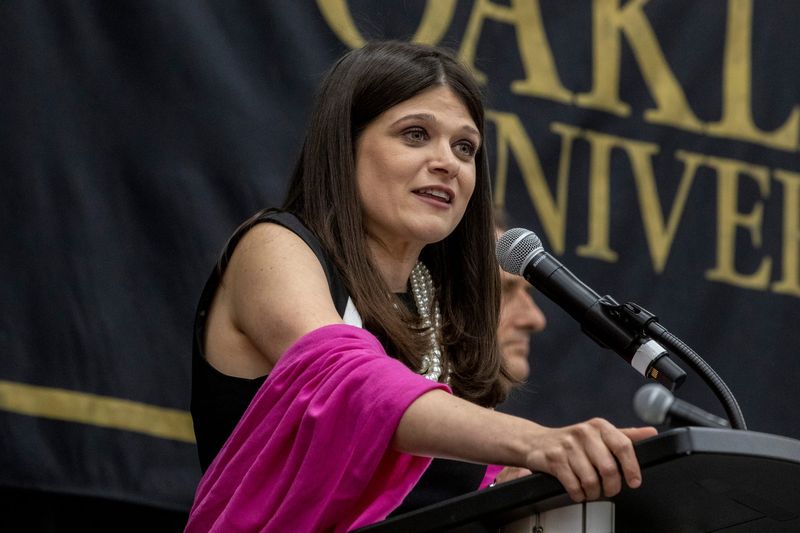
U.S. Rep. Haley Stevens, D-Birmingham, introduced legislation in Congress that would strip federal funding away from investor-owned utilities that raise their rates for customers within a year of the last price hike.
Stevens’ bill, announced Thursday, March 12, comes about a month after the Michigan Public Service Commission approved a $242 million increase to DTE Energy’s electric rates, a price hike that amounts to about $5 more a month to the typical customer’s bill. DTE has since signaled it will open another rate increase case in front of the MPSC in April, leading to outrage from ratepayers and energy affordability advocates in the state who note Michiganders already pay some of the highest utility prices in the Midwest.

Stevens’ proposal sets a three-year timeframe: In year one, any utility that sought an additional rate hike would lose any funding it received from the U.S. Department of Energy. In years two and three, it would lose federal funding if it sought a rate hike and did not issue a pay cut to its five highest-paid employees that is double the percentage of its intended rate increase.
Since the rate case process typically takes about a year, any increase to DTE’s electric prices wouldn’t take place until 2027, if DTE follows through with the April timeline for opening a new case.
Stevens’ measure isn’t likely to advance through Congress, which is controlled by Republicans in both the House and Senate and holds deeply entrenched partisan divides. But Stevens, who is also running for one of Michigan’s U.S. Senate seats this fall, said utilities should not be able to pass higher costs off on ratepayers while taking in record profits.
“Michigan families are paying more and more for electricity, yet too many are getting worse service in return,” Stevens said in a statement. “While hardworking Michigan families struggle to afford higher bills, corporate executives are getting richer off their backs. That is unacceptable.”
In February, DTE Energy reported making $1.5 billion in profit in 2025.
In a statement March 12, DTE spokesperson Ryan Lowry said the utility is “focused on keeping bills as low as possible for our customers.” He pointed to recent reliability improvements in the company’s electric service and said, since 2021, DTE’s electric bill growth has been among the lowest in the country, compared to other states.
“In the face of increasingly extreme weather and to deliver on the commitment to improve reliability, the company must continue to invest to deliver the energy our customers demand and deserve,” Lowry said in an email.
After the MPSC approved DTE’s latest electric rates in February, company officials and regulators noted the increased rates would allow the Detroit-based utility to invest in reliability upgrades across its grid. DTE serves about 2.3 million electric customers, mainly in southeastern Michigan. The company also noted improvements to its electric service last year — its customers spent 60% less time without power in 2025 than in 2024.
Investor-owned utilities like DTE and Michigan’s other major utility, Jackson-based Consumers Energy, occasionally receive funding from the federal government. For example, DTE received $140 million in tax incentives through the Inflation Reduction Act to convert its Trenton Channel coal-fired power plant to a battery energy storage facility.
The ability to file rate cases annually helps Consumers address needs in its electric infrastructure, said Katie Carey, Consumers director of media relations.
“By contrast, extending the time between rate cases can lead to underinvestment in critical infrastructure and higher, more significant cost increases for customers when cases are filed in the future,” Carey said in a March 12 statement.
This story was updated to add new information.
You can reach Arpan Lobo: alobo@freepress.com
This article originally appeared on Detroit Free Press: Stevens: Strip federal funds from utilities for repeated rate hikes
Reporting by Arpan Lobo, Detroit Free Press / Detroit Free Press
USA TODAY Network via Reuters Connect