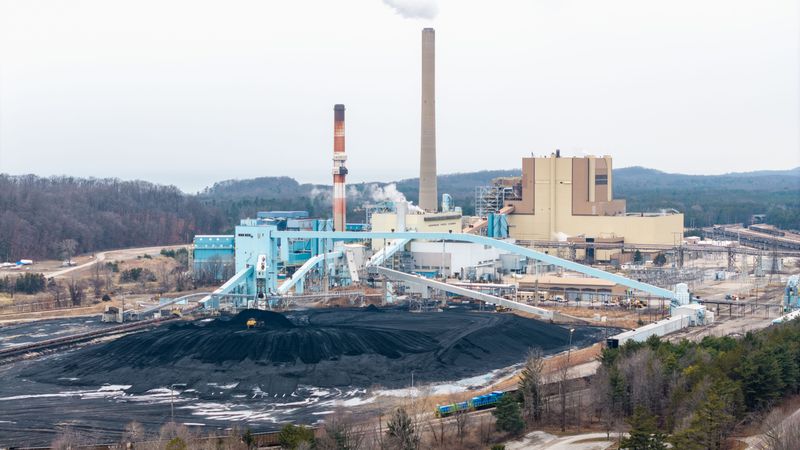
Port Sheldon Township — The coal pile at the J.H. Campbell Generating Complex was supposed to be gone by now.
Instead, it’s plainly visible from across Pigeon Lake, a small waterbody that runs along the coal-fired power plant’s southern border before emptying into Lake Michigan. Bulldozers look like toys as they crawl up and over the large pile, scooping loads that send an odor like hot asphalt drifting past the plant’s barbed-wire border.

Consumers Energy planned to close the Campbell plant last May, a move it negotiated with state officials and advocacy groups seeking a cleaner, more affordable power grid. Plant operators were running the 64-year-old plant’s two working units at a minimum load “to burn the last little bit of coal in the pile,” said Shaun Johnson, Consumers Energy’s executive vice president of business transformation.
Then, a week before the Campbell plant’s final day, came the order from President Donald Trump’s administration: Keep it running.
Consumers replenished Campbell’s coal pile with about 3 million tons of the stuff in the next eight months, according to a federal energy database that shows information through January. The coal was hauled by rail from Wyoming’s Powder River Basin and burned in west Michigan, where emissions of particulate matter, sulfur dioxide and mercury drift with the wind.
The May 23, 2025, order was the first of more than a dozen 90-day emergency orders U.S. Energy Secretary Chris Wright has issued to utilities and power grid operators in four other states, forcing them to extend the life of fossil fuel plants otherwise destined for closure. Wright said their power was needed to protect against shortages.
Advocacy groups and Democratic states tied to the Midwestern electricity grid, including Michigan, are challenging Wright’s use of federal emergency powers, claiming he falsified an energy emergency to prop up the coal industry and overrule local decision-makers. They made their case Friday before a panel of judges on a federal appeals court.
Even officials in Republican states are pushing back after seeing their share of the Campbell Plant’s bill.
“We didn’t even know the plant existed,” said Chris Nelson, South Dakota Public Utilities Commission chair, who estimated his state’s customers already are on the hook for well over $1 million in Campbell costs. “Certainly, the plant is of no benefit to our customers in South Dakota. Now, all of a sudden, we are faced with paying our proportional share of those ongoing costs. Our contention is that that, just frankly, is absolutely unfair.”
Campbell runs at a loss. The remaining tab — $180 million for the first 10 months — will be spread to customers of 11 states on the grid managed by the Midcontinent Independent System Operator, or MISO. Michiganians, including those who aren’t Consumers customers, and people as far away as eastern Montana will pay a share.
The additional cost and the additional pollution released from Campbell’s smoke stacks over the last year add insult to injury for activists who negotiated to close the coal plant in 2022, said Sergio Cira-Reyes, lead environmental justice strategist for the Grand Rapids community organization Urban Core Collective, one of the groups that negotiated the Campbell plant closure.
Activists rallied their communities to close the plant, he said. Their accomplishment was snatched away.
“It was a significant win for the community,” Cira-Reyes said. “We celebrated it. Fast forward to last year — in May — when the Department of Energy decided to single-handedly take that victory from our community. It was a sad day for all of us, and I think it’s been a sad year. People are feeling the effects of that in their lungs when they take a breath, but also when they get their bill at home.”
Critic says of plant’s jumpstart: ‘I’m paying to get poisoned’
Burning coal releases particulate matter, sulfur dioxide, mercury, lead and other pollutants that harm people’s health. The J.H. Campbell plant released 62.1 pounds of mercury in 2024, as well as 26.1 pounds of lead, 75,663 pounds of ammonia and other toxic pollutants, according to the latest available U.S. Environmental Protection Agency air emissions data.
When it arrives in Grand Rapids, about 30 miles away, pollution from the Campbell coal plant layers on top of other pollution residents already face, particularly those in the more industrialized parts of the city, said Fredericka Brown, an organizer on Urban Core Collective’s education justice team and director of early childhood education for Parents for Healthy Homes.
Some Grand Rapids neighborhoods also confront emissions from diesel trucks in their neighborhoods and vehicles on nearby highways, plus emissions from the incinerator on Market Avenue Southwest that generates electricity by burning municipal and commercial trash. Those living in older homes also may face the environmental hazards of lead in dust, paint, pipes and soil, said Brown, whose 10-year-old son Ny’jiere has asthma and allergies she manages with air purifiers, medicine, inhalers and breathing treatments.
“It’s taking steps backward instead of forward, keeping that coal (plant) running,” she said. “On top of that, they keep raising our rates. So I’m paying to get poisoned, basically. I am paying these companies to poison our environment and our homes with this air pollution.”
Burning coal is also a significant contributor to climate warming. In 2022, about 20% of U.S. electricity came from coal, but coal represented 55% of the energy sector’s carbon dioxide emissions, according to the EPA. “Human activities have contributed substantially to climate change by adding CO2 and other heat-trapping gases to the atmosphere,” according to the EPA.
The J.H. Campbell plant released 6.64 million metric tons of carbon dioxide in 2023, EPA data show, as much as more than 1.4 million passenger vehicles release in a year.
That’s a driving reason Consumers Energy, the Michigan attorney general, and environmental and community advocacy groups agreed on a plan to close Campbell in 2025, 15 years before its previous retirement date. To replace the power, Consumers bought the natural gas-fired Covert Generating Station in Van Buren County and agreed to build new solar power and battery storage.
The early retirement would save Consumers Energy customers an estimated $600 million by 2040, the groups said at the time.
How Consumers kept Campbell coal plant running
Consumers Energy officials were meeting with local officials and economic development groups to discuss the future of the property once the site was restored in 2030. There was a small contingent who wanted to rescue the plant and develop a municipal utility to power it, Ottawa County Commissioner Jim Barry said, but the idea didn’t gain traction. Most in the community were ready to move on.
The federal emergency order trumped the local discussion over the plant and its future, he said.
“I really hesitate to tell a business how to run their business,” said Barry, who described himself as a conservative Republican. “If they thought they had it handled and their plan was to close the plant, that was fine as far as I was concerned.”
The residents of the nearby Port Sheldon Beach Association were “blindsided” to hear Campbell would continue operating instead of shutting down, said Chuck Schmucker, 71, a retired Michigan state court administrator who lives across Pigeon Lake from the plant. Although they had questions about who would take over responsibility for dredging the channel to Lake Michigan, all the neighbors who weighed in wanted to see it closed, he said.
“We were going to have a little party at midnight, as if they were going to be pulling a switch and shutting it down,” Schmucker said. “There’s a lot of noise, there’s a lot of light pollution. It’s lit up at night. Everybody was looking forward to the plant shutting down.”
Schmucker said he thinks his neighbors would support the federal emergency order if they felt it was justified.
“No one wants to have a brown-out, or to not have electricity or have other problems,” he said. “Everything I’ve read says they don’t need this energy; this is more for political reasons. It irritates you a lot more when you’re thinking we have the pollution, the noise, the light pollution, and we’re only enduring this because of a political reason.”
Wright has issued his Campbell plant orders under Section 202(c) of the Federal Power Act. With his first order, Trump’s energy secretary said MISO did not have enough electricity for the summer months. In contrast, MISO planning documents indicated there were “adequate resources to meet anticipated demand,” a spokesperson said at the time.
Michigan Attorney General Dana Nessel, a key player in the fight against Wright’s orders on the Campbell plant, told a state House committee in March that Wright’s emergency powers are supposed to be reserved for extreme circumstances like hurricanes or war and usually done after consulting utilities and local energy regulators.
“None of those circumstances had existed when this occurred,” Nessel said in March. “This is just pure policy preference from the White House enacted in an unlawful manner that usurps local and state control.”
Attorneys for the Department of Energy, Michigan, Illinois and Minnesota, and environmental and ratepayer public advocacy groups clashed in federal court on Friday over whether Wright properly used his emergency powers to force Campbell to stay operating. The attorney representing Wright said the energy secretary had full discretion to determine what qualifies as an emergency, so long as there is substantial evidence, while the others said the emergency orders should be reserved for use as a last resort.
Consumers Energy has not gotten involved in the court challenge against Wright’s emergency orders. The Jackson-based company’s interest is in ensuring the costs of running Campbell don’t fall squarely on the shoulders of its ratepayers and instead are spread throughout the region, Johnson said.
“If you’re going to declare an emergency across MISO North and Central, that’s who should pay for this,” the Consumers executive said. “That’s the only position we’ve taken in this case.”
In his most recent renewal of the order, Wright cited Campbell’s output during a late January storm, when the plant generated more than 650 megawatts per day.
“The energy sources that perform when you need them most are inherently the most valuable — that’s why beautiful, clean coal was the MVP of recent winter storms,” Wright said in a February statement. “Hundreds of American lives have likely been saved because of President Trump’s actions, saving America’s coal plants, including this Michigan coal plant, which ran daily during Winter Storm Fern. This emergency order will mitigate the risk of blackouts and maintain affordable, reliable, and secure electricity access across the region.”
Wright’s latest emergency order for Campbell Plant expires May 18. Consumers Energy company officials expect he will issue another emergency order to replace it, Johnson said. He said he anticipates the emergency orders will keep coming through the rest of Trump’s term, which ends in January 2029.
Consumers Energy executives weren’t warned the emergency order was coming, Johnson said, although they suspected it after seeing signals from the Trump administration, like the president’s April 2025 executive order for federal officials to embrace coal mining and use.
Plant operators had to act fast to comply. Consumers secured a new coal purchase contract within five days and managed to get it at the same cost as previous longer-term contracts, Johnson said.
They’ve had to deal with mechanical issues at one of the three operating units, Unit 2, which has had nine outages over the last year, mostly because of boiler tube leaks and fan vibrations, Johnson said. The unit was shut down when the emergency order came because Consumers officials didn’t think it was worth repairing, as they planned to close the plant. Although the issues continue, Consumers does not plan significant repair work.
“As things break, we will fix,” Johnson said. “For affordability and cost reasons, we will not make major capital investments in a machine we know is not going to run for the long term.”
Consumers has had to enact expensive staff retention policies to keep experienced people working at Campbell. The plant requires experienced staff to operate it safely because the plant is relatively old and has “bespoke” repairs to its components, Johnson said.
The company never planned to lay off Campbell plant employees. Instead, it would have transferred or retrained them. About 250 people work at Campbell when the plant is at full staff. Right now, there are about 219 there, Johnson said, including employees of Consumers and some contractors.
Jackson-based Consumers Energy expects to spend up to $4 million on staff retention measures for each 90-day period, according to a recent federal financial filing.
“You’ve got to do something to keep the right people there who are trained and know how to operate these units,” Johnson said.
States battle over coal plant costs
Staff retention programs are one of many costs that leaders in some MISO states say they shouldn’t bear.
“I think this whole thing is just deeply unfair,” Minnesota Public Utilities Commission Vice Chair Joseph Sullivan said. “How we pay for it is just going to be unfair because nobody should be paying for it. Why should people in Minnesota be paying for a power plant that Michigan regulators said, ‘No, we need to turn this off.’ This isn’t good enough for Michiganders anymore, so why should Minnesotans pay for it?”
In addition to the challenge in federal court, states and parties, including Missouri, South Dakota and the Organization of MISO States, have weighed in on cases before the U.S. Federal Energy Regulatory Commission about who will pay to operate Campbell.
FERC has determined the cost will be spread through the north and central MISO region, which includes all or portions of Michigan, Wisconsin, Indiana, Illinois, Kentucky, Missouri, Iowa, Minnesota, South Dakota, North Dakota, Montana and Manitoba, Canada. The commission has yet to approve a formula for dividing those costs, but it will likely do so based on each state’s projected energy use.
Consumers spent $401 million operating the Campbell plant from June through the end of March. It sold enough power to generate $221 million in revenue, leaving a net cost of $180 million for the 10-month period, according to the company’s financial filing.
In the first 90-day emergency period, Consumers spent about $55 million on supplies like fuel, coal and chemicals, Johnson said. It spent $11.5 million on operations and maintenance costs, including labor. It spent an additional $52 million on property taxes and depreciation of the plant. Those are the costs left over after energy sales, Johnson said.
The Consumers executive argued that the utility’s electricity customers will benefit from the emergency orders because they would have had to pay the fixed costs, property taxes or depreciation, regardless of whether the plant was operational or not. Instead, those fixed costs will be shared by residents of the other 11 states, who will finance about 90%, Johnson said. He estimated that it will save Consumers’ customers $15 million per month, which the company will propose to distribute on customers’ bills.
South Dakota submitted a comment to FERC opposing exactly that.
“To now try to spread those fixed costs related to Campbell Plant across (utilities) that never benefited from the plant during its useful life is inherently unfair,” South Dakota commissioners said in their comment. “The company and their customers should bear the fixed costs of this plant because South Dakota was not part of the decision to build and operate the plant for South Dakota customers.”
Assistant Attorney General Michael Moody, chief of the special litigation division, said it is still unfair for DTE Energy customers on the east side of the state to pay any share of the cost of powering the Campbell plant in west Michigan. He said Consumers customers also shouldn’t be on the hook for buying coal or operating Campbell, since Consumers and MISO have said they do not need the power.
Consumers customers already paid to replace Campbell’s output by buying a natural gas plant in Covert Township and building new solar arrays, Moody said.
The assistant attorney general said the outcome of the court challenges and FERC decisions about the Campbell plant likely will influence the future of the other plants that Wright has ordered to continue operating through the emergency orders.
“Any additional cost is just unfair, really, to all the customers of the state,” Moody said. “It’s not like the coal plant is a winner.”
ckthompson@detroitnews.com
This article originally appeared on The Detroit News: States across the Midwest are fighting over this Michigan coal plant
Reporting by Carol Thompson, The Detroit News / The Detroit News
USA TODAY Network via Reuters Connect