There’s something troubling happening to fish that live more than 600 feet below the surface of Lake Superior.
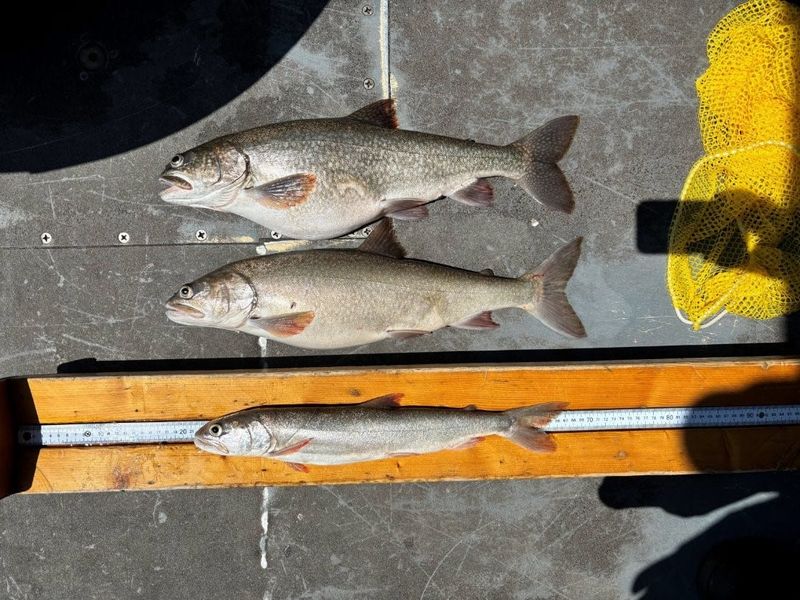
Researchers are increasingly finding emaciated lake trout, which they call “zombie fish,” during deepwater surveys in Lake Superior. The emaciated fish’s bodies are far thinner than their healthy counterparts.

It’s unclear what is causing the fish to grow so thin, said Edward Baker, manager of the Michigan Department of Natural Resources Fisheries Division’s Marquette Research Station. The cause could be limited food, a germ or disease, or bites from invasive sea lamprey.
Fish health experts from Michigan State University were to join DNR fisheries workers on a sampling trip this week to try to understand what’s happening. The DNR research boat, RV Lake Char, was headed to Superior Maximus, the deepest point of Lake Superior at 1,300 feet deep. They’ll collect samples from inside the fish’s bellies to see what they have been eating and will look for sea lamprey bite wounds.
“When we bring up fish that are emaciated, (the MSU fish health experts) are going to be taking samples and taking fish back to the lab and trying to figure out if there’s a pathogen involved,” Baker said.
A pathogen is the worst-case scenario, Baker said, since it could spread to the lake trout that live in shallower waters and favored by anglers.
“That would be cause for serious concern for sure,” Baker said. “Right now, it’s more of a point of curiosity. We’re observing a natural phenomenon that we don’t know the cause of, so we’re just trying to see if we can figure out what the cause is. We think it’s nothing to be concerned about at this point.”
Lake Superior lake trout population restored
The lake trout that live in the deepest parts of Lake Superior are called siscowet. They store a lot of fat in their flesh, which Baker said research believes helps keep them buoyant in deep water, where there is high water pressure.
In 2015, only 3% of the siscowet DNR fisheries workers netted in deep Lake Superior water were emaciated. In 2025, about 20% of the siscowet were emaciated. The numbers are worse at Superior Maximus. There, 37% of the fish were emaciated in 2024 and 54% were emaciated in 2025.
The Great Lakes Fisheries Commission’s Lake Superior Committee members announced in 2024 that Lake Superior’s lake trout population was “fully restored” after it had been decimated by sea lampreys and overfishing in the mid-20th century. The commission was established in 1954 to control sea lampreys, coordinate fishery management and rehabilitate lake trout. After decades of stocking lake trout in Lake Superior, the fish started reproducing naturally in the 1990s.
It was a major milestone, said Greg McClinchey, Great Lakes Fishery Commission director of policy and legislative affairs. As top predators in Lake Superior, lake trout are important to the lake’s ecosystem.
“The lake trout are an absolute keystone species,” he said. “It’s critically important we understand what’s going on with them. This is currently happening only in Lake Superior, so we want to be sure we understand why so it doesn’t spread, or so if it does (spread) we’re prepared to deal with it.”
Like all lake trout in Lake Superior, siscowet are the top predator in deep water. They primarily eat deepwater sculpin, burbot and kiyi, fish that also live deep in Lake Superior.
Baker suspects a lack of food is not what’s causing the emaciated fish. He pointed to footage collected by a remotely operated vehicle that traveled to the bottom of Superior Maximus early this month.
“I don’t think there’s a second of that video where there isn’t a deepwater sculpin in that frame,” he said. “I don’t think it’s a food limitation just based on that video.”
ckthompson@detroitnews.com
This article originally appeared on The Detroit News: Something’s going on with these Lake Superior lake trout
Reporting by Carol Thompson, The Detroit News / The Detroit News
USA TODAY Network via Reuters Connect
By Carol Thompson, The Detroit News | USA TODAY Network