ST. IGNACE — The cedar was scattered in a circle, the tobacco was then cast upon it and the burning sage was carried through the room. It was a blessing for the occasion, because this was a solemn event.
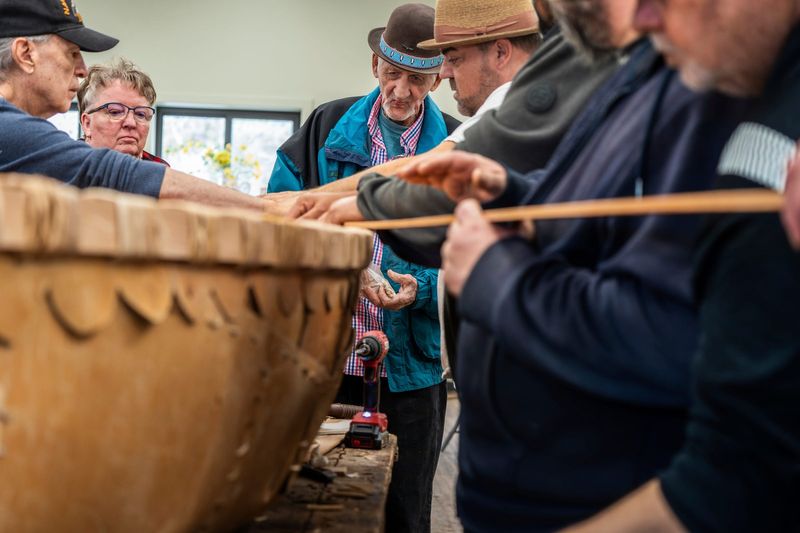
Several members of the Sault Ste. Marie Tribe of Chippewa Indians had come together inside a little building on a cold spring day to make a simple canoe, the same way their ancestors once did.

The local history museum had burned to the ground years ago after being struck by lightning, and the new building needed an authentic Native American birch bark canoe before it opened. So museum officials turned to a tribal elder revered not just for being one of the few who can make them, but also for all of his work teaching others how to make them, too.
“I love making canoes,” said 83-year-old Ron Paquin, in his raspy voice. This would be the 84th canoe he would build. “I’ll make them till I die. The key thing is, I taught quite a few people. Not all of them are going to start making canoes. But if they ever want to make one, they’ll have somebody that knows how to do it.”
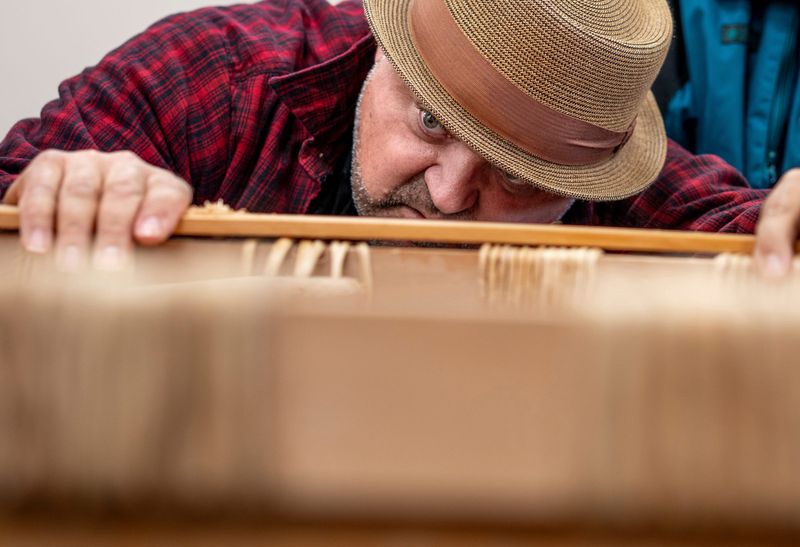
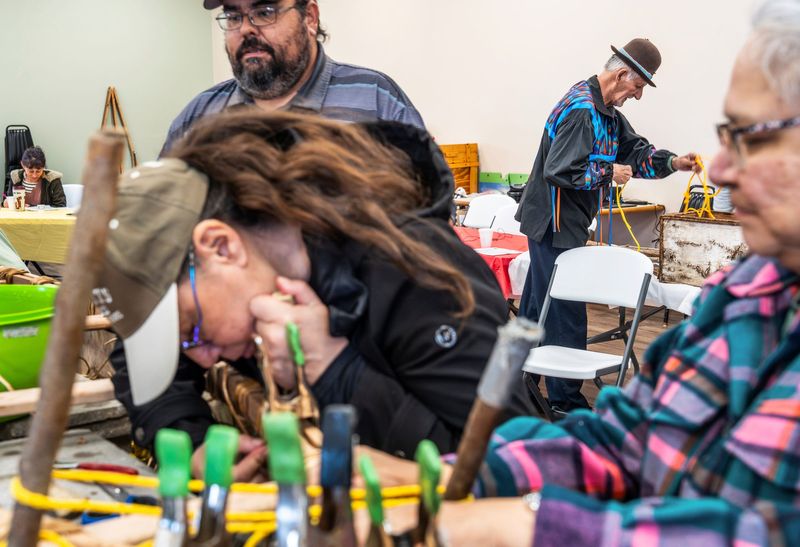
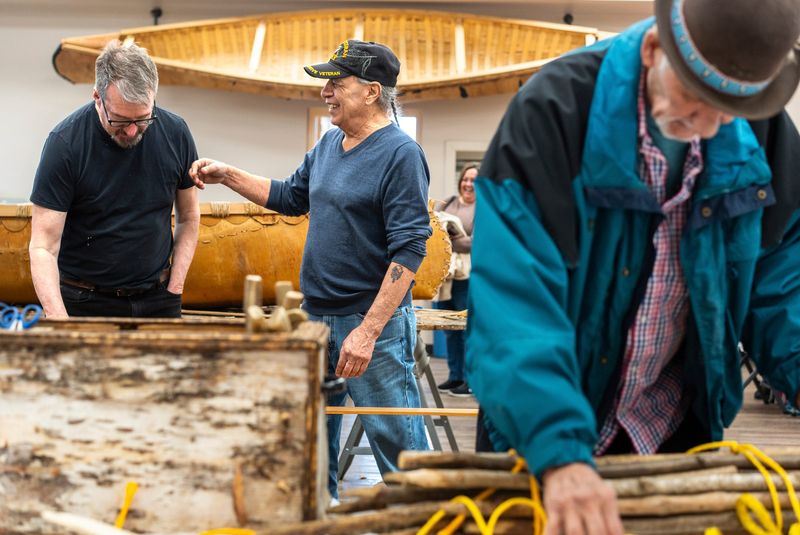
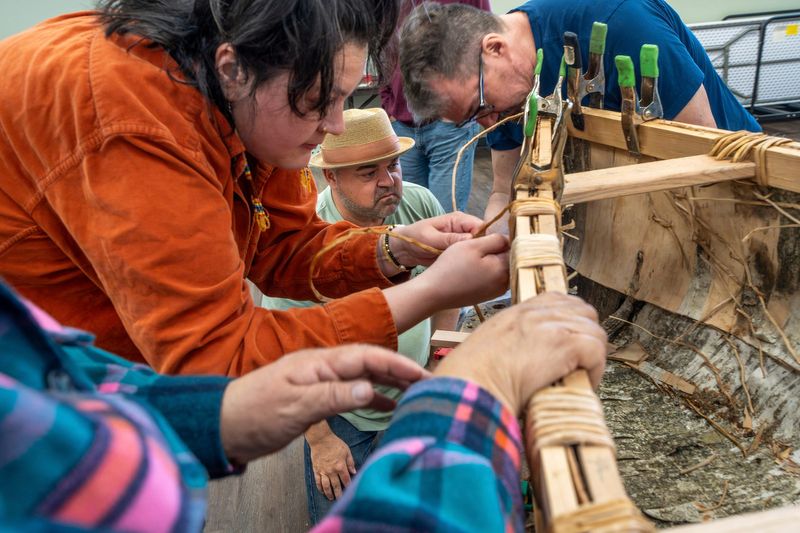
About a dozen men, apprentices of the elder, were helping build the canoe, which for centuries has been made using things found in nature — roots, bark, sap, wood. Several women sat nearby, making traditional crafts out of similar materials. Others stood on the sidelines, watching something they likely had only read about before this.
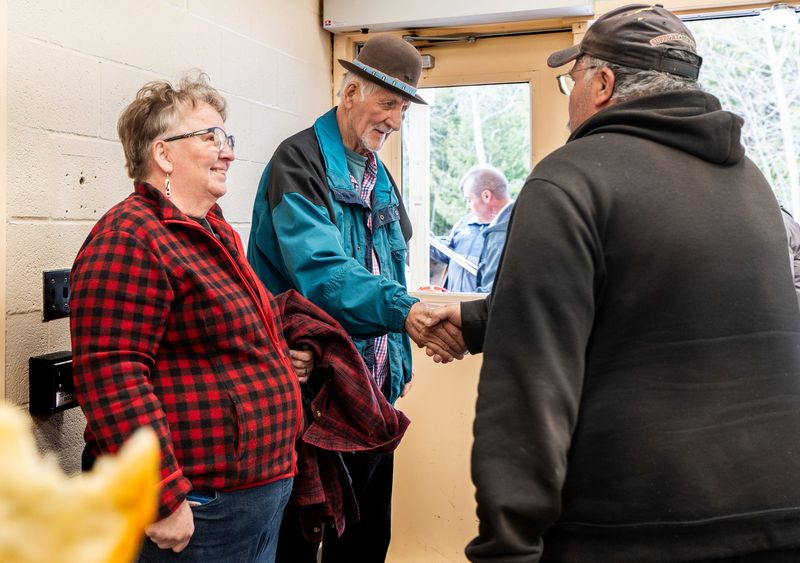
“It is one of the most wonderful experiences of my life,” said Sandra Clark, director of the Michigan History Center, which oversees the state’s museums and historic sites. She traveled from Lansing to watch. “How many people can do something like this as part of their job?”
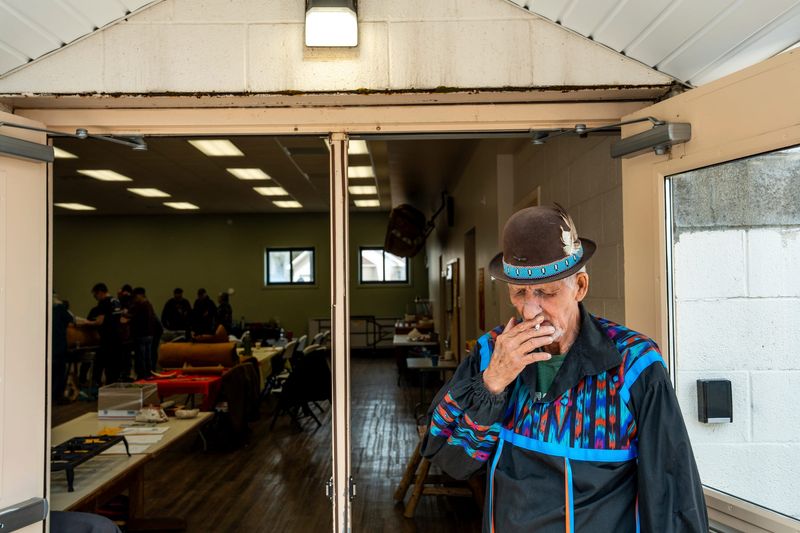
The setting was a typical, modern community center — overhead fluorescents, folding tables, coffeepot in the corner, brochures for the Alcoholics Anonymous meetings held here every week. But what they were doing that day was no different than it would’ve been centuries ago, when their forefathers gathered on this very land to make canoes the very same way.
“We have a teaching that when you do things that your ancestors did you have a spiritual connection to them, even the ones that you did not meet,” said Josh Homminga, 47, an apprentice of Paquin’s who’d come down from Bay Mills to help with the build. “Thousands of years ago our relatives were making these, and we’re still doing it. It’s a connection to those that are no longer here. And you need to pass it on, because if Ron didn’t share how to do this, then it would die with him.”
Yet for most of his life, few people would’ve imagined this elder as the keeper of any traditions. Because much of his life was spent just trying to stay out of prison.
***
Paquin didn’t know anything about being Native American when he was growing up. All he knew was trouble.
He was born into poverty in St. Ignace, neglected by his parents, beaten by an aunt and uncle who took him in, then sent back home again to his abusive mother and alcoholic father in a bedbug-infested shack with no electricity. Early on, a neighbor tried to sexually abuse him. Later, he said, a babysitter succeeded at it.
He’d escape it all by leaving home, wandering town, stealing to eat. His parents reacted by sending him away to one of the infamous American Indian boarding schools in the region. That was the first inkling he got of his cultural identity.
“I never thought much about it before I went there,” he said. “I had seen that in public school I was darker skinned than lots of the other kids, but I never paid no attention. Being Indian wasn’t important anyhow because I felt so bad about being poor and raggedy.”
Those boarding schools have since become notorious for the stories of abuse that have come out over the years, and his was no different, he said. Severe beatings for small transgressions were common, and among those faults was being Indian, a trait the schools were designed to erase.
Within three days of arriving, he ran away. After being dragged back, he left 12 more times until the fed-up school finally sent him home to more abuse from his family. He was growing to be an angry and violent boy.
One night, a drunken family fight escalated, and he tried to smash his dad’s head with a rock after the old man swung a fireplace poker at him. Off he was sent to reform school. Then back home. Then back to reform school. Then back to the aunt’s house afterward.
Nobody, it seemed to him, wanted him for long.
***
The men stood around a water barrel, staring at the murky brown water inside.
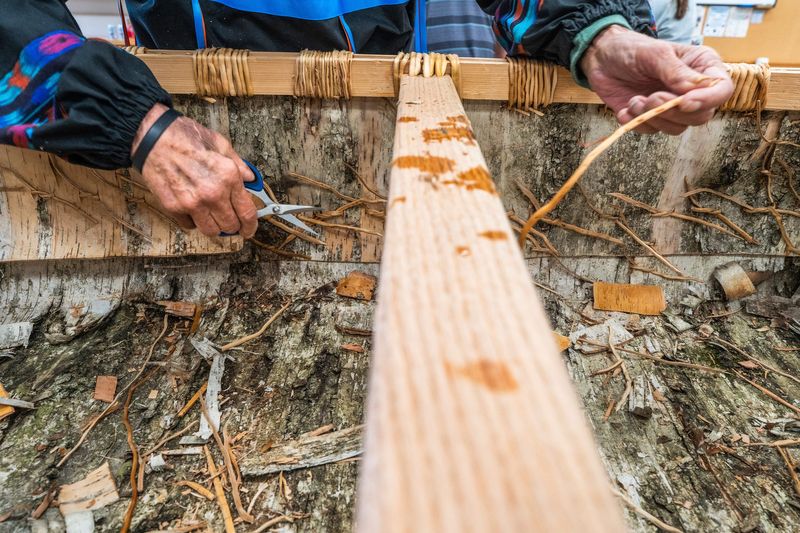
“I hope we got enough damn roots,” Paquin said, looking at the handful of spruce roots softening in the water. They were the thread that would bind everything on the still-unfinished canoe, and there weren’t many left.
There’s no store to buy American Indian canoe supplies if they run short. The bark is shaved and peeled from trees in late summer to make the hull. The birch ribs take time to find, carve, soften and fashion into shape. The bear fat and pine pitch traditionally used as sealant on the seams isn’t always on hand. And the spruce roots that hold all these things together, which must be hand dug from the forest floor, are the hardest to get of all.
If anyone could scavenge it all, though, it would be Paquin. When he was a kid, he and his brother would flee home and stay for long stretches in the St. Ignace woods, living in tents, stealing food and clothes from nearby cabins, trapping animals for meat and fishing the lakes for their dinner. Time and again in life, he returned to the woods.
By then, he drank. He’d get drunk on the weekends and go to the local dance hall just to start fistfights, hundreds of them by his own count. He’d grown too old for reform school, so after one particularly vicious bar fight he was arrested and sent to a mental institution for evaluation, followed by prison for several years. He got out, hurt someone again, and wound up back behind bars for several years.
The other inmates always talked about how they wouldn’t return once they were released, and yet they’d be back, time and time again. Paquin was close to becoming one of them. “I met lots of guys later on in the penitentiary that was in reform school with me,” he said.
He was 25 when he was released from his second stint behind bars. After all those wasted years he had no education, few skills, a long rap shee and an inclination to drink and get into trouble. His future looked dim.
But rather than become a stereotype, he willed himself to quit drinking, to stay out of trouble, to stop letting every perceived insult turn into a vicious brawl.
“I knew this wasn’t a way I wanted to live,” he said. “I went to a parole board the last time, I said, ‘You guys aren’t never gonna see me again.’”
He met and married a woman named Carole, whom he credits above all with motivating him to behave back then. Together they had a son. He also went around town on a sober apology tour, making atonement to everyone he’d wronged in some way: his extended family, his friends, old enemies, victims of his anger. Few believed him.
***
“We can start doing the planking whenever you’re ready, Ron,” Avery said to Paquin. They stood by the husk of the canoe, now taking shape after the birch bark had been stitched together.
“In about two hours, it’s gonna look a lot different,” Paquin told him enthusiastically.
“When we start putting those ribs in there, and the ribs start pushing out on everything, it really makes it start coming to life,” Avery replied.
For centuries, being on the water was second nature to the tribes of northern Michigan. The rivers were their highways, and their canoes were their vehicles.
“It’s one of the most amazing technologies that Native American people had,” Avery said. “The canoe was such an amazing structure that when settlers came over and they saw that, they quit using their boats and started using canoes. If you see any canoe now, it’s based off our canoe.”
Fishing was long the fallback work for many Native Americans in the region, something they’d done for centuries. Paquin was no different. He got his first job on a fishing boat at 9 years old, cleaning smelt for 4 cents a pound and scaling herring for a penny a pound.
By age 12, he was selling smoked fish to tourists waiting for the Mackinac Island ferry in the summer. And he’d spent years — between fights and incarcerations — working long hours for low pay on other people’s boats.
Even during his wildest times, he’d always been a hard worker.
“I like to work,” he later wrote in his memoirs. “I think it’s good for people to work and sweat. I can’t stand people who just live off of other people’s labor, and I cannot tolerate anybody that’s lazy.” No matter what happened in life, he always came back to fishing. Now that he was out of prison, he quickly found work on another fish tug.
It would be the first time his heritage came to mean something to him.
***
By the 1960s, Michigan’s trout and walleye stocks were nearly depleted by commercial overfishing. In response, the state drastically restricted commercial fishing licenses, banned the use of large-mesh gill nets that would snag and kill all sorts of fish no matter the kind actually being targeted, and prohibited the commercial fishing of perch, walleye and lake trout.
The tribes, however, believed that the real goal was to conserve the hunting and fishing for tourists with deep pockets. The effort to increase sport tourism over commercial fishing that began in the 1960s was no secret. Salmon were introduced into the Great Lakes to control invasive alewives, but proved wildly popular with vacationing anglers.
Suddenly, several waterways in northern Michigan that Native Americans had relied on for sustenance were designated for sport fishing only. On top of all that, the tribes had relied on gill nets for centuries, the one method specifically banned. It seemed like the state’s policy was aimed directly at them.
“The state just wanted rich white people to catch them fish, not poor Indians. And that’s the truth,” Paquin later wrote in his memoirs. “Conservation had nothing to do with it. The lake trout is all planted. How can you have conservation of planted fish?”
Then, something happened.
Back in 1836, his ancestors had signed the Treaty of Washington, in which the Chippewa and Ottawa tribes of the eastern Upper Peninsula and northern Lower Peninsula handed about 14 million acres of land to the federal government — more than a third of what’s now Michigan. In exchange, the tribes were granted permission to keep hunting the land and fishing the waters. After many years passed, few remembered the agreement.
But in the early 1970s, copies of that treaty resurfaced and began circulating among the tribes, and a movement arose in the region to assert tribal fishing rights based on that old document.
The tribes said they believed these rights were still valid, that they did not need to adhere to state hunting and fishing laws and regulations. Plus, they said, their little nets and small fishing boats had a fraction of the impact on fishing stocks that the big commercial vessels had inflicted. And they started casting their nets wherever they wanted in protest.
“Here this treaty was signed in 1836, and we just found out about it in 1972,” Paquin said in his writings. “I’d say that’s sneaky, and it’s no accident. The government has no right to make this a goddamn sportsman’s paradise. Talk about greed. The sportsman has got about 10,000 lakes in Michigan. They got 36,000 miles of creeks, rivers and streams to fish. Plus 36,000 square miles in the Great Lakes, and they want them all. They’re so greedy that they don’t want to share nothing with us at all.”
For the tribes, it was a much different climate back then.
“My grandfather, my mother told me quite a few times, that he would not teach her the language,” said Ruben Blackcloud, 73, who had come to St. Ignace from Saginaw to learn the birch bark canoe tradition from Paquin. “He would not share any of the ceremonies because he was brought up in a time where it was not good to be Indian. And that’s where we lost a lot of our language, a lot of our ceremonies. And we were put in schools where they forced religion on you, and their food, and their culture. Like the old saying goes, ‘Kill the Indian, Save the Man.’ That was all real.”
The fishing controversies only made things worse.
Paquin said people would steal or destroy their nets during the middle of the night, or fire warning shots at them in broad daylight as they fished, or gang up on them on the water in boats to scare them off. Police would pull them over near fishing sites to harass them. Local prosecutors would relentlessly pursue charges against tribal fishermen caught in the act. State politicians publicly accused them of being anti-conservationist. A sport fishing group called the Stop Gill Netting Association pledged to “put gillnetters on the endangered species list.” A bumper sticker making the rounds in the region at the time said: “Spear an Indian, Save a Walleye.”
“Indians got a raw deal around here back then,” Paquin said. “It was hid pretty good, so they didn’t know how bad off they was. In the days what I’m talking about now, no one admitted being Indian. You was looking for trouble if you did.”
***
The long cedar beam that caps the sides of the canoe broke in two when they pulled it out of the water barrel and bent it into place. So did the only spare piece they had. The lumber stores were closed for the weekend. And the nearest replacement piece was miles away in Saginaw.
But Paquin didn’t want to quit.
“Sometimes he gets excited and doesn’t want to stop,” said Adam Avery, 53, a longtime apprentice, who would head home to Saginaw to send the spare cedar cap back north. “He’s like a little kid sometimes when we get him going. Like, he gets excited when you get him out in the woods. You know, he just wants to go. And he’s kind of the same way when you get him building a canoe.”
Before the fight over tribal fishing rights, Paquin hadn’t thought much about being Chippewa. Thanks to that battle, he had no choice.
“I never knew nothing about my heritage until this got going. Never learned no history, no treaties,” he said. “I got Indian friends that are Indian full bloods, and they still don’t want to admit they’re Indian because of all that, you know?”
He got a copy of the 1836 treaty and slogged through it with his wife’s help so he’d know what he was talking about at fishing rights meetings. For a guy who barely learned how to read, it was a chore. Yet he became such a knowledgeable advocate that at one meeting, when it came time to pick a chairman of that group, they chose Paquin.
At the time, tribal fishermen in the region would leave their nets in the water, and after they left state game wardens would yank them out and seize them, Paquin remembers. More than once, he said, he hopped in a boat and chased the DNR to take back his nets.
Sometimes the wardens would grudgingly return the nets, but would keep the fish he and his fellow Native Americans had caught.
The back and forth went on for years as the dispute wound its complicated way through both state and federal courts. In 1979, a federal judge set the tone for future cases by ruling that the 1836 treaty still applied, and that the state could not govern the tribes’ fishing rights. Consent decrees between the tribes, the state and the federal government in 1985, 2000 and 2023 upheld those rights.
“I got a lot to do with the Indian rights and the fishing,” Paquin said. “I kept it going. My group that I belong to told me, ‘Don’t quit, just keep going,’ you know? And I did, ’cause of my living, you know?”
But the battles had taken their toll.
***
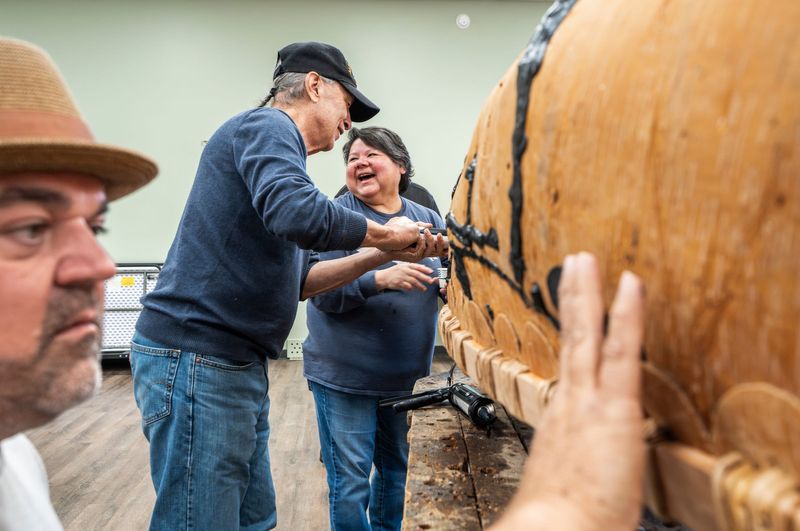
Since they had to wait for the wood cap to be delivered, they turned to sealing the gaps in the bark of the canoe’s hull. For centuries, the Chippewa used bear fat and cedar sap mixed with charcoal ash as a sealant, until someone figured out that roof tar in a caulking tube from the hardware store worked a lot better and lasted longer.
Sometimes, a better way comes along.
For many Native Americans of northern Michigan, fishing was one of the few ways they could make a living. And the ever-changing, unevenly enforced restrictions proved devastating.
“I don’t believe them people ever considered the Indian families what was being fed and clothed from fishing money,” Paquin wrote in his memoirs.
He struggled like everyone else. As fishing work dried up, so did his income. His utilities were shut off. His family lost their home. The IRS hounded him for back taxes. He needed to find new work fast.
During the 1950s and ’60s, the owners of the souvenir shops in town would hire local Native Americans to add an air of authenticity to their trinkets. They’d situate them in shacks behind the storefronts, where they’d sit and fashion souvenirs as tourists gawked at them.
Paquin and his wife took one of those jobs. They’d stylize little wooden totem poles by painting neck stripes, eyes, a beak and some Chippewa designs along the sides such as rain clouds, arrows and teepees. He began making his own crafts at home to sell, too, including hand-woven birch bark baskets, a traditional skill he’d taught himself.
Tourists were eager to come north and buy authentic Native American crafts. And the couple’s creations sold nearly as fast as they could make them.
During the 1970s, officials in St. Ignace sought to upgrade the local museum dedicated to the history of the local Chippewa tribe and make it a tourist attraction. Paquin was becoming known around town for his traditional craftsmanship, and museum officials asked him to create an exhibit for the museum.
Nobody had ever taught him any traditions. His father used to deny even being Indigenous, though Paquin said he remembers going to town with him as a child and hearing him speak French and Chippewa to people.
So Paquin got some books on traditional Native American handicraft and studied them. And within two weeks, he’d made such a convincing display of Indian life for the exhibit that he was commissioned to make a full-size birch bark canoe, the ultimate emblem of Native ingenuity.
Paquin knew nothing about canoes. It took him all summer to gather the materials from the woods and build it. It took just as long to study other people’s work and trace back the technique. And when he was finished with it, it turned out he’d put the cedar in backwards.
Over time he learned by trial and error, until he perfected the ancestors’ technique. “I had to teach myself, ‘cause nobody was around who knew how to do it.”
Museums began contacting him. Private collectors. Art galleries. All of them wanted an authentic birch bark canoe. The more he made, the more he was regarded as the foremost expert in making them.
And now Ron Paquin — the former drunken brawler, the angry convict, the troublemaker — had transformed himself into a revered expert and a respected elder. It was something that would’ve been unthinkable for most of his life.
“I never pictured myself doing anything, you know?” he said. “But you gotta work with yourself a lot, you know? I’ve done that, and I’m damn proud of it.”
In the years since then, he’s received numerous awards and accolades, including nine Master Artist Grants from Michigan State University and an ArtServe Michigan grant to show others how to make canoe. The Ziibiwing Cultural Center of the Saginaw Chippewa Indian Tribe commissioned him to create more than 70 items for its collection. He draws dozens of apprentices to the Upper Peninsula each year, eager to learn from him.
Sometimes he gives demonstrations at schools to local students. And sometimes, among them, is a troubled kid who might just find redemption through embracing their heritage — just like Paquin once did.
“A lot of people talk about blood memories and things being passed down genetically, and some of these kids didn’t know they needed it or wanted it,” Avery said. “But the second they start working with it, you can see it in them, and they get excited. They get happy. You know, the teachers will be like, ‘This kid, I would have never thought he would have taken to this, you know, just because of his behaviors. But he gets in there and he’s like the best kid.’ And it’s just that connection.”
***
As he sat in his living room one night years ago, Paquin picked up a tape recorder and began telling stories from his life: Abuse. Fights. Jail stories. Women. Harrowing conditions on fishing boats where he’d watched men die. The death of his nephew, who fell through the ice and drowned right in front of him. And the heartbreak following the sudden death of his wife Carole in her sleep, before she got to see how he turned his life around.
A professor who was visiting the Upper Peninsula to chronicle the fight over tribal fishing rights met Paquin at one of the meetings, heard the recordings, found them astonishing, and transcribed and assembled them into a starkly honest autobiographical book called “Not First in Nobody’s Heart,” in which Paquin recounted all the bad things he ever did in confessionary detail, followed by all the work he did to change his life. It only increased his legend in the region.
Not long after, Paquin got a job as an interpreter at the Museum of Ojibwa Culture in St. Ignace, where he’d spend hours explaining the exhibits to visitors, and where he fell in love with the woman who was the director.
They became a couple and made plans to marry. She broke the news to her family by sending her brother a copy of Paquin’s autobiography, the one with the stories about drunken fights and prison stints. Her brother immediately jumped on a plane to Michigan to talk sense into her.
“What are you thinking? He could go back to prison!” he told her.
“You’ve got to give him a chance,” she told him.
“I don’t know why I did that,” the 73-year-old Molly Paquin now says with a laugh. “I was impressed by him, but you had to know him, and see how he is now. He talks all the time about how art and canoe making is his therapy, and his keeping his hands busy keeps his mind straight. That’s one of his mantras.”
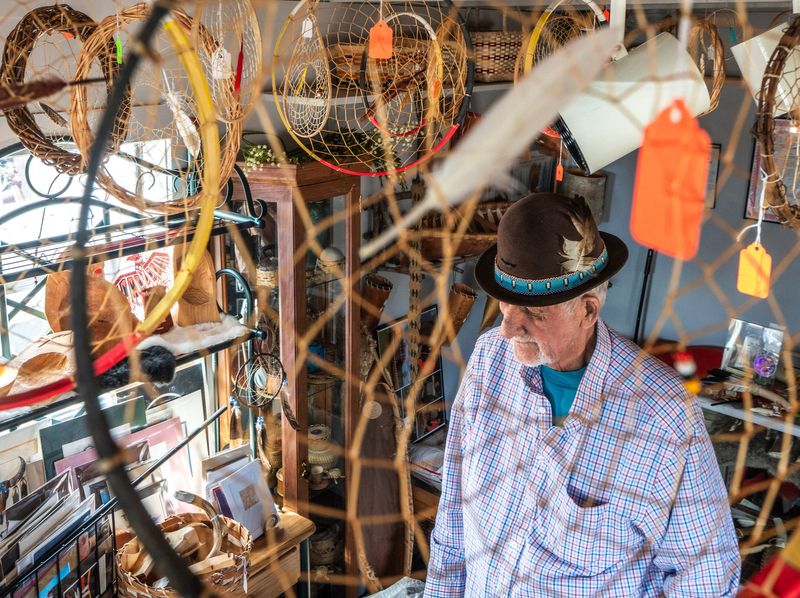
Almost three decades later, they live in St. Ignace in a little house of fieldstone on the main drag, with a small, wooden cabin next door that serves as the storefront for his creations. From the road it looks like an ordinary shed unless his wife puts on the lawn a portable sign that announces it as “Ron’s Birch Bark Studio,” which still gives no hint that here lives a tribal elder quietly saving ancient traditions, and no indication that those traditions in turn saved him.
“I think you should be proud of what you are,” he said as he sat in his workshop at the back of the house, with a view of the tribe’s ancestral waterways outside, partly hidden by the tourist hotels that now surround him. “I think any nationality you got in you, you should be proud, ‘cause it’s gonna be with you till you die, you know? You can’t change it. Be proud of it.”
John Carlisle writes about Michigan. His stories can be found at freep.com/carlisle. Contact him: jcarlisle@freepress.com. Follow him on Twitter @_johncarlisle, Facebook at johncarlisle.freep or on Instagram at johncarlislefreep.
This article originally appeared on Detroit Free Press: Sault Tribe elder works to keep ancestral tradition from dying
Reporting by John Carlisle, Detroit Free Press / Detroit Free Press
USA TODAY Network via Reuters Connect
By John Carlisle, Detroit Free Press | USA TODAY Network