

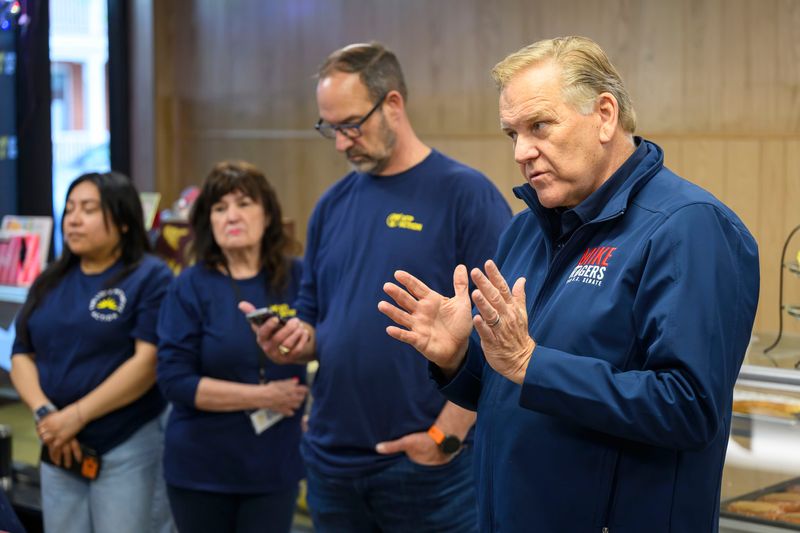
Republican Mike Rogers, who is making his second run for U.S. Senate, says his campaign is “night and day” compared to where he stood two years ago at this point, having avoided a primary challenge this time around and improving his fundraising over 2024.
The former seven-term congressman from White Lake Township is attempting to be the first Republican to capture a Senate seat in Michigan since 1994.

That was the year that former state Republican Party Chairman Spence Abraham defeated former Democratic U.S. Rep. Bob Carr.
That was also the last year that Michigan witnessed a protracted, competitive Democratic Senate primary, as is currently underway between U.S. Rep. Haley Stevens of Birmingham, former public health official Abdul El-Sayed of Ann Arbor and state Sen. Mallory McMorrow of Royal Oak.
The Detroit News spoke to Rogers last week about the stalled opening of the Gordie Howe bridge, the Trump administration’s deal to end the war with Iran, the Department of Justice’s weaponization fund and whether he supports federal housing regulator Bill Pulte as acting director of national intelligence.
Rogers spoke to the News on the same day that his campaign sent a cease and desist order to El-Sayed for repeatedly calling Rogers a “pharma lobbyist” who took a $14 million payout from the pharmaceutical industry.
Editor’s note: This conversation was edited for length and clarity.
Question: Is this the first cease and desist that you’ve sent from your campaign this year?
Answer: Maybe ever in my political career.
This is exactly the kind of thing that allows people to lose faith in politics, because it’s just so unfounded in any speck of truth and, you know, it’s been consistent — the distortion and lies on this thing. Like I’ve never seen before.
You’re either going to have the courage and character to represent you and what you stand for, or we’re going to take you out when you lie to us — lie to Michiganders, first and foremost, and about us, secondly.
We felt it was important enough — certainly, Kristy and I did, and our team agreed — that we have to do something.
Q: Will you file a lawsuit if they don’t respond by the deadline in your letter?
A: If he continues to do it, we will pursue all legal avenues we have. We feel very confident. I’m not a lawyer, but I read the law. We’ve had our lawyers review it. He’ll find himself on the losing end of a lawsuit if he keeps this up.
Q: You put out a video last week saying that Michigan has lost some 40,000 jobs in the last eight years. How specifically would you bring manufacturing jobs back to the state?
A: Just going around the state, you learn that on the education piece, we’re down to 45th in state rankings. That contributes to manufacturing loss, by the way.
We have to be competitive. With two people of the same party in office for 32 years, we have walked away from keeping defense industrial base work in the state. We’ve lost submarine component manufacturing on the west side. At one time, Michigan actually built under 700-foot ships. That’s gone.
We lost the air base in the north, lost the sub-tracking station. We used to build the main battle tank.
Well, guess what? All that still happens. It just doesn’t happen in Michigan. And what I plan to do is make us competitive. But if we don’t get our energy rates competitive, we will not attract new manufacturing. So we’re going to very aggressively open up American energy production, making sure we have sustainable, cheap electricity and energy prices. That’s going to be critical for us.
We also have to fix the education system. That’s why I’ve called for putting shop back in every high school and engaging in building out the infrastructure for getting kids connected to skilled trades.
Q: You also said in your video that you can get the Gordie Howe International Bridge open. The bridge is done. Canada paid for it. The White House is blocking it. What would you do to make this happen?
A: You need to elect Mike Rogers to the Senate. I’ll get it open.
Out of the two senators we have there, nobody can go and have a conversation with the White House because all they do is poke him in the eye. He’s going to be there for two years. This is an opportunity to send somebody back that understands what’s at risk.
When Canada was trying to allow a huge number of Chinese cars to be brought into Canada, they took the tariffs from 100% down to 6%, and I think they’ve upped their quota to 70,000 on all 100% Chinese-made cars to be able to be brought in to Canada. And, as I’ve said, this is the biggest existential threat we have to the American automobile business is Chinese-made cars built here in the United States, or imported here to the United States.
It’s because they’re not being competitive. They are subsidized by the Chinese Communist Party. That will eliminate more jobs than we can handle. My argument was, let’s use the bridge opening as an opportunity to stop Canada from hurting American automobile workers.
Q: That would be the ask?A: Completely. And I would use that leverage. Because the bridge ― it’s not like commerce stopped, right? There’s nothing coming across it now.
I mean, it was not a great deal for us. We’ll never see any revenue from that thing, from what people around the bridge tell me, for a long time. One hundred years, someone told me.
Well, I don’t know if that’s true or not, but it’s breathtaking, that part. We’ll get through all that.
It’s what Canada is doing on autos, and the one that it hurts first is American content providers, so people who are building, putting nuts and bolts in things and widgets together.
Those Chinese cars are going to start competing against that content, so the content that we sell, both to Canada and America, is at risk.
My argument is, let’s not do this to ourselves because folks are in a hurry to get that bridge open. Let’s use this as an opportunity to push back on this Chinese car production issue that Canada has. I don’t know if they don’t understand it or do, but it’s also going to hurt the Canadians as much as it’s going to hurt us, and we ought to do something about it.
Q: Should the Canadians agree to continue allowing truck traffic through Windsor on Huron Street to access the Ambassador Bridge? I understand that they want to restrict trucks to the new Gordie Howe. Do you think that the Canadians should maybe make a concession on that front to get this bridge open?
A: Honestly, I don’t ― I’m not sure I know enough about it. That certainly wasn’t my concern. … I would have to look at it, honestly. I’m not sure what that would entail.Q: Well, I imagine that the owners of the Ambassador are maybe concerned that their truck traffic business would suffer if all the trucks were forced to go to the Gordie Howe.
A: Was that part of the original agreement?Q: That is not my understanding. But trucks don’t have another option right now, right? But when there’s a second option, my understanding is that’s something that, locally, Windsor could move to do.
A: Well, they probably ought to at least protect the ability for trucks to have a choice. The whole benefit of a second bridge is choice. I wouldn’t take away the choice. It doesn’t seem right to me.
Q: I wondered if there’s pressure being put on Canada to allow that choice to continue. … I haven’t talked to (Ambassador Bridge owner) Matthew Moroun, but I’m guessing that’s something he’s asking about.
A: Neither have I. … To me, this is about Chinese cars. This is not about his bridge or their bridge. I don’t care.
Q: Well, President Trump has suggested he’s OK with Chinese cars coming into the U.S.
A: That’s where he and I disagree. That is the one place that having somebody that can actually have a constructive conversation with him I think is also going to be important for the future of building cars in Michigan.
Q: Trump’s also said that he doesn’t care about inflation right now. I’m betting, though, that you are hearing about inflation from voters on the campaign trail?
A: I think that was taken out of context. I think he was trying to make comparisons to what inflation was. I don’t think that’s what he meant.
Here’s what I know: Everything that we’re doing ― and if they get this Iran deal done, which it looks like they are ― I’ve already seen gas prices coming down. Listen, that’s what I want, too: A non-nuclear Iran and getting our prices back under control, because it’s hard. I mean, you know, those inflated costs aren’t helping anybody, but we see a good trajectory about where it’s going.
We think that fertilizer prices will come down, and that’s good for agriculture. … We’re going to do everything we can to bring prices down across the board, and what’s interesting about this is it allows you to see what kind of permanent, high-price efforts that the Democrats put into their bills when they were in charge. We have to dismantle some of that, too.
The Democrats voted against the biggest tax decrease in the history of the country. They voted against removing taxes on your overtime. Those are real things that people are benefiting from that the Democrats would rather say, ‘Hey, we want you know we’re going to have more tax to your overtime so we can pay illegals’ healthcare bills.’
Q: That’s temporary for no taxes on OT. You think that should be permanent?
A: Absolutely, and I’ll make sure it’s permanent.
Q: You were a big critic of President Obama’s Iran deal. There’s been criticism from Republicans on the Hill after the details came out about Trump’s memorandum of understanding with Iran. Do you think what it lays out are steps in the right direction or the wrong direction? What is your take?
A: Two huge differences. One, Obama gave American cash to them. There was no degrading of their military capability, their naval capability, their intelligence capability, their missile program, their enrichment program. As a matter of fact, it guaranteed the enrichment of uranium. It is my understanding today that none of that is American money (under the Trump MOU).
Q: Are you certain there’s no American money there?
A: This is all seized assets from the Iranians, No. 1. No. 2, they’ve degraded their navy capability, their standing military capability, more importantly, the Islamic Revolutionary Guard Corps’ capability. They’re on fourth round of leadership.
I am withholding some judgment to see what comes out of the negotiations, but there’s not even a comparison (to Obama’s deal), and I was there during that time. We’ll see what comes out of it.
If we get an Iran that does not have nuclear capability and is no longer a threat in the way it was to its neighbors, that in and of itself is a major accomplishment.
Q: So you’re reserving some judgment, here. You’re not saying that you 100% support the MOU at this point.
A: Yeah, and I have a feeling a lot of people who are very opinionated don’t know either. I would just like to know what I’m looking at to make a final judgment, but I will say we are better off today than we were when it started. I passionately believe that.
Q: Do you think that the Congress should have to vote on whatever it comes out of this deal?
A: I think it would be helpful to the country to have it go before the Senate.
Q: Another hot topic since the last time I talked to you has been this DOJ weaponization fund. Did you have concern about that at all, with the payouts to the J6ers and others who felt the Biden administration wronged them?
A: It’s dead.
Q: If it were to come back? Because the president is still talking about it like it’s not dead.
A: They have said it’s dead, and I believe it’s dead.
Q: OK.
A: That’s probably a good place for it.
Q: You were chair of the House Intelligence committee. What are the stakes behind the expiration of the FISA domestic surveillance law?
A: I think the president has to weigh in and get the kind of FISA bill that he supports, and I would be supportive of that. It’s always when people are playing games with something that there is huge bipartisan support. They just need to understand what’s at stake.
I haven’t followed it as closely as I normally would, but I’m hoping they get it worked out and get it worked out soon, and I think they’ll probably get to a place that it works for national security and making sure that Americans’ rights are protected.
Q: Would you support Bill Pulte for DNI if you were in the Senate?
A: No idea. I mean, I don’t know much about him. Because, I’ll be honest with you, we spend most of our time worried about our education system in Michigan, the fact that our median wages are going down, the fact that we’ve lost so many manufacturing jobs. By the way, everyone that leaves is a middle-class job that goes out of this state, but it’s probably not coming back. Unless you get a guy like me who’s trying to figure out how to get it back. I spend most of my time on those issues.
Q: If the DNI nominee were somebody whose background was in the housing industry with no national security or intelligence background, would you like to see that person in charge at the Office of the Director of National Intelligence?
A: Did I tell you about my housing bill that I proposed? We’re very excited about it, and I talk about it out the doors all the time. Here’s the good news: I did talk to Pulte when he was over at Housing about the kinds of things that we could do, and I pitched my housing package that I will get done when I get here.
Q: That’s your proposal to allow people to use 529 savings accounts for mortgage down payments?
A: And the other three parts of it. We’ve had great conversations in Detroit about the rebuilding on these lots. They’re going to pass a housing bill here that I think will help a little bit with that. What I’ve proposed when I get here is going to ramp that up, and you can’t fix Detroit if we don’t have good housing stock. That’ll be a big part of making sure that Detroit continues its renaissance.
Q: How are you feeling about the campaign right now, compared to this time two years ago?
A: That’s really night and day for us. People didn’t realize we got seriously outspent financially last time. We’ve made a lot of corrections on that. We actually were in a tough primary at this point last go round.
Q: Right, Sandy Pensler.
A: I think they spent $5 or 6 million bucks, and it’s really hard when you have that to recover after that August 4 primary.
Well, guess what? We announced last April, we’ve been working, bringing unity to the party, reaching out to independents. I actually have solutions on these big things. It’s not rhetoric, it’s not nonsense on education, on skilled trades, on attracting defense industrial base manufacturing back to the state. And so that has been going exceptionally well, and the Democrats on August 5 are going to have to figure out how they put it all together again.
… This is a change election. This isn’t a national election. We’ve hit well over 350,000 doors already, which has never been done in Michigan. And by the way, this grows every week, and by the end of the next couple of weeks, we should be pushing 50,000 doors a week.
When we go, when we’re talking to people, they don’t trust Democrats. I know they’re not happy with maybe the president, but they don’t trust Democrats because they know when they’re in charge their costs go up, and we’re going to make sure that we reduce costs over the long run and give opportunity.
My goal is, if your kids can’t look you in the eye when I’m done with my first term and say, ‘I choose to be here because I have a great opportunity and a great job opportunity and got a great education,’ then I will have failed.’ What people understand is they need somebody like me, a guy who actually worked on an assembly line, who gets what’s at stake, who’s been part of the Michigan fabric of building things.
They’re ready for that, and that’s what I think the Democrats are missing. So, let them fight it out about lofty things that don’t make a difference in people’s lives, other than making them more expensive. And we’re going to talk about opportunity for your kids and grandkids to stay in the state of Michigan and grow and prosper there.
mburke@detroitnews.com
This article originally appeared on The Detroit News: Q&A: Mike Rogers on the Iran deal, weaponization fund, bridge politics
Reporting by Melissa Nann Burke, The Detroit News / The Detroit News
USA TODAY Network via Reuters Connect
By Melissa Nann Burke, The Detroit News | USA TODAY Network
