A popular beach in the Upper Peninsula’s Keweenaw Peninsula will remain closed throughout the summer, as the U.S. Environmental Protection Agency undertakes a $12 million cleanup of toxic sediments accumulated over nearly a century from the region’s booming copper mining days.
The campground and marina at the Lake Linden Recreation Area in Houghton County will remain open but the beach on Torch Lake will be closed for 2026 to facilitate the removal of about 13,300 cubic yards of sediments contaminated with lead, zinc and polychlorinated biphenyls (PCBs).

After removing the contaminated sediment, workers will restore dredged areas with clean backfill material and sand, EPA officials said. Boaters are advised to stay clear of equipment in the water while the work is ongoing.
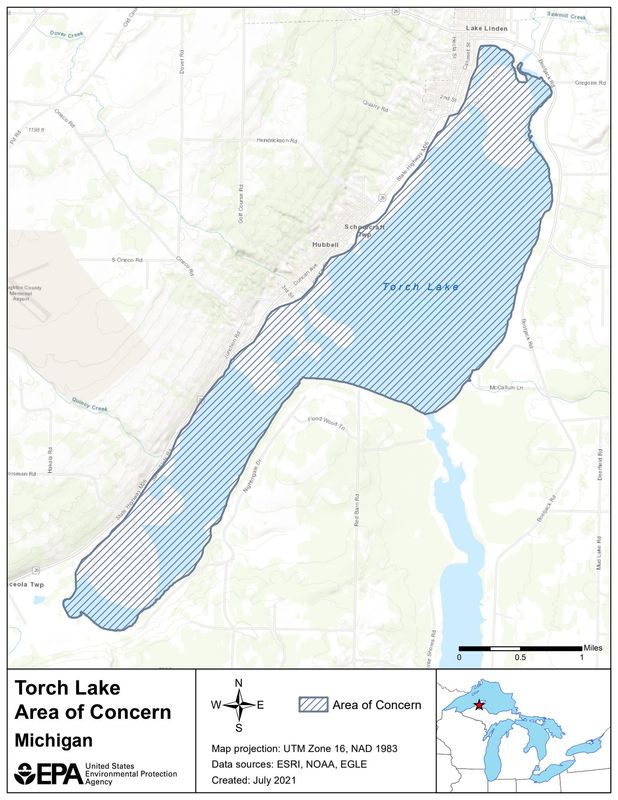
The cleanup is part of the EPA’s ongoing effort to address contamination in the Torch Lake Area of Concern, one of 23 areas in the United States with significant environmental degradation identified under the 1987 Great Lakes Water Quality Agreement. Copper mining in the region began during the 1940s and continued until 1968. It left 200 million tons of waste material known as stamp sands within the lakebed of Torch Lake.
The village of Lake Linden has provided clean sand cover for beach areas on Torch Lake, with informational signs and hand-washing stations for people to clean up after contact with the water, said Peter Baril, health officer and chief executive with the Western Upper Peninsula Health Department. Fencing was also installed to prevent people from accessing certain portions of the area where environmental exposures would be potentially more direct.
The EPA’s Emergency Response Branch has conducted several response actions locally over the years, including a 2007 emergency removal of soils and waste at the Lake Linden public beach area to address the elevated concentration of contaminants including arsenic, PCBs and heavy metals.
“It’s been something that the state and EPA have been looking at for a long time,” Baril said. “From a public health or environmental health standpoint, this is a positive thing, because we are getting rid of a lot of that material.”
The project is funded by the Great Lakes Restoration Initiative, congressionally approved environmental remediation funds, and Honeywell International Inc., participating through a Great Lakes Legacy Act cost-sharing agreement.
Identification of resource impairments and potential human health risks led the EPA to list Torch Lake on the National Priorities List, or the Superfund, in 1986. The Torch Lake Superfund Site was first identified due to contamination affecting Torch Lake and later included additional shoreline property, as well as additional water bodies and facilities in the area where stamp sands, tailings and slag were disposed of in mining operations going back to the 1800s.
There are many such contaminated former mining sites throughout the U.P. and the region, Baril said, but “the Lake Linden area is somewhat unique in that it is a recreation area.”
“We are happy to see the removal; happy to see the effort, the EPA work going into our small communities and getting some of this stuff taken care of,” Baril said.
Due to the complex nature of the legacy contamination from mining and very large, affected area spanning several townships, investigating environmental contamination, evaluating solutions and prioritizing remediation projects and their funding is an ongoing process. EPA and Honeywell will also assess cleanup options for a future project in another area of legacy contamination on Torch Lake, known as the Hubbell Processing Area, EPA officials said.
Contact Keith Matheny: kmatheny@freepress.com.
This article originally appeared on Detroit Free Press: Popular Keweenaw Peninsula beach closed for summer to remove legacy toxins
Reporting by Keith Matheny, Detroit Free Press / Detroit Free Press
USA TODAY Network via Reuters Connect
By Keith Matheny, Detroit Free Press | USA TODAY Network