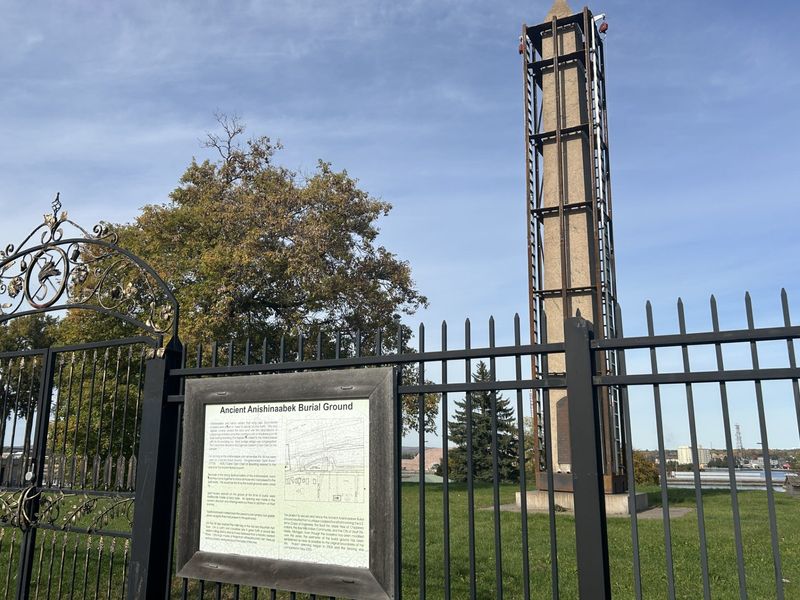
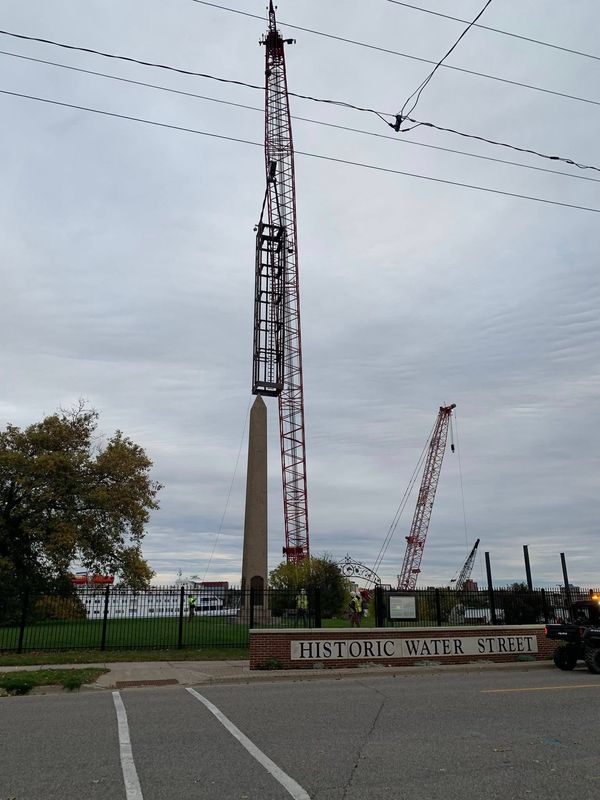
SAULT STE. MARIE — After years of fighting, local tribes have won the battle to remove a large stone obelisk from an ancient burial site.
The obelisk was installed in 1907 to mark the 50th anniversary of the Soo Locks. It was placed on burial grounds in what is today known as Brady Park without the consultation or permission of any local tribe. The obelisk was placed and is maintained by the U.S. Army Corps of Engineers, who operate the Soo Locks.

There has been a burial site at the location for several hundred years, although nobody knows exactly how long. Oral history and storytelling confirm that members of tribes who lived in the area before it was called Sault Ste. Marie had been buried there for generations.
This history was questioned by non-tribal members due to a lack of grave markers, but grave markers were not typically used by ancient Native Americans.
“We estimate that the burial site is several hundred years old and we know this due to local oral tradition,” said Sault Tribe Chairman Austin Lowes. “Culturally we buried people different than western societies, but there are 100% graves there.”
Two sisters from the Bay Mills Indian Community first launched a grassroots effort to have the obelisk removed in December 1998. Paula Carrick and Wanda Perron led the protest, and have continued to advocate for the obelisk’s removal for decades.
“My sister and I started the history department out here in Bay Mills,” said Carrick, a historian with the Bay Mills Ojibwe History Department. “My sister, Wanda, always knew there was a burial site out there, because we had a relative of our own buried there.”
Tribal historians eventually discovered proof of the site originally being a burial ground in maps published by the U.S. Corps of Engineers itself.
In a June 10 press release, the Corps of Engineers said they were exploring “options that minimize harm to both historic resources and Tribal cultural practices.”
“The Bay Mills Indian Community and Sault Ste. Marie Tribe of Michigan conducts cultural and religious practices at the burial site,” the release stated. “Those practices in the presence of an obelisk celebrating the semi-centennial of the construction of locks, which destroyed most of the burial site, continue to have an ongoing negative effect on their members. The Bay Mills Indian Community and Sault Ste. Marie Tribe of Michigan have requested that the Corps of Engineers remove the obelisk from the burial site to mitigate this effect.”
Following a period of public input, the Corps of Engineers upheld the decision to remove the obelisk.
“We feel good about this. We view the obelisk as a desecration,” said Lowes. “If a monument of a different culture was put up at your family cemetery where you buried your loved ones for hundreds of years, how would you feel?”
The obelisk has had a cage placed around it to make it easier to remove. The actual removal will be scheduled for early November.
“I just want to give attention to the people who worked so hard on this from both the Sault Tribe and the Bay Mills community,” said Lowes.
— Contact Brendan Wiesner: BWiesner@Sooeveningnews.com
This article originally appeared on The Sault News: Obelisk to be removed from ancient burial site in Sault Ste. Marie
Reporting by Brendan Wiesner, Sault Ste. Marie News / The Sault News
USA TODAY Network via Reuters Connect