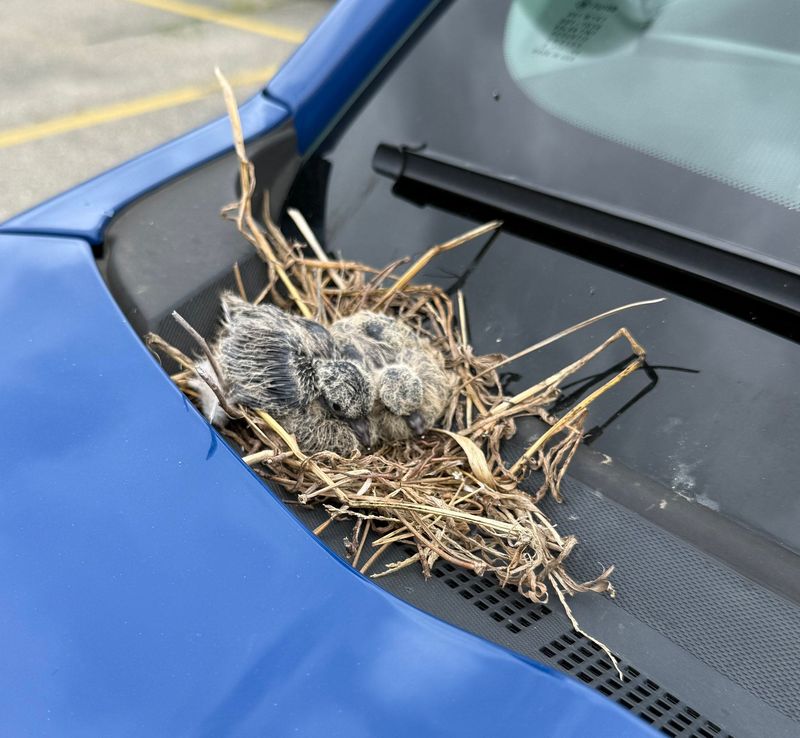
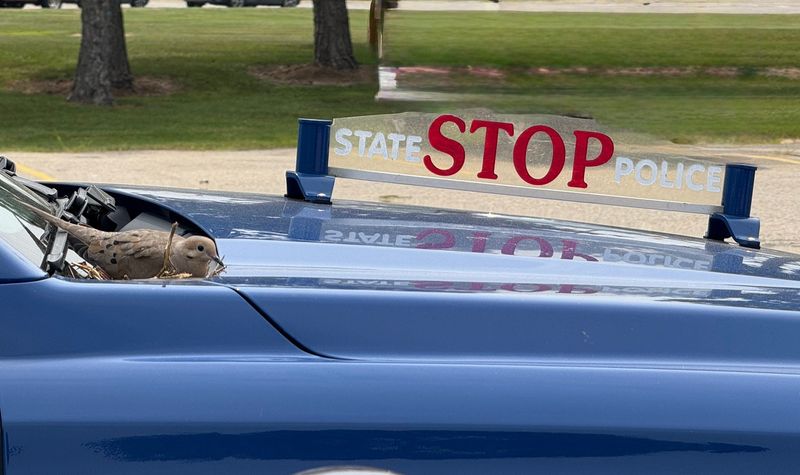
Michigan State Police First District said in an early August post on X that a mourning dove had built a nest on the hood of one of their patrol cruisers outside at their Lansing Post; now the bird has hatched a pair of eggs.
“We are proud to announce our Mourning Dove babies have arrived,” MSP’s First District said on X on Aug. 21, “The proud parents are taking turns keeping the babies warm and safe.”

The vehicle, parked at 7119 N. Canal Road, is not currently being used, which allowed the bird and her nest to be undisturbed.
“Never let it be said the MSP doesn’t care about nature,” the MSP First District on Aug. 4. “Over the weekend a mother bird built a nest on one of our patrol cars at the Lansing Post.” Luckily the patrol car was not being used today, allowing the mother bird and her nest to remain undisturbed.”
Mourning doves are known for building their nests fast and flimsy, according to Audubon.
“After a pair picks a site, the males will bring back twigs and stems for the females to weave into a loose pile — often so loose that you can see the eggs through the bottom. And they’re not very picky about location: While doves often seek out trees or shrubs, they’re just as likely to nest in flower pots, cacti, or air conditioners,” the Society said.
Mourning doves are found in the United States, southern Canada, Mexico, Bermuda, the Caribbean, and Central America, according to the U.S. Fish & Wildlife Service.
They are the most abundant game bird in North America, with an estimated U.S. population of 350 million and are mostly found in open areas with scattered trees, yards and forest clearings.
Are they morning doves or mourning doves?
The birds are “mourning”doves, so named because of their low, repetitive call.
When you hear a mourning dove’s familiar cooing, the song is almost always coming from a male looking for a mate, according to Audubon. Males will claim a favorite “cooing perch,” a prominent spot where they can catch the attention of females with their songs. They’ll even defend their favorite singing sites from other males who try to land there.
What to do if I find a bird’s nest near my home?
According to the U.S. Fish and Wildlife Service, most bird nests are protected under the Migratory Bird Treaty Act (MBTA).
This law says: “No person may take (kill), possess, import, export, transport, sell, purchase, barter, or offer for sale, any migratory bird, or the parts, nests, or eggs of such bird except as may be permitted under the terms of a valid permit…”
Under the Act, it is illegal to destroy a nest that has chick or eggs in it . It’s also illegal to keep a nest they take out of a tree or find on the ground unless they have a permit to do so.
Usually it is required that you wait for the nest to become inactive before destroying it.
Jalen Williams is a trending reporter at the Detroit Free Press. Contact him at jawilliams1@freepress.com.
This article originally appeared on Lansing State Journal: Mourning dove hatches chicks on State Police cruiser. Where the birds made their nest
Reporting by Jalen Williams, Detroit Free Press / Lansing State Journal
USA TODAY Network via Reuters Connect