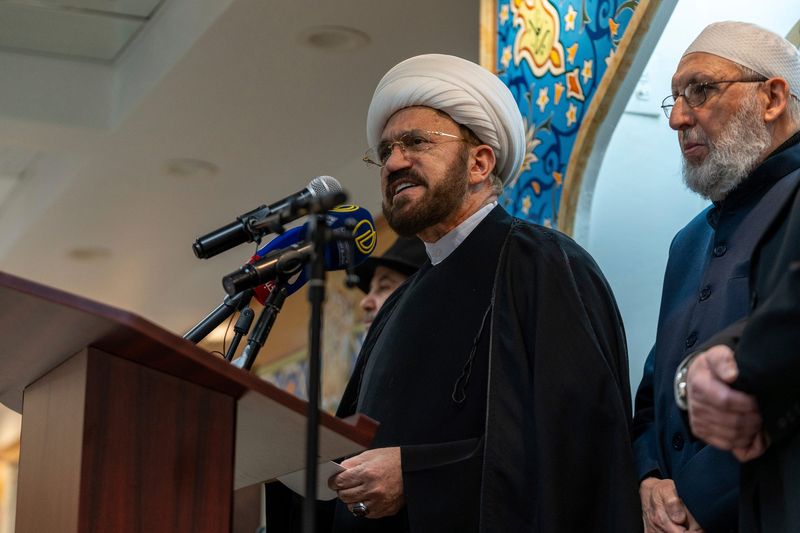
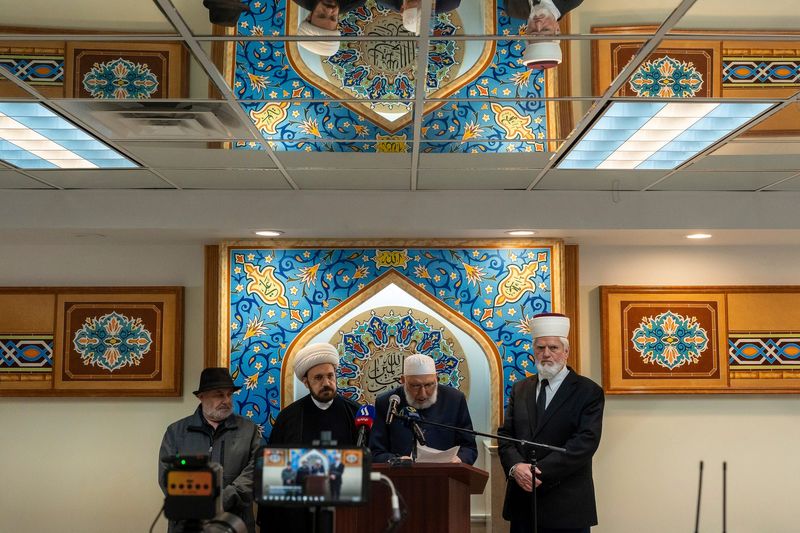
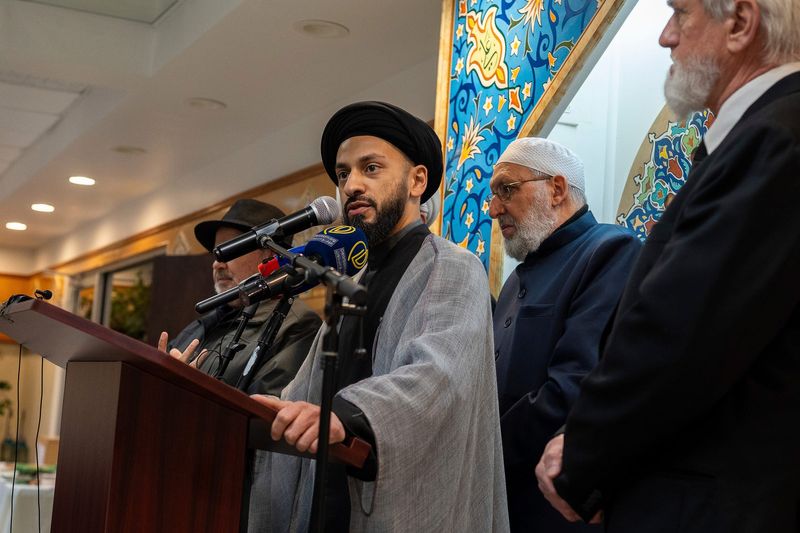
Muslim leaders in Michigan gathered in a Dearborn Heights mosque to call for peace and an end to the war against Iran as mourners gathered in religious centers for services remembering people killed in Iran and other parts of the Middle East.
“We call on (President Donald) Trump … to stop this war today,” Imam Mohammad Ali Elahi, leader of the Islamic House of Wisdom in Dearborn Heights, said from his mosque Tuesday, March 3, at a news conference of Islamic and Arab American leaders. “Put America first, not (Israeli Prime Minister) Netanyahu first. … This must come to an end today. It is hurting so many nations in the region. It is hurting the interest of our people. The price of oil is already up. Things are getting out of control. So much disruption, so much casualties.”

Elahi, a native of Iran who’s a prominent interfaith leader in Michigan, appealed to Trump to live up to his promises on the campaign trail in 2024 in Dearborn of being a president of peace.
“Donald Trump promised to end the wars,” Elahi said, but instead “he started the wars. … American lives have been lost, and a big amount of American tax dollars has been wasted.”
More than 800 people have died so far in the war that began Saturday with U.S. and Israeli strikes, including at least 175 of the victims being students and others at a girls’ elementary school, the New York Times reported.
“You (Trump) are the same guy who cared about the Iranian people, (saying) that you didn’t want even one of them to be executed, but now you go and bombed a school, 150 girls with their bags full of blood and under the rubbles of the destroyed building,” Elahi said.
Elahi’s plea was echoed by other Muslim leaders who spoke, which included a mix of denominations, and Imad Hamad, an Arab American advocate who leads the Dearborn-based American Human Rights Council.
The news conference started with Imam Mustapha Elturk, of the Islamic Organization of North America mosque in Warren, reading a statement by the Imams Council of Michigan, which is cochaired by Elturk and Elahi, condemning the attacks against Iran. Hamad said he has been flooded with calls from metro Detroiters with roots in the Middle East worried for loved ones in Arab nations such as Lebanon, where residents in the southern part of the country are being told by Israeli forces to evacuate their homes. Many who live in Wayne County have roots in southern Lebanon, which has seen renewed conflict after the United States struck Iran.
“They have immediate family members and relatives and loved ones that fled the south of Lebanon area, moving toward the capital of Beirut and beyond, but there’s no safe place anymore for them,” Hamad, who has relatives in Lebanon, told the Free Press after the news conference. “Thousands of people are being stranded on the streets for the past two days. People literally slept on the streets.”
Some from Michigan are among the Americans who feel they are stranded in Lebanon and other Arab nations, finding it difficult to get back as the U.S. State Department tells Americans who are in several Arab countries to leave.
The fear about the future comes at a time of despair for some Shia Muslims in metro Detroit over the targeted killing of Ayatollah Ali Khamenei, who was killed along with family members Saturday, Feb. 28, in a strike led by the United States and Israel. Khamenei was the top political leader of Iran and also a religious leader known as a marja, a Shia cleric whose views and rulings were followed by many Shias in Michigan.
The largest Middle Eastern group in Dearborn and Dearborn Heights are Lebanese Shias. At some Shia centers and mosques in Wayne County, Khamenei and others killed in Iran were remembered as martyrs at services on Saturday and Sunday. Khamenei is similar to the pope in terms of his authority among the faithful, but there are other marjas some Shias in metro Detroit follow, such as Ayatollah Ali Sistani of Iraq.
The war is also being felt in metro Detroit’s south Asian communities, as the death toll in Pakistan rose to 25 after protesters demonstrated outside the U.S. embassy and consular offices. Some of the deaths came after U.S. Marines fired at demonstrators in Pakistan, though it’s unclear whether their shots killed anyone, Reuters reported.
Elahi, who was born in Iran, said Sunday during a service at his mosque that he first met Khamenei about 50 years ago while they were attending a lecture by another cleric. After the Islamic revolution in 1979, Elahi became a chaplain for the Iranian navy, providing religious education, and remembers having lunch with him. Elahi said the way in which Khamenei died, not in hiding or in a shelter even though he was a target, shows that he may have deliberately chosen how to die.
“I think he chose this way … to live with dignity, to die with dignity,” Elahi said. “He was martyred.”
At another large Shia mosque, the Islamic Institute of America in Dearborn Heights, a “memorial for the Shouhada (martyrs) of the Islamic Republic of Iran” was held Sunday, March 1, a flyer read.
At the Hadi Institute in Dearborn, a speaker spoke Sunday about Khamenei, with a picture of the slain leader sitting at the front of the desk he sat at. At the Islamic Center of America in Dearborn, the largest Shia mosque in Dearborn, a cleric recited mournful prayers Saturday night as some in the crowd wept. The following day, Sunday, the mosque posted on its social media accounts in Arabic an Islamic phrase said after someone dies: “To God we belong and to Him we return” against a black backdrop symbolizing mourning.
On Tuesday, the Islamic Center of America released a statement that read in part: “We speak today with hearts that are heavy and anguished. We are devastated by the continued killing of innocent people and the relentless escalation of violence unfolding before the eyes of the world. Every life taken unjustly is not a statistic — it is a mother or father, a son or daughter, a child with dreams, a family forever shattered.”
Elahi noted that Trump himself had expressed respect for Khamenei in June, when Trump said of the Iranian leader: “Look, you’re a man of great faith, a man who’s highly respected in his country.”
And last week, Secretary of State Marco Rubio told Bloomberg that Trump would be open to meeting with Khamenei, Elahi said.
“What happened, a man of great faith and highly respected that Donald Trump was ready to meet with him, now they suddenly go and bomb him,” Elahi said at the news conference. “How embarrassing, how unfair and heartbreaking to kill a religious leader, a religious authority.”
Elahi said Khamenei is “the same scholar who issued a fatwa (Islamic ruling) forbidding the production of nuclear bomb. If it was not for his fatwa and his religious ruling, Iran could have an atomic bomb now, but this man said ‘no.’ Instead of rewarding him, they kill him.”
At the news conference, Imam Arif Huskic, a survivor of the ethnic cleansing of Muslims in Bosnia in the 1990s who arrived in the United States as a refugee, gave a heartfelt plea for peace, breaking down as he beseeched God.
“Replace missiles with mercy, revenge with reconciliation and division with unity,” said Huskic, who leads the Common Word Institute, an interfaith group. “Make us promoters of love, defenders of justice and builders of bridges between faiths and nations. Oh, God, guide us, forgive us and unite us.”
The conflict is also being followed closely in the Jewish community. On Monday, March 2, the Jewish Federation of Detroit, the largest Jewish umbrella group in Michigan, announced it had donated $250,000 to the Jewish Agency for Israel for its fund that helps victims of terrorism in Israel.
“This fund is designed for precisely these moments — delivering urgent emergency assistance within 24–48 hours to those directly impacted, and sustaining families as they recover in the weeks and months ahead,” the Jewish Federation of Detroit said in an email to supporters. “Our dollars will bring relief where it is needed most: to the injured and traumatized, to bereaved families.”
Iranian Americans in Michigan who disliked Khamenei have differing views from those expressed at Tuesday’s news conference. On Sunday, some of them with a group called “Freedom 4 Iran,” rallied in downtown Detroit along Woodward Avenue cheering the death of Khamenei, whom they blamed for a cracking down on protesters in December and January that resulted in thousands of deaths. The group is supportive of Reza Pahlavi, a son of the Shah, who was overthrown in 1979 by Islamic groups led by Ayatollah Ruhollah Khomeini. Khomeini died in 1989 and was succeeded by Khamenei. Freedom 4 Iran plans to rally again against Iran’s government Sunday from noon to 2 p.m. at Campus Martius in downtown Detroit.
Contact Niraj Warikoo: nwarikoo@freepress.com
This article originally appeared on Detroit Free Press: Michigan Muslim leaders pray for peace, mourn deaths in Iran war
Reporting by Niraj Warikoo, Detroit Free Press / Detroit Free Press
USA TODAY Network via Reuters Connect