This story has been updated to correct a typo.
CHEYBOYGAN – Once upon a time the Cheboygan Lock and Dam generated hydroelectric power for the Procter & Gamble plant just south of downtown. It was here that P&G manufactured Charmin, the nation’s most well-known toilet paper.

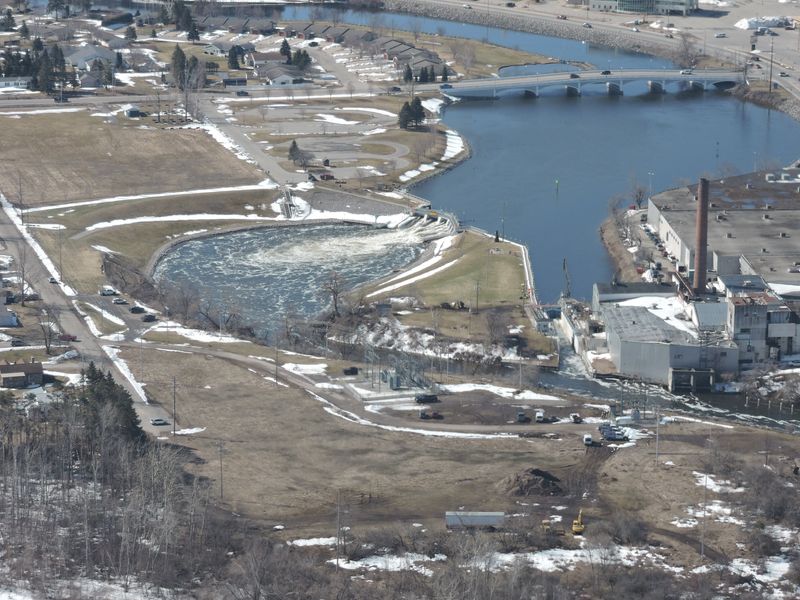
But it’s been decades since this public-private dam has been fitted to produce energy. Instead, it is standing witness to an impatient Cheboygan River thrashing foamy and white through the dam’s spillway with a force that feels less like spring runoff and more like a warning. It feels angry.
On Tuesday, April 14, I talked to locals who heeded warnings to gather up their things and go. A day later, I better understood the urgency that officials conveyed. Based on what I saw, damage would be catastrophic if the dam overflows.
On the front line are contract workers using pumps to control what seems uncontrollable. They are working with purpose along the dam that runs parallel to Lincoln Street. At this point, they have been here for five days, working around the clock.
This is the part of natural disaster planning that most of us don’t get to see. The deliberateness of the work. The stacking of sandbags that weigh more than the average 10-year-old child. Knowing where to place those sandbags where they can be most effective. The rush of the water coupled with diesel-powered machines make for a loud workplace for those doing the unglamorous work of buying time.
This is what it looks like to hold the line — 21st century-style with modern approaches that belied an old-timey method in my mind: a hand-to-hand sandbag line.
Where I grew up, two modern, powerful, multistory dams were built just hours from our family home. They were popular for school field trips and outdoor family fish fries.The Cheboygan Lock and Dam, constructed in its current form in 1921, was surely a marvel years ago. But even to the layman’s eye today, it seems like a relic, though still quite impressive.
Time, as it turns out, is the issue here. As crews work in the present, this critical moment has been shaped by the past — and will almost certainly define its future.
The dam sits just south of downtown, where the river makes its final push toward Lake Huron. It is indeed a structure built for a different era, under different assumptions about the weather, water and risk. Today, those assumptions are shifting.
State officials have acknowledged the dam is not capable of what engineers call “the probable maximum flood” — essentially, a worst-case scenario. The standard is not theoretical anymore. It’s the benchmark by which communities measure whether they are prepared for what’s to come. And what’s to come is not as predictable as it once was.Freeze-thaw cycles are different. Snowmelt patterns are less consistent. Rain arrives heavier and faster, sometimes layered on top of conditions that have pushed systems to their limits to begin with. Even here in Cheboygan, where hardy residents said the last major flood came more than 50 years ago, the river feels different. Stronger. And less forgiving.
To be sure, this is not a story about failure. It is a story about responses. The sacrifice of workers and their families and a community that rallies around one another in times of crisis. About those who show up before sunrise in freezing temperatures and fog to tame water. And those staffing shelters taking care of the relocated.
About agencies coordinating in real time. About a community that, for now, is holding steady because people are paying attention. (While visiting the dam, there was buzz of a next-day visit from Gov. Gretchen Whitmer.)
About a story of what comes next.
One important question waiting for an answer is this: Are we ready for what used to be once-in-a-generation natural disasters to become more common? Answers won’t come from bigger sandbags and pumps alone. These are generational challenges.
Long-term solutions will require investment, modernization and a hard look at 19th-century infrastructure that was never designed for rapidly evolving 21st -century conditions. They will require coordination between public and private ownership, and a willingness to interrogate uncomfortable truths about cost, risk and responsibility.
But today, history will show that on a cool, gray April day in 2026, with Cheboygan River pressing as it never had in most of our lifetimes, the first line of defense was still humans determined not to let the water win without a fight.
Byron McCauley is a regional columnist for USA Today Co. Email: bmccauley@usatodayco.com. Call: (513) 504-8915. This column originally appeared in the Cheboygan Daily Tribune.
This article originally appeared on The Detroit News: Holding back the river at Cheboygan’s lock and dam | Opinion
Reporting by Byron McCauley, The Detroit News / The Detroit News
USA TODAY Network via Reuters Connect