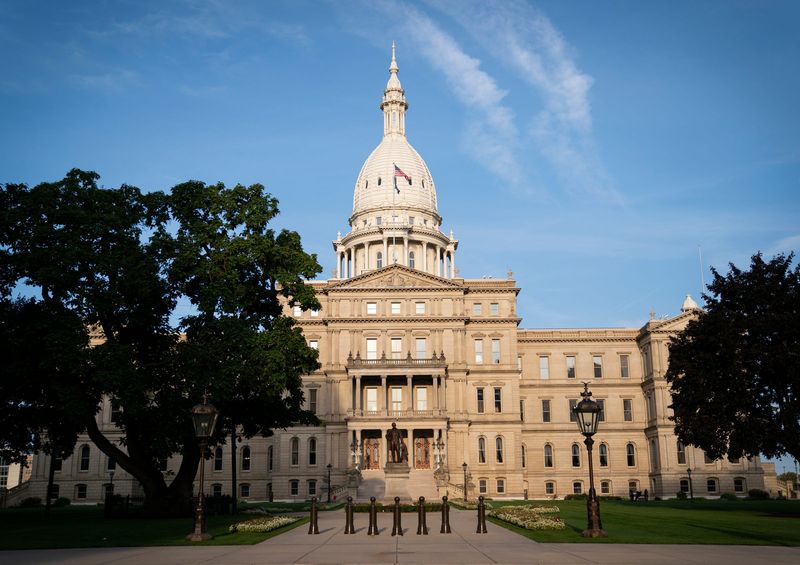
LANSING — The GOP-controlled state House passed its plan to cut property taxes by more than $5 billion late on May 20, but without a promised tax on luxury services to replace lost revenue for schools and local governments.
All but one House Republican present supported the bills, which were opposed by Democrats except for Rep. Karen Whitsett, D-Detroit, who attended a House session for the first time since August 2025, to support the plan. Most bills passed 57-46, with Rep. Jaime Greene, R-Richmond, voting no.

“This is a big step forward for true savings for the people of Michigan,” House Speaker Matt Hall, R-Richland Township, said at a news conference following the votes.
But Michigan House Democrats, in May 20 posts on social media, denounced the plan as a “shady late-night scheme” to “give billionaires a tax break and leave you with the bill,” putting schools, roads and public safety on the chopping block.
Hall has promised the cut to property taxes would be revenue neutral, but said May 20 that details on his proposed sales tax on luxury services to replace the lost revenue still need to be worked out with the Treasury Department. He said he expects the 6% sales tax to be applied to robocalls, lobbying, telemarketing, limousine services, and private jets, among other services, but that details will be worked out as part of the negotiations to finalize the 2027 budget.
House Bill 5873 would repeal the State Education Tax, which applies six mills to taxable property to support the School Aid Fund. Eliminating the tax would reduce School Aid Fund revenues by $3.2 billion in 2027 and $3.3 billion in 2028, according to a House Fiscal Agency analysis.
House Bill 5872 would eliminate the “pop-up tax,” which allows property assessments to increase by more than 5%, to align more closely with market value, when homes or other taxed properties are sold. Current law, which bars annual assessment increases of more than 5% or the rate of inflation, would also apply following a sale. A House Fiscal Agency analysis estimates revenue loss, mostly to the state and local governments, would be $200 million to $250 million the first year and total more than $2 billion by 2035.
House Bill 5874 would repeal the state’s 0.75% portion of the Real Estate Transfer Tax, which is applied to the value of a property and paid by the seller when the property is sold. Repealing the tax would reduce School Aid Fund revenues by $475 million in 2027 and by $488.3 million in 2028, according to a House Fiscal Agency analysis.
House Bill 5878 would eliminate the personal property tax. The repeal would reduce state and local tax revenues by $1.7 billion to $1.9 billion, according to the House Fiscal Agency. Hall said the legislation would result in major savings for utilities and the Legislature would claw back those savings, reducing utility bills by $1 billion a year. House Bill 5879 would bar Michigan utilities from applying for a general rate increase for two years after the repeal is approved.
Greene said in a news release she supports responsible property tax relief but she “cannot support a property tax package that creates uncertainty for local governments, schools, and the essential services our residents rely on every day.”
In other developments in the Legislature May 20:
The House is in session May 21, the Senate is holding no votes due to a Senate Memorial Day ceremony.
Contact Paul Egan: 517-372-8660 or pegan@freepress.com.
This article originally appeared on Detroit Free Press: Michigan House OKs $5B property tax cut without replacement revenue
Reporting by Paul Egan, Detroit Free Press / Detroit Free Press
USA TODAY Network via Reuters Connect