

With more streamlined designs, flat-screen TVs, speakers and other electronic components can be incorporated into the home more seamlessly these days. Here are some clever ways to highlight or hide these features to better suit your rooms.
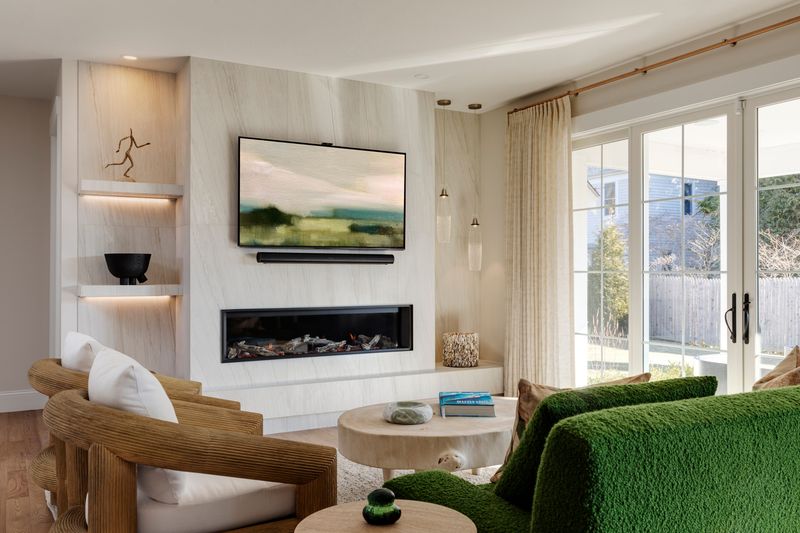
Frame TVs that look like art can become a focal point, says Anna Versaci, principal of Anna Versaci Design in Birmingham. “With clients, we incorporate TVs from the initial conversation,” the designer explains. “We need to know the size, as well as the speakers. Soundbars are a popular part of the display, but you never want to see cords.”

When TVs are not mounted on the wall, zip ties can corral cords that can be tracked down a furniture leg to conceal them.
Popular Frame TVs, where the screensaver essentially becomes art, do require a small box that needs to be hidden somewhere. “It’s really all about placement to make sure your electrical is in the right location,” says Versaci. “You also need to think about sightlines. The way people interact with media is so different now.”
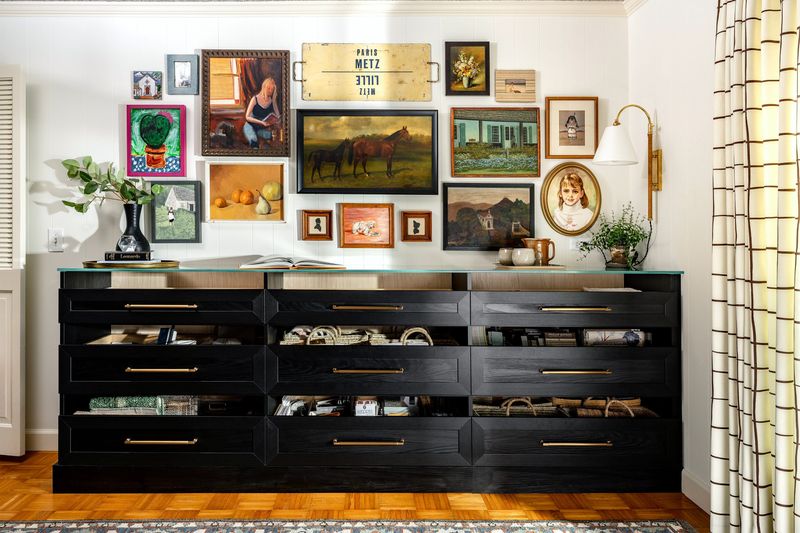
For creative placement, she says you can install a TV in an art gallery wall and turn the brightness down when it is on the art setting. Some models offer after-market frames in finishes like walnut, brass or polished nickel. Since many TV screens are still black when not in use, the designer likes to incorporate the shade into a space. “It can be for your cabinetry hardware, drapery rod or piping on a pillow,” says Versaci. “A little black really grounds the room and relates to other pieces. It’s important to think about a TV as a design element, not an afterthought.”
Hide and seek
Ruth Casper, interior designer and owner of Ruth Casper Design Studio at the Michigan Design Center in Troy, worked on a lower level with nine TVs and a gaming area for adults. “They have 20 to 30 people there on the weekends for gaming and sports. The lower level is the hub of their home for their family. They wanted it to look concealed and clean and inconspicuous,” says the designer who preplans these features with an electrician. Here, below one TV, 16 outlets hide behind a retrofitted console that also provides storage.
For another project, Casper concealed an electrical panel with triptych art that opens for easy access. “The frame depth allowed us to add a hinge and a small magnet keeps it shut. The homeowners love it,” she says. “I always design around what the builder does. Sometimes the easiest or most cost-effective way to get electricity into the home is right in the middle of a room.”
Lastly, Casper adds: “It’s important to have a lot of forward-thinking with your electrician and your audio/visual installer. All the wires and outlets need to be preplanned for a renovation or a new-build. You still need to incorporate speakers, even with Frame TVs. You can conceal them in the ceiling or behind drywall in some cases.” The designer sometimes hides unsightly wires in a basket with a hole drilled into the bottom.
All together now
Dan Paulson, CEO of Paulson’s Audio & Video in Farmington Hills — with a new experience center set to open later this year at the Michigan Design Center in Troy — agrees that technology and design have become intertwined. “People still want great Wi-Fi to watch their favorite shows and they want to be entertained, but design is still the star,” he says. “The most prominent television can look like art, so the design is still the focus in the space.”
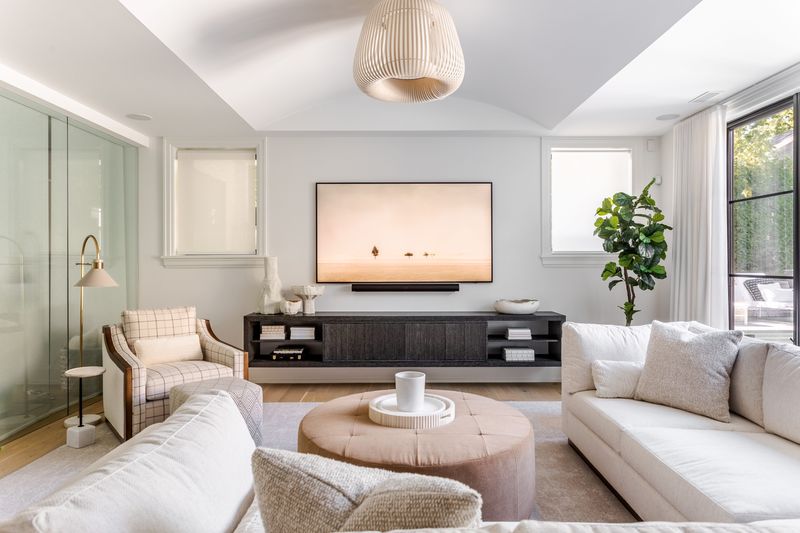
Even the most substantial models let you design the space around them. “TVs that are 75 inches are the average size we’re installing in homes,” says Paulson. “They’ve just become the focal point with beautiful credenzas below them. Most are on the wall with a low-profile cabinet for storage.”
Other features can easily be concealed, like after-market soundbars that offer color and frame selections to complement your décor. “TV speakers have become so small,” he adds. Invisible speakers that are hidden behind drywall are another popular option.
Outdoor TVs can be installed on an exterior wall or in a structure like a pergola, while speaker wedges can be mounted from a roofline to blend in with gutters or trim. “You can customize the color, so they practically disappear,” adds Paulson.
“People care about performance, but you can do it with design in mind,” he says. “With music or televisions, even with big bulky products, you can have the perfect experience and still love the way your living room looks.”
The perfect blend
When it comes to media components, Armina Kasprowicz, principal for Armina Interiors in Rochester Hills, often consults with audio/visual companies for the best results. “Technology is always changing,” she says. “With TVs that you can disguise, many times clients have a whole integrated system with speakers in the ceiling. The options are getting better all the time.”
For instance, she says soundbars and speakers can be completely hidden or recede into the millwork.
These media features need proper planning. “With a renovation or new construction, it’s worse when it’s an afterthought and best when you think about it in advance,” she says.
Placement should be an important consideration for TVs. “Everybody is different. For neck support, some people like it slightly higher,” the designer says. “The way the whole room is arranged needs to serve your needs. For comfort, there are a lot of factors that are part of that decision, like how you sit and recline.”
In general, technology should serve a space, adds Kasprowicz. “We want the experience, but the TV should not compete with the room. There should be no wires or black rectangles. Even TVs from the last decade give you the ability to download photos from an app to fit the mood,” she says. “In springtime, I like to see nature and landscape art or family photos. I had a client with black-and-white photos on the TV that were artistic and a perfect fit for the room.”
Custom built-ins can also accommodate TV screens like the one she designed in a panel system on a track with a sliding door. “It looks like a piece of furniture,” says Kasprowicz.
“We always try to integrate the TV somehow. It depends on the room and the layout, but it should feel intentional. Every element needs to be part of the design,” she adds. “People do not like the TV to dominate the room, especially now that they are in front of the TV all the time, but they can also have conversations or read a book and have them blend into the background. When you’re not watching it, you can enjoy a view or a landscape; something that makes you smile, not just a TV.”
Jeanine Matlow writes the Smart Solutions column in Homestyle. You can reach her at jeaninematlow@earthlink.net.
This article originally appeared on The Detroit News: Make your TV a design feature instead of an eyesore
Reporting by Jeanine Matlow, Special to The Detroit News / The Detroit News
USA TODAY Network via Reuters Connect
By Jeanine Matlow, Special to The Detroit News | USA TODAY Network
