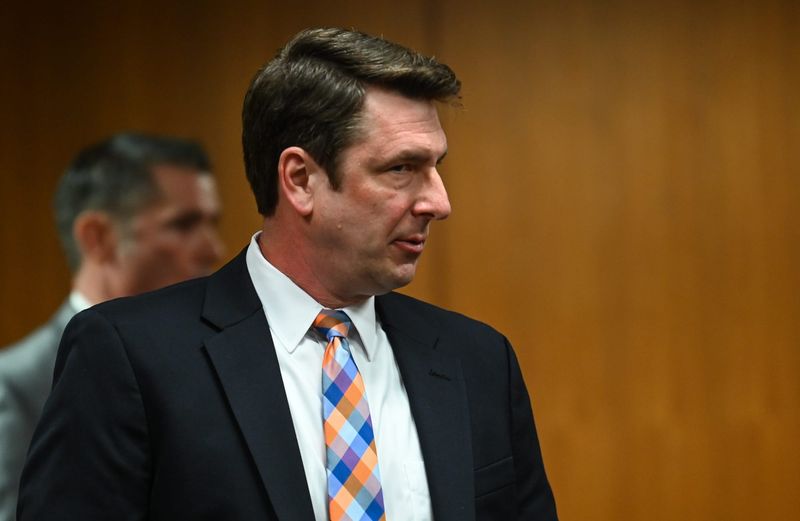
LANSING — A former Lansing police lieutenant who pleaded no-contest to a misdemeanor embezzlement charge last year likely committed “additional criminal acts” while working for the city, an internal investigation found.
Ryan Wilcox made numerous “questionable purchases” with city tax dollars, falsified overtime, conducted “unauthorized searches” using a police database of his ex-wife, her new boyfriend and that man’s family, and used a city vehicle for personal travel inside and outside Michigan, according to a summary of an internal investigation by Lansing police. And in addition to mowing lawns for his private business on city time, which an earlier Michigan State Police investigation confirmed, the report said he also worked another job without proper city authorization.

The city released a four-page Lansing Police Department “Citizen/Police Complaint Form” in response to a State Journal public records request for the report from the internal affairs investigation, which went on for a year after Wilcox’s criminal case ended. The city denied the release of any other documents, saying doing so “would divulge internal affairs investigatory techniques and have a substantial chilling effect on participation in future investigations.”
Wilcox, 46, was put on paid leave in May 2024 after Capt. Justin Moore, his then supervisor, brought concerns to Police Chief Bob Backus, who was the assistant chief at the time, about Wilcox mowing lawns for his private business while on the clock for the city and using police resources for personal reasons, among other issues.
Jackson County prosecutors charged Wilcox with a felony in February 2025, and he pleaded no contest to a misdemeanor the following month, days after retiring from the department and receiving his full pension. Wilcox would have forfeited his pension had he been convicted of a felony connected to his job.
Wilcox could not be reached for comment. He has declined all previous State Journal requests for comment and told state police that he couldn’t recall a specific time when he put in for overtime pay that he didn’t work.
In May 2025, Lansing District Court Judge Cynthia Ward sentenced Wilcox to 10 months of probation and ordered him to pay $18,500 in restitution to the city, which he paid back earlier this year. The state police detective had previously testified that his investigation had a limited time frame, from 2022 to 2024, and that the criminal complaint covered the first five months of 2024.
The city’s internal investigation found that the $18,500 in restitution is likely an undercount.
‘Not calculated as part of the loss estimate to the city’
“Overtime, while mentioned (in) several sections of the MSP criminal report, was not included in the issued criminal charges and was not calculated as part of the loss estimate to the city,” Lt. Josh Traviglia, an LPD internal affairs investigator, wrote in the summary released to the LSJ.
Wilcox was the 37th highest overtime earner in the city from Jan. 1, 2020, until he retired, despite spending the last nine months of that time period on leave during the criminal investigation, the State Journal previously reported. His pension likely is inflated by his improper overtime because retirement payments are based on total pay, not base salary.
Wilcox submitted five overtime sheets in October 2023 that appear to have three different signatures, including Moore’s.
Wilcox’s outside employment wasn’t just mowing lawns. State police also determined that, while on city time, he worked for North Lynnwood, Washington-based Ergometrics, also known as the National Testing Network, a private company that helps police departments with hiring and promotions. The internal affairs investigation confirmed that Wilcox never received city approval to work for the firm.
Neither Backus nor Mayor Andy Schor responded to inquiries from the State Journal about whether they want the city to pursue criminal charges related to Wilcox’s overtime.
The four-page document the city released does not provide a more clear timeline of how long Wilcox’s conduct went unchecked, despite Moore telling state police that there had been more than a decade of jokes and rumors within the department about Wilcox’s lawn mowing business.
Wilcox stored lawn mowing equipment — which he used while on the clock for the city — at the police department’s firing range, according to state police records. The State Journal reported last year that LPD’s current and former leadership were likely at the firing range at times Wilcox’s lawn mowing equipment was parked there.
Backus did not respond to a State Journal question about whether internal affairs investigators tried to determine if anyone in the department had knowledge of Wilcox’s conduct but failed to take proper action. He had previously said that was a goal of the internal investigation. The summary released by the city does not address that stated goal.
Financial oversight issues beyond Wilcox
It’s also unclear whether Backus has given Schor “a full briefing on the matter,” which Scott Bean, the mayor’s spokesperson, had previously said would happen once the investigation ended. In August 2025, months after the criminal case ended, Schor told the State Journal that Wilcox was an isolated bad actor and that he was comfortable with the city’s oversight of its credit cards issued to employees and overtime.
The State Journal’s reporting, however, found significant issues with the city’s employee-issued credit card oversight, including charges on cards assigned to department directors occurring while they were on leave or after their employment ended, including the card assigned to former Police Chief Ellery Sosebee, who led the department when Wilcox was put on leave.
Additionally, State Journal reporting documented that the city five years earlier in 2020 had concerns about credit card use by one of the its top officials outside the police department, which was uncovered following a federal investigation into the use of grant money.
Last year, following Wilcox’s sentencing, Schor said he wanted the city to rely more on invoices for purchases instead of city credit cards when possible. It’s not clear how that process is working. In December, the State Journal asked for invoices from two vendors, Amazon and an office supply firm, over a four-month period. The city said it wanted $1,110 and at least five weeks to provide the invoices. The State Journal opted not to pay that amount.
In July 2025, the State Journal reported that Wilcox charged $105,000 to his city credit card from December 2021 until he was put on leave 2½ years later, in May 2024. About 44% of his charges were for Amazon.
The internal affairs investigation found that Wilcox had access to three separate city accounts and made “several questionable purchases,” Traviglia wrote, but the investigation “was unable to locate any of these purchased items, nor was the (office of internal affairs) able to determine any legitimate purpose for their purchases (excluding one purchase whose purpose could not be definitively determined either way).”
State police obtained search warrants for Wilcox’s office, his work vehicle, phone records and his work cell phone, tablet and computer. They found several cell phones in his office, along with $1,800 in cash believed to be for his lawn mowing business. They found receipts and packaging for a vehicle GPS tracker and alarm clock with a covert camera. An MSP report indicated that the tracker and covert camera prompted an additional investigation.
Records obtained through a public records request show that Wilcox bought several spy cameras — including one concealed in a phone charger and another in a five-port USB hub — and four 190MB memory cards.
City said release of more records would ‘have a substantial chilling effect’
For more than a year, the city has fought the release of records related to the Wilcox investigation and the department’s actions once state police began their criminal investigation. The State Journal previously reported that lax oversight of the city’s credit cards, an ongoing issue for years, likely allowed Wilcox’s criminal conduct to persist.
In response to a public records request for “the report from the internal affairs investigation,” the city attorney’s office provided the four-page document, which it called a “charge sheet” but denied the release of “any other record related to the LPD Internal Affairs investigation.”
Assistant City Attorney Matthew Staples wrote that the release of additional records “would divulge internal affairs investigatory techniques and have a substantial chilling effect on participation in future investigations.”
At the end of his investigative summary, Traviglia wrote that “Wilcox’s actions garnered a large amount of media attention that portrayed the Lansing Police Department in a very negative light. It was clear to the (office of internal affairs) that Wilcox’s conduct discredited the department, impaired the efficiency of its operations and greatly affected the reputation LPD has with the community it serves. There was overwhelming evidence that Wilcox violated LPD Rule of Conduct 1.02 Unbecoming Conduct.”
The State Journal will appeal the denial of the full internal affairs investigation, which under city policy will be decided by City Council President Peter Spadafore.
Spadafore has denied two State Journal appeals this year, including when he opted to keep an internal investigation from public view. That investigation related to a controversial music video filmed at the downtown fire station last fall in an incident that raised questions about fire department leadership.
“The City has a supreme interest in encouraging frank communications because they allow city government to effectively investigate internal matters and have the option to explore new ideas without the constant threat of public scrutiny,” Spadafore wrote in his Jan 28 denial letter.
Contact reporter Matt Mencarini at mjmencarini@lsj.com.
This article originally appeared on Lansing State Journal: Investigation finds added likely ‘criminal acts’ for ex-LPD officer
Reporting by Matt Mencarini, Lansing State Journal / Lansing State Journal
USA TODAY Network via Reuters Connect