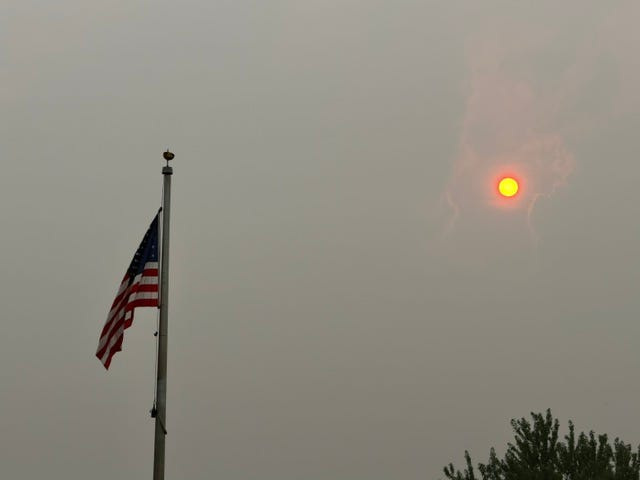
A massive, dense plume of smoke from wildfires burning in Canada and northern Minnesota is drifting across Michigan on Thursday, July 16, has created some of the worst air quality in the world throughout the state.
As of 7:30 a.m. on Thursday, July 16, officials say the smoke is making the air in Greater Lansing hazardous, reaching a reading of 449 on the Air Quality Index. Readings over 300 are considered hazardous.

“Near-surface wildfire smoke will continue today (July 16) through Friday (July 17), perhaps lingering across parts of the area into Saturday (July 18). Reduced visibility and air quality concerns will persist through this time,” the Gaylord National Weather Service said on July 16 on X.
A statewide air quality alert remains in place for Thursday, July 16, because of fine particulate matter in the smoky air.
The website IQAir says Detroit has the worst air in the world today among major U.S. cities, with Minneapolis, Minnesota, and Chicago also in the top five. Numerous Michigan cities have air readings just as bad or worse than Detroit’s.
Residents are urged to limit their outdoor time as much as possible, keep windows closed, run central air conditioning with MERV-13 or higher rated filters and avoid any wood burning.
For those who have to head outdoors, monitor for symptoms, including wheezing, coughing, chest tightness, dizziness, or burning in nose, throat and eyes.
Here’s more on the air quality index and a map of current conditions:
How bad is the air quality in Greater Lansing?
The map below displays the current air quality at monitoring sites in the U.S., Canada and Mexico. Air monitoring sites are color-coded based on the pollutant (ozone or particulate matter) with the highest value. Particles that are less than 10 micrometers and 2.5 micrometers in diameter are called PM10 and PM2.5, respectively.
An AQI of 50 or below means the current air quality is good. The shaded areas of the map show the approximate boundaries where air quality is available and listed as anything other than good. The information is updated hourly.
What does ‘PM2.5’ mean on the air quality index?
On the AQI, particulate matter readings, labeled “PM2.5,” range from 0-301 or higher, and measure the fine particulate matter in the air, such as smoke, dust, soot or dirt.
The “2.5” figure means particles are 2.5 micrometers in diameter or smaller, according to the EPA — that is 30 times smaller than the average human hair, which is about 70 micrometers in diameter.
Air quality index: who belongs to a ‘sensitive group’?
“Sensitive groups” identify people who may be more at risk for breathing in polluted air than others.
According to the EPA, people who have respiratory problems (like asthma), heart or lung disease, diabetes, are a senior or child, or of a lower socioeconomic status are all considered within a sensitive group.
In addition, outdoor workers and pregnant people are within the sensitive groups based on Michigan’s Health and Human Services Department.
How can I stay updated on air quality in Lansing?
Michigan residents can check current conditions through EGLE’s MiAir Quality Index Dashboard. The interactive map provides AQI scores for cities across the state.
Residents can also use AirNow, a part of the U.S. Air Quality Index, and check local conditions by searching their ZIP Code or city. AccuWeather also has an AQI feature that lists the current pollutants in the air.
In addition, Michigan’s HHS Department has a Facebook and X account. The department allows residents to subscribe to alerts through the EnviroFlash system.
Contact Sarah Moore @ smoore@lsj.com
This article originally appeared on Lansing State Journal: How bad is the air in Lansing? Check the air quality map
Reporting by Sarah Moore, USA TODAY NETWORK / Lansing State Journal
USA TODAY Network via Reuters Connect
By Sarah Moore, USA TODAY NETWORK | USA TODAY Network