

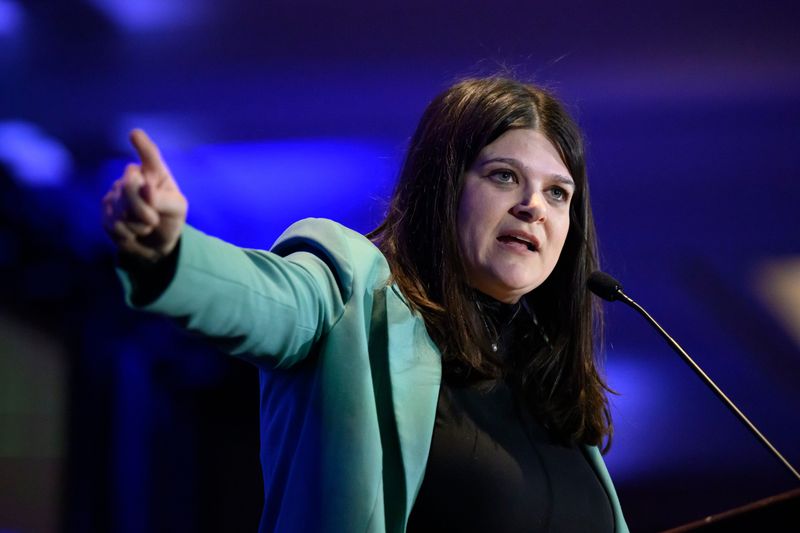
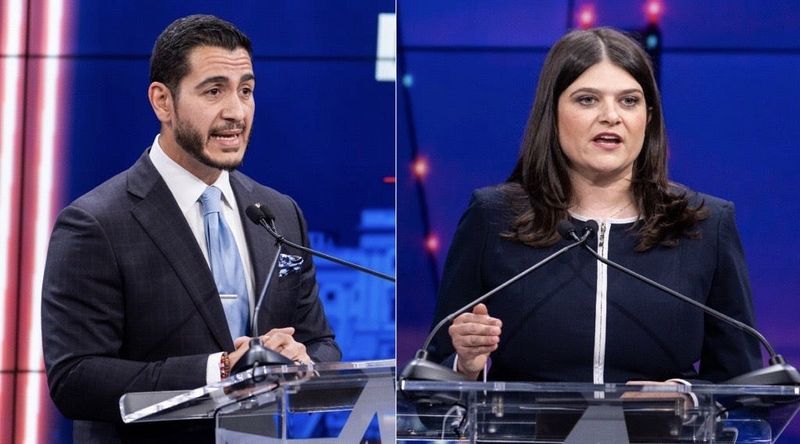
Lansing — Groups backing U.S. Rep. Haley Stevens are currently poised to outspend committees supporting former health official Abdul El-Sayed by a $12-to-$1 margin on TV ads in Michigan’s contentious Democratic U.S. Senate primary, according to tracking data.
The difference in the amount of campaign commercials is potentially historic, said three longtime Michigan political observers, and could influence the primary election’s outcome.

The tracking data, reviewed by The Detroit News, covered both ads already aired and reservations leading up to the Aug. 4 election. The reservations could change. But as things stood Thursday, pro-Stevens groups were slated to fund $52.6 million in ad time, while pro-El-Sayed groups were scheduled to fund $4.1 million in ad time.
Jason Cabel Roe and John Sellek, two consultants who’ve primarily worked in Republican politics in Michigan, said they weren’t aware of a past race with such a disparity in commercial spending.
“On the one hand, super PACs are becoming massive funding vehicles as candidates and committees push the envelope,” Sellek said. “But we’ve never seen a gap quite like this.”
Likewise, asked if he recalled a TV ad spending difference similar to what was playing out this summer, Bill Ballenger, a former state lawmaker and Michigan political commentator, replied, “Never.”
Stevens of Birmingham has served in the U.S. House since 2019. She’s been endorsed by former U.S. Sen. Debbie Stabenow, D-Lansing, and current U.S. Sen. Gary Peters, D-Bloomfield Township, whose seat Stevens and El-Sayed are running to fill.
El-Sayed, a progressive Democrat from Ann Arbor, raised more money for his campaign than Stevens did in the last disclosure quarter: $4.6 million to $2.1 million.
However, groups supporting Stevens that spend money directly on ads, outside of the candidates’ campaigns, have dominated the TV airwaves in Michigan.
United Democracy Project, which has been funded in part by the American Israel Public Affairs Committee or AIPAC, is slated to spend $28.5 million either supporting Stevens or attacking El-Sayed. And a group called A Stronger Michigan, which hasn’t reported its donors’ names to the Federal Election Commission, has spent $12.1 million in support of Stevens.
In an interview Thursday, U.S. Sen. Bernie Sanders, I-Vermont, who’s endorsed El-Sayed, referenced the large amount of spending and said the race had become “Abdul vs. the billionaire class and their unlimited amounts of money.”
“This is of national significance,” Sanders said. “If the people of Michigan can stand up to this onslaught of money, it may teach the billionaire class a lesson that they cannot continue to try to buy elections.”
But Sanders acknowledged being concerned the ad spending might potentially impact the outcome on Aug. 4.
Currently, individual donors can give up $7,000 per election cycle to a U.S. Senate candidate. But there are no limits on how much people or corporations can give to super PACs that work independently to promote or criticize candidates.
Arik Wolk, spokesman for the Stevens campaign, pushed back on Sanders’ remarks.
“Nothing says status quo quite like an 84-year-old millionaire who’s spent over three decades in Congress supporting another millionaire who won’t be honest about his finances,” Wolk said, referring to Stevens’ criticisms that El-Sayed hasn’t released a new personal financial disclosure.
The majority of the pro-El-Sayed’s ad spending has come through his campaign. A super PAC called Fighting for Michigan has also spent or reserved about $800,000 in TV advertising time benefiting El-Sayed.
Fighting for Michigan’s top donors have included the Institute for Middle East Understanding, which gave $300,000, and Saikat Chakrabarti of California, a political adviser and software engineer, who gave $250,000, according to federal disclosures.
Roxie Richner, spokeswoman for El-Sayed, said his campaign had more than 10,000 volunteers out making calls and knocking on doors.
“You can buy a super mega yacht for $50,000,000,” Richner said. “Apparently, you can also try to buy a U.S. Senate seat. At least that’s what AIPAC and (President Donald) Trump-aligned billionaires are trying to do.”
In recent years, Michigan has seen few to no statewide primaries reach the level of outside spending of the race between El-Sayed and Stevens. The top outside spender in the 2018 Democratic primary for governor, which featured Gov. Gretchen Whitmer, U.S. Rep. Shri Thanedar and El-Sayed, shelled out only about $2.4 million.
In the 2006 general election, when Democratic incumbent Gov. Jennifer Granholm and Republican billionaire businessman Dick DeVos ran against each other. The DeVos side had a $33 million-to-$23 million advantage in TV ad spending, according to tracking by the nonprofit Michigan Campaign Finance Network.
cmauger@detroitnews.com
This article originally appeared on The Detroit News: Haley Stevens has a lopsided spending advantage against Abdul El-Sayed
Reporting by Craig Mauger, The Detroit News / The Detroit News
USA TODAY Network via Reuters Connect
By Craig Mauger, The Detroit News | USA TODAY Network
