Oakland County ― Tesla is expanding its Robotaxi rideshare service to include Florida, Texas, and California as it competes with Alphabet’s Waymo, Amazon’s Zoox, and other autonomous rideshare services. But consumers are already buying retail Teslas to self-drive them in cities across the US.
Senior citizens most notably.

Determined to maintain their individual transportation independence, they are using Tesla’s hands-free Full Self Driving system as a driver assist. Though by no means exclusive to seniors in its ability to add another set of eyes to the road, FSD helps elderly drivers maintain a cocoon around their car as their confidence in reflexes and eyesight naturally deteriorate.
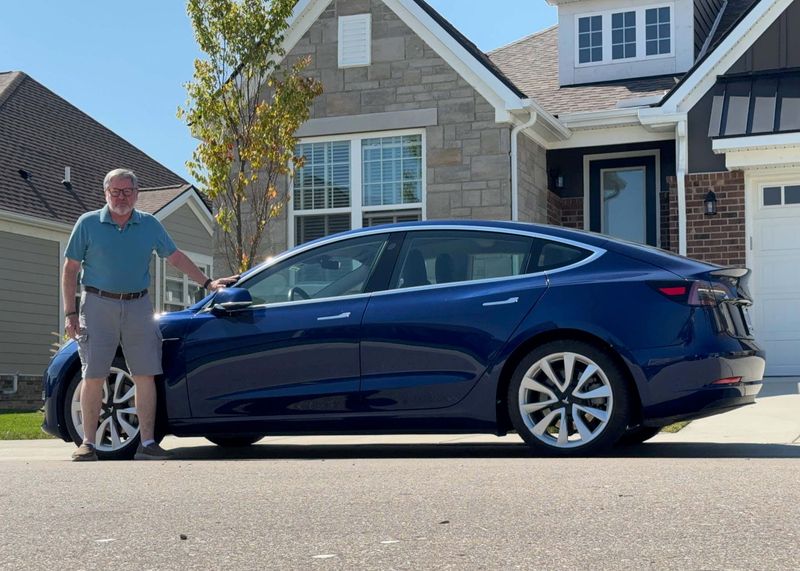
“It’s as good a driver as I am,” said Dick Amacher, 78, a retired General Motors engineer from Rochester Hills who drives his Model Y and Model 3 on FSD 98% of the time. “Here’s the thing, it will not go through a red light. It will not go through a stop sign. Every once in a while, I’ve driven through neighborhoods where stop signs were partially obscured by low hanging branches, for example. . . and (the Tesla) sees them before I do.”
Alphabet founder Sergei Brin launched Google’s autonomous car program (now called Waymo) in 2014 with the idea of giving seniors independence. Now, as Waymo and Tesla duke it out in a high-capital-cost, high-stakes race to dominate the ride-share space, that sci-fi vision ― shared by Tesla CEO Elon Musk ― is fast becoming reality with Tesla’s version 14.3 FSD software. FSD has made enormous strides in the last two years thanks to millions of miles of real-world customer use and Artificial Intelligence advancement.
“Tesla self-driving enables safer mobility for senior citizens,” posted Musk on X July 11 in response to a Tesla post documenting how FSD has changed some seniors’ lives.
“I can’t tell you what it means to a son to see his mother’s world now expanding when before ― much like other older people ― it was shrinking and becoming smaller,” said the son of Tesla customer, Lois, in a Tesla ad. “I see her driving across San Diego County to visit her daughters, to visit her grandkids, and it makes me so happy to know that she has this freedom now.”
Said Lois: “I’ve been driving for 75 years. I find that I’m able to just do it. I don’t have to wait for someone, and it’s been a wonderful experience.”
I have witnessed FSD’s evolution in my own, 2025 Tesla Model 3. I drove multiple hands-free trips in Michigan and Virginia while I interviewed senior Tesla owners who have determined FSD is a better driver than they are.
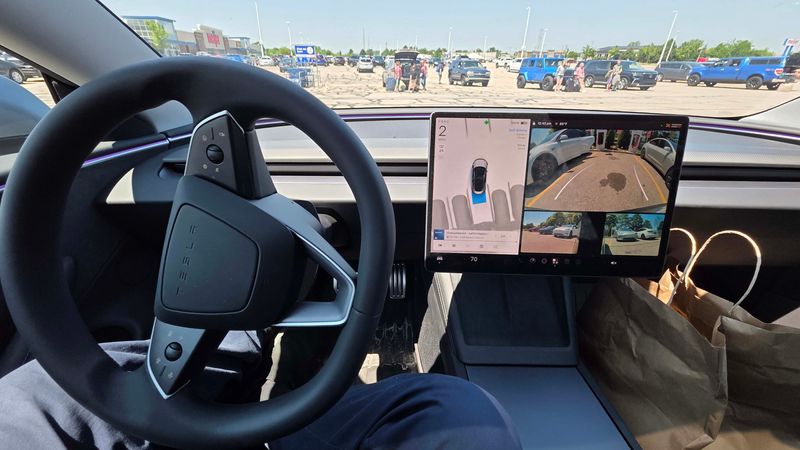
In my Oakland Hills Driveway, I engaged Tesla’s voice assistant: “Hey, Grok, navigate to Sunrise Convenience Store, Memphis, Michigan.” The store, 52 miles away, makes my favorite popcorn packed in big party bags. I steered the car out of my driveway and a FULL SELF DRIVING button on the 15-inch center screen indicated the system was active. I pressed it and didn’t touch the steering wheel again (hands on my knees or sipping a Snapple) until I returned from my round trip. The Tesla expertly navigated Telegraph Road, four-lane M-59, two-lane roads, exits, passing maneuvers, stop signs, etc. before pulling into Sunrise’s parking lot, locating a spot, and parking itself.
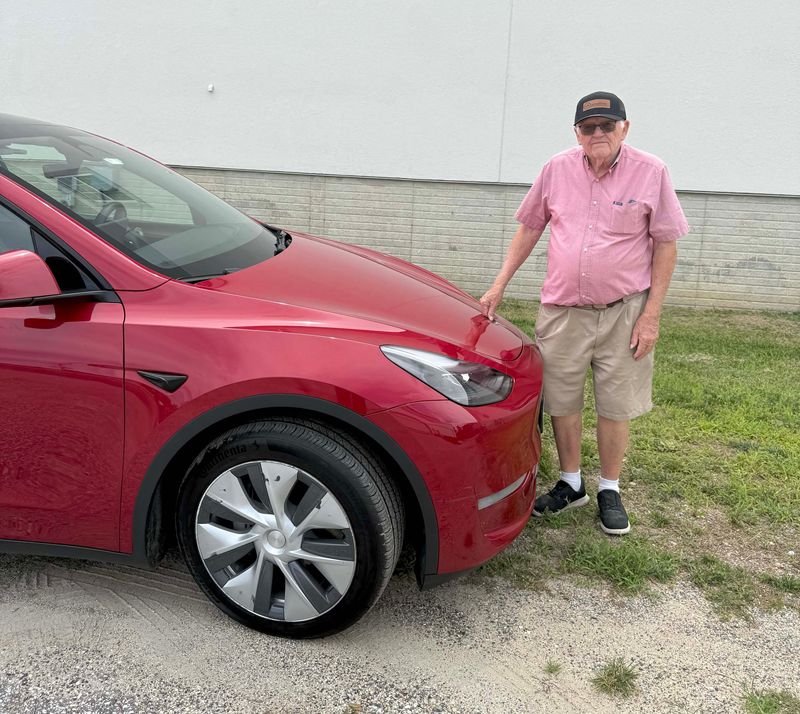
Leonard Kraus, 92, owns a red Tesla Model 3 that drives him on his daily routine.
“My daughter said, ‘Dad, you got enough money to hire a chauffeur,’” said Kraus who bought his car in 2021 and has watched FSD steadily improve with over-the-air updates. “I’m not going to hire a chauffeur to go down to the Wawa (store) and get a coffee. That’s one of my fun things.”
He recommended Tesla FSD to his 95-year-old brother-in-law. “He’s an old farmer, and he’s fascinated with self- parking,” said Kraus. “He told (my sister) that he didn’t think he parked that well when he was a young man. They use it kind of like me. He put all their (family) addresses in FSD and all they have to do is hit the button, and Tesla takes them there.”
Said Kraus: “I don’t think I would be driving without it.”
“This is the promise of autonomous driving. . . because people do not want to give up their personal mobility,” said Autoline auto analyst John McElroy in an interview. “It opens mobility for everybody, every segment of society. Not just the elderly, but even the young. Anybody with any disability ― potentially, when we get to Level 4 ― even the blind will be able to (go) places. With people in their 70s, 80s, 90s ― especially (when) driving at night ― there is a guardian angel looking over their shoulder.”
So-called Level 4 autonomy ― in ride-share Robotaxis, for example ― is when the car has complete control. Tesla’s FSD is a Level 2, hands-free system requiring a driver behind the wheel that the system can detect with a camera.
On a trip to Charlevoix, Michigan, FSD included charging stops on my 250-mile route. While the 303-mile range Model 3 Performance could make it there without a stop, I set arrival energy to 35% so I’d have enough juice to get around town once there.
At Exit 164 in Bay City, my car activated its right turn signal and proceeded to the Tesla Supercharger in the Meijer parking lot off Wilder Road. The screen indicated I might have to wait 10 minutes when I arrived due to heavy use. But when I arrived, open stalls were available. The Tesla chose a space then backed in, the steering wheel spinning in front of me. I plugged in the charger and went inside Meijer for 15 minutes while the car filled up on electrons.
An avid traveler, Amacher likes to take long road trips in his Model Y to Florida and Northern Michigan. According to FSD data, he goes hands-free 98% of the time. He finds FSD makes the correct choices even in challenging conditions. Like roundabouts.
“Roundabouts are perfect,” he said. “That really amazes me. There was a roundabout in Venice, Flordia (people) call the ‘circle of death.’ Since FSD version 14, it’s so good in roundabouts ― someplace where many average drivers fail ― especially an elderly driver. FSD waits until there’s a good spot to get into a roundabout, it stays in its lane, and takes it through.”
Exiting Reagan National Airport, my TURO Model Y rental merged onto the 14th Street bridge over the Potomac River into Washington, DC ― a chaotic, multi-lane intersection of multiple highways. FSD navigated it with aplomb in bumper-to-bumper midday traffic, then drove me hands-free through southeast DC to Maryland and my Virginia destination 72 miles south.
McElroy took the keys away from his father a few years ago. Now, he would be comfortable if he used FSD which Tesla offers as a subscription for $99 a month.
“Tesla claims ― and I believe them ― at the current level it’s safer than human driving,” said the Autoline analyst who has driven extensively with FSD. “I’m not sure anything’s ever going to be perfect. I have no question that autonomy – once it’s widespread – is going to save tens of thousands of lives a year.”
“This is going to be a big deal for Tesla. It’s not increasing (auto) sales that much. If you’re stuck in a given sales range, how do you boost your revenue? You get more people to use FSD.”
Amacher and Kraus are quick to advise that FSD is not perfect. Drivers need to be engaged and occasionally intervene.
After lunch at Nicky D’s Coney Island on Woodward Avenue, I engaged FSD to take me home. The Tesla expertly backed out of the parking space ― then erroneously took the restaurant’s EXIT laine onto Woodward instead of the ENTRANCE lane, ignoring the ENTRANCE directional arrow painted on the asphalt. I intervened and steered the Tesla to the proper lane, then re-engaged FSD onto Woodward.
In my experience FSD is a work in progress reading the road surface ― inconsistently reading surface information like arrows, potholes, and obstacles like a block of wood off a pickup truck.
Kraus takes over from FSD in his neighborhood to navigate a series of speed bumps.
“The Tesla slows down to 20-23 mph over the speed bumps, and it’s still too fast. So, I just take over,” said Kraus who owns a construction company and makes regular trips to work sites.
He recommends elderly drivers interested in Tesla FSD take rides with family and friends first to learn the system’s details.
“When I bought it, I said to one of grandsons: ‘I want you to get the car and drive it for a couple months. Then you can teach me how to drive it,’” recounted Kraus. “A half-hour lesson (at the Tela store) is just going to tell you the basics. It takes a little more instruction for the elderly.”
In my experience, FSD is an assistant for a licensed driver ― not for a driver who can no longer function. McElroy goes further in recommending government regulation.
“We need regulation,” he said. “Tesla should be licensed for FSD. There should be a driver’s test for FSD ― or any autonomous system ― especially in how well it works when it encounters other autonomous cars. We need some sort of industry standard, because once it has a standard, then everybody can work to that standard. I think some amount of regulation will actually accelerate the use of autonomous technology.”
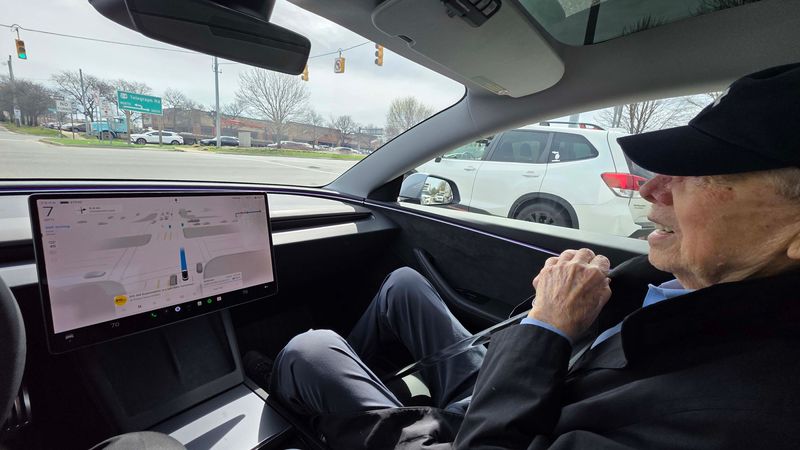
Jack Christian, 95, of Bloomfield Hills is retired and keeps a daily schedule. He asked me to give him a ride in my Model 3 around his neighborhood at West Maple and Telegraph. To Nino Savaggio grocery store. To Oakland Hills Country Club. I never touched the wheel, the Tesla delivering us to each address, parking flawlessly (in the case, of Oakland Hills, delivering the car to valet) in midday traffic.
Christian quickly got comfortable ― the car confidently following traffic laws.
Returning from Memphis, Michigan, I heard a siren behind me on four-lane M-53. My Tesla slowed, then pulled over on the right shoulder. When the ambulance passed, FSD got back up to speed. I didn’t touch the wheel or pedals.
Kraus and Amacher have had similar experiences. Driving Amacher into Detroit, FSD exited the expressway near Wayne State.
“All of a sudden the Tesla pulls over to the curb. I’m like: ‘what is going on?’” said the 78-year old. “Turns out there was an emergency vehicle coming from behind. FSD saw that it was an emergency vehicle before I did. It has vision in every direction simultaneously. A human being cannot replicate that.”
“FSD doesn’t recognize handicap spots and that’s wrong,” he said, thinking of FSD blind spots. “It has a habit of picking a safe place to park. But we’re being critical on details of something that we wouldn’t even have dreamed possible just five years ago.”
Henry Payne is auto critic for The Detroit News. Find him at hpayne@detroitnews.com or Twitter @HenryEPayne
This article originally appeared on The Detroit News: Forget rideshare. How seniors are using Tesla FSD for transportation.
Reporting by Henry Payne, The Detroit News / The Detroit News
USA TODAY Network via Reuters Connect
By Henry Payne, The Detroit News | USA TODAY Network