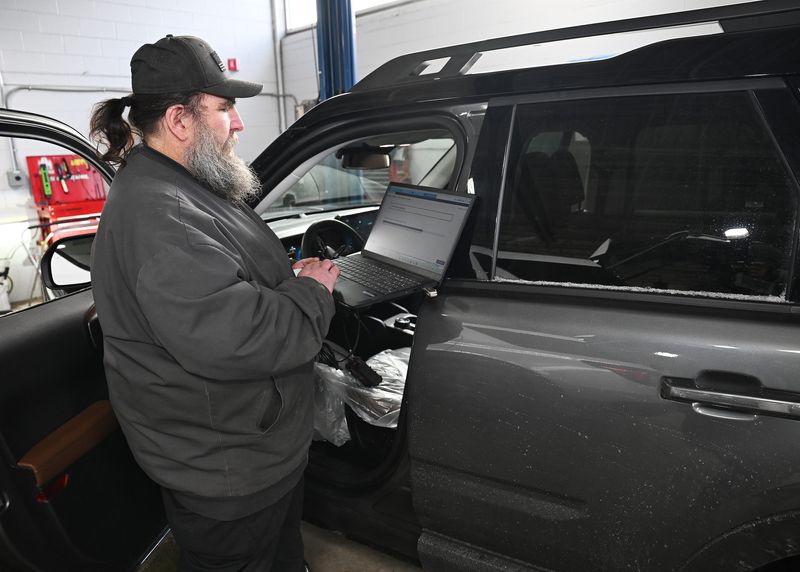
Ford Motor Co. over the past year recalled more vehicles than the rest of the major automotive industry, resulting in one study projecting that one of its models could see close to 100 recalls over the course of its lifetime.
Recalls are often a hassle for customers who may have to take their vehicle into a dealership for a fix or coordinate with a service department to have it picked up for the repair. Their costs also weigh on balance sheets, and have hit Ford’s quarterly financial results previously. CEO Jim Farley has underscored quality as a key focus for the Dearborn automaker and for unlocking Ford’s adjusted operating profit margin target of 8% in 2029.

Auto search engine iSeeCars.com analyzed recall data from between April 2025 and March 2026. It found Ford had both the highest number of recalled vehicles and 12 vehicles among the 25 cars with the most projected recalls over a 30-year lifespan. That included four of the top five led by the Lincoln Aviator with a forecasted 92 recalls. The industry median is 3.9 lifetime recalls per model.
“There has been undisputed quality issues with Ford’s launches. That’s been a pretty well-known factor for over 10 years,” said Karl Brauer, iSeeCar’s executive analyst. “The fact that Jim Farley has been there as long as he has, and it hasn’t been addressed yet is somewhat surprising.”
Ford, however, says it is addressing its quality problems. Ford set a record in 2025 for the number of recalls it issued in a single year: 152, according to the National Highway Traffic Safety Administration. Approximately 90% of recalls from the past year came from 2015-2022 model year vehicles, which puts the engineering of those models between 2013-2020. Farley became CEO in October 2020.
The brand had four top spots on the J.D. Power Initial Quality Study, two vehicles in Consumer Reports’ Top 10 Picks in New Cars and its best reliability finish in 15 years this past fall, spokesperson Mike Levine said in a statement. Additionally, warranty costs declined by $500 million in 2025 compared to 2024. Executives and white-collar employees received increased bonuses for quality improvements last year.
“We are moving in the right direction,” he said. “However, we aren’t resting on these achievements. We remain laser-focused on improving quality for our customers in every vehicle we assemble.”
The Lincoln Aviator, Lincoln Corsair, Ford Maverick and Ford Bronco made up four of the top five models with the most projected recalls. Maverick, Brauer noted, went on sale in late 2021.
“That’s a pretty recent launch fully under the auspices of the leader of the company,” he said. “That doesn’t reflect well on the newer launches. I understand over the last two years, the launches are that much better and clean. But we won’t know for another five-plus years.”
Ford’s recalls approached 20 million vehicles, leaving a wide spread from second-place Toyota Motor Corp., which recalled over 4 million vehicles. Third-place Stellantis NV recalled 3.4 million models.
Ford recalls also are happening after Ford agreed to a settlement with in NHTSA in November 2024, Brauer added. It mandated that the company review the previous three years of recalls to ensure Ford included all the needed vehicles it needed to do so and expand any recalls if needed.
“That may inspire it to be that much more proactive in recalls than a lot of other automakers,” Brauer said.
Over the past two years, the company also doubled its safety team to find and fix problems, and now it is testing critical systems to failure. Last year’s recalls additionally included about 40 reissued recalls related to software. An audit found the company didn’t have a robust way of ensuring the software was in the right place. The effort was to ensure the software had been installed correctly.
In 2026, Ford has issued 31 recalls compared to 40 at this point a year ago. Approximately 80% of its recalls this year are software-related with the ability to be fixed by an over-the-air update, mobile repair service or at a dealership, Levine said.
Over-the-air updates often can go almost unnoticed by customers, Brauer said, and have been an advantage of electric vehicle makers like Tesla Inc., which has issued many recalls that often don’t require a physical repair job. Although Tesla Models Y, 3, X and S are among the 16 most recalled cars, all four drop out of the top 25 when excluding over-the-air recalls.
Meanwhile, Mercedes-Benz dominated the fewest predicted recalls list, with nine of the top 10 models and 15 of the top 25 models. The study predicted the vehicles on the list to have less than one recall over their 30-year lifespan.
Cars recalled in 2026 are three times higher so far than in 2025, according to the study, a potential reflection of higher NHTSA standards and lower quality, Brauer said.
“If you’ve got your heart set on a vehicle has high recalls, go in knowing that at least,” he said. “The goal of the study was not necessarily to tell you what cars you should buy or not buy, but to have an idea of the potential unexpected dealer visits you might be required to make if you buy one of the more recalled cars.”
bnoble@detroitnews.com
@BreanaCNoble
This article originally appeared on The Detroit News: Ford recalls in past year outpaced auto industry combined, study says
Reporting by Breana Noble, The Detroit News / The Detroit News
USA TODAY Network via Reuters Connect