Maybe, you meet someone who is fun to chat with on a dating site. Maybe, someone reaches out with a compliment on a professional platform. And somehow along the way, your newfound love or friend shares a great way to make some cash — say a hot stock tip, gold, or way to get ahead with cryptocurrency.
Honey, hold onto that dough, you’re about to be scammed.

Cryptocurrency investment fraud is the “one crime that’s head and shoulders above the rest,” said Bryan Drake, supervisory special agent with the FBI field office in Detroit.
It’s often referred to as “pig butchering” or fattening up the targeted victim with false flattery and promises before the financial slaughter.
Michigan savers targeted by cybercurrency investment crooks
“The No. 1 in losses for the state of Michigan is cryptocurrency investment fraud,” Drake said. “Second to that is tech support scams.”
Consumers in Michigan reported losing more than $381 million to cybercrime-related schemes in 2025, based on reports to the FBI Internet Crime Complaint Center.
Out of the $381 million, Drake further explained, $173 million involved cryptocurrency investment fraud alone.
“It’s almost half. That’s one scam by itself,” Drake said.
Drake told the Detroit Free Press that it’s shocking to consider the lengths that scammers will go to to convince consumers to invest their savings in cryptocurrency. And then the crooks will take elaborate steps to retrieve the cash.
“It’s hitting all age groups, but it’s really hitting the seniors the most,” Drake said.
Michigan ranked in the top 15 nationwide for cybercrime in 2025 with more than 22,000 cases reported to the FBI Internet Crime Complaint Center.
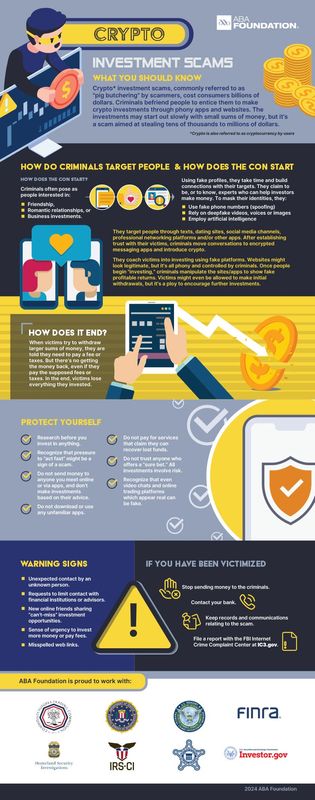
Those who are scammed are told to file a report with local police, contact your bank, and immediately go to the FBI at www.ic3.gov to report fraud. The IC3 site is monitored 24/7 by analysts at the FBI, Drake said, and that team goes straight to the individual banks to try to put a stop to wire transfers in particular. But that can only happen, he said, if a report is made quickly, say within the first 24 hours to 48 hours.
How the investment scam works
Scams are big business for organized crime, including massive “scam compounds.” And the crooks evolve with the times.
In one of the odder warnings, the FBI alerted consumers on June 15 that some legitimate financial institutions are now denying the suspicious transfer of money by their customers, but scammers have a way to get the cash anyway.
“Scammers inform victims in-person cash pickups are required to continue investing with the fraudulent investment firm or to pay purported fines to withdraw their investments,” according to the FBI alert.
In other cases, the FBI stated, “the fraudulent cryptocurrency exchange may inform victims their account has been ‘flagged,’ allowing the scammer to suggest the use of cash couriers as an alternative.”
The con artists connect with you on social media. They might pretend to be interested in a friendship initially, a romantic relationship or even indicate that they’re involved in financial investments. Sometimes, according to the FBI, unsuspecting people are introduced to investment groups that falsely claim to be knowledgeable insiders.
Oh, they like you and they’re more than happy to give you step-by-step guidance on trading or investing in cryptocurrency or gold.
Sure, they’re thrilled to have a shot at stealing your money.
Crooks sound believable because they hide behind fake, friendly profiles — sometimes even stealing identities and photos of real people or celebrities. They use deepfake videos and voices to sound convincing.
After they’ve built up some level of trust with you, they’re going to mention these great — but remember they’re phony — opportunities to make money. And it’s happening every single day all around metro Detroit.
A 68-year-old man reported to Troy police that he met someone on LinkedIn who convinced him to invest money in GoMarkets. Go Markets is a real online broker. But this deal deserves a “Go Directly to Jail” card.
The crooks directed the man a fraudulent GoMarkets website domain. He handed over money. Later, he realized that it was a scam, according to a Troy police report dated May 17.
The Go Markets site warns of online scams where fraudsters initially contact potential victims by scraping together details from various online sources. Once you make an investment, the crooks could try to convince you that your money has doubled in value already — and you should invest even more cash.
In another case in late April, a 25-year-old man said he was contacted about a supposed security breach regarding his crypto account.
He told Troy police that he called the number he was given. He then was told to set up a decentralized crypto wallet. He transferred money to the wallet. And his money was gone. It was transferred out a short time later by the suspects, according to the Troy police report.
About $7.2B lost in 2025 to cryptocurrency investment fraud
The FBI’s 2025 Internet Crime Report, which was released in April, shows cyber-enabled crimes defrauded consumers of nearly $21 billion. Figures are based largely on victim reports and experts say the number likely significantly underrepresents actual losses, as many victims do not report to law enforcement.
FBI Special Agent Drake in Detroit noted that roughly one third of all those reported losses — some $7.2 billion — involved cryptocurrency investment fraud. It was the highest source of financial losses to U.S. consumers in 2025.
A key feature of this scam is that criminals coax victims into investing on websites that look legitimate but are totally fake and completely controlled by the crooks.
Victims are encouraged to begin investing by sending wire transfers to various domestic and international bank accounts, according to the FBI. The victim believes it’s all on the up-and-up.
“Once people begin ‘investing,’ criminals manipulate the sites/apps to show fake profitable returns,” according to an alert from the ABA Foundation, an arm of the American Bankers Association.
What happens when you want to withdraw money? Well, you’re asked to send more money — supposedly covering fees or taxes. But you don’t get a dime. You lose what you’ve invested.
AI and crypto scams prove to work for the crooks
Cryptocurrency and artificial intelligence-related complaints are among the costliest scams out there.
Consumers who submitted a broad base of complaints involving cryptocurrency reported losing more than $11 billion based on 181,565 complaints, according to FBI data. In 2024, the FBI launched Operation Level Up, a proactive initiative to counter crypto investment scams.
For the first time in its nearly 25-year history, the report based on data from the FBI Internet Crime Complaint Center featured a section on artificial intelligence. Consumers filed 22,364 complaints relating to AI, which totaled nearly $893 million in losses.
The report noted that AI technology enables the mass production of convincing synthetic content, such as fake personalized conversations. And the crooks are creating high-quality content.
“Scammers are creating fake profiles and scripts produced by AI chat generators to make speech more believable,” the report indicated. Such voice technology also can mimic the sound of a loved one in distress.
How to spot a crypto scam
Some glaring red flags of these scams include:
Federal Trade Commission sees uptick in scams
Data from the Federal Trade Commission, which is different than FBI data, indicated that consumers reported that crooks stole a record $15.9 billion in 2025 in a variety of scams — up from $12.5 billion in 2024.
The most money lost — $7.9 billion or nearly half of the reported losses — involved some form of investment scams in 2025, according to the FTC.
New data from the Federal Trade Commission reveals that people reported losing a staggering $3.5 billion to imposter scams in 2025, with reported losses increasing nearly three times since 2020.
Consumers can go to ReportFraud.ftc.gov to file complaints about scams, companies and unwanted calls. The FTC doesn’t resolve individual problems but shares information with law enforcement to help with investigations.
What’s being done to catch the crooks?
Every single time I write about scams, a reader reaches out to complain about why more crooks aren’t being caught. So, I asked Drake during an interview in Detroit what gives.
“These are complex cases to investigate,” Drake said.
Sophisticated technology is used to spoof numbers. Crooks call from numbers that are hard to trace or sometimes not traceable at all.
All the fraudsters aren’t working out of their mom’s basement.
Most of the bad actors, some 90% or more, are outside of the United States, Drake said.
“The long arm of the United States government is only so long,” Drake said. “And if they’re in a place where we can’t touch them, then it makes it hard for us to enforce the law.”
Experts note that criminals run scams on U.S. consumers out of Southeast Asia, Russia, Nigeria, India, Jamaica and elsewhere.
“They’re all over the globe and that makes it difficult for us to put handcuffs on them,” Drake told me in an interview.
In November 2025, the U.S. Justice Department announced the creation of an interagency Scam Center Strike Force to target industrial-scale scam centers operated by Chinese criminal organizations in Southeast Asia.
The Justice Department announced in early June that the strike force initiated a “disruption week” where the government and private firms joined forces to tackle cyber-enabled and cryptocurrency fraud targeting U.S. consumers.
Millions of social media, email, and internet access accounts used in scams by organized crime in Southeast Asia ended up being voluntarily interrupted by some private companies. According to the Justice Department, the government shared information that enabled private sector participants to voluntarily freeze more than $3.8 million in cryptocurrency involved in laundering of money stolen from U.S. consumers.
Efforts also led to the arrests of seven scammers in Thailand and the opening of new cases by the Royal Thai Police Anti Cyber Scam Center.
“Unprecedented problems call for novel, bold solutions,” said Assistant Attorney General A. Tysen Duva, of the Justice Department’s Criminal Division, in a statement.
Private sector participants included officials from Apple, Coinbase, Google, Meta, Microsoft, Silent Push, SpaceX, TRM Labs, and Zenlayer. The statement noted: “Meta played a key role in coordinating the event and encouraging broad private sector participation to maximize scam compound disruption.”
Most of us who are hit by a tech support scam call cannot imagine the scale of cyber-scam compounds in places like Cambodia, which some now call “Scambodia.”
“That is where the majority of these calls — the spam messages, the phone calls, impersonation, all these scams — are coming from, the scam compounds,” Drake said.
Many times, Drake said, the scam operators advertise employment opportunities that seem legitimate but lucrative. Once applicants are hired, though, they end up walking into scam compounds that have fences that are 15 feet or 20 feet high with barbed wire on them.
“Once they go in, they can never come out,” Drake said. “When they go in, they take their passport and their ID. And now they’ve just become a human trafficking victim.”
It’s horrific to imagine the lengths to which scammers will go to drain Americans of their hard-earned life savings.
Contact personal finance columnist Susan Tompor: stompor@freepress.com. Follow her on X @tompor.
This article originally appeared on Detroit Free Press: FBI says that flirtatious person online could be a crypto fraudster
Reporting by Susan Tompor, Detroit Free Press / Detroit Free Press
USA TODAY Network via Reuters Connect

By Susan Tompor, Detroit Free Press | USA TODAY Network