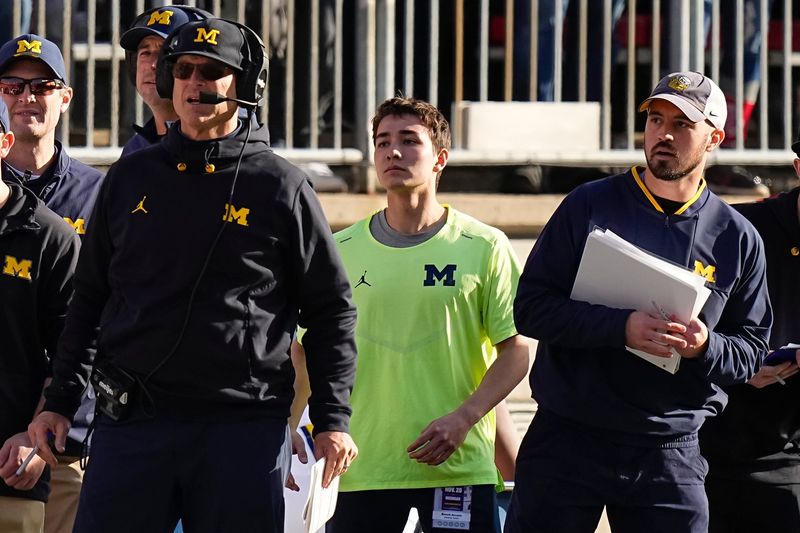
The Michigan football sign-stealing saga should be nearing a conclusion after representatives from the program, athletic department and university legal counsel met with the NCAA Committee on Infractions in June in Indianapolis to find a resolution and put the matter to bed.
Now, the man at the epicenter of the scandal, former recruiting staffer Connor Stalions, has spoken out on the matter once again, and seemingly left more questions than answers.

Yet, in an effort to prove gaining signs made no difference, he own-goaled himself.
Over the weekend, a report surfaced that TCU coach Sonny Dykes — who led the Horned Frogs to a somewhat surprising 51-45 win over U-M in the 2022 Fiesta Bowl in a College Football Playoff semifinal — was tipped off the Wolverines had his team’s signals.
“We had some intel that (the sign stealing) was going on,” Dykes said. “Look everybody does it to an extent, but we had some intel that it was kind of next level there.”
The Horned Frogs got the notice in enough time to change many of their signs, while keeping others the same. TCU ran for 263 yards against a defense which had previously allowed just 85 ground yards per game, and its 488 yards of offense was the second most by any team (Ohio State, 492) the entire year.
Stalions, however, implied U-M did not lose because it didn’t have the signs, rather he pointed to the players and the lack of execution. He also said the same thing when the team won: It was not because he had the signs, rather because the team played well that day.
“We lost because we turned the ball over & had a poor game tackling,” he said in a lengthy post on X early Saturday, July 12, replying to the report. “And TCU played well. Congratulations. The same way we won the Natty (when I was not with the program) because we blocked well, tackled well, and took care of the rock. Welcome to the game of football.”
Stalions said he was not “fooled” because the TCU signs that were changed were “dummy signals” from the quarterback to the wide receivers, however he was only focused on what was relayed from the offensive coordinator to the quarterback.
While sign stealing is not against college football rules, advanced scouting is, per NCAA bylaw 11.6.1 which was instituted in 1994 to ensure a level playing field — that’s what Stalions, through a group of intermediaries, is accused of doing.
In an effort to prove relaying opponent signs did not help Michigan, Stalions said Saturday there were seven games in which he “knew almost every signal the whole game: 2021 MSU, 2022 MSU, 2022 PSU, 2022 OSU, 2022 TCU, 2021 Georgia, and 2021 Wisconsin.”
Michigan went 4-3 in those games, while in the other 36 games during the three-year run from 2021-23 the Wolverines were an unblemished 36-0. While Stalions is of the opinion there’s no competitive advantage to be gained, what seems to be the logical follow-up question would be why would he go to such lengths to get the signs in advance and risk breaking the rules?
As a result, Michigan and staffers face 11 violations, including six level ones, the most troublesome of which is that former coach Jim Harbaugh “failed to monitor” his staff appropriately, given the alleged sign stealing went on for a span of three years at reportedly more than 50 games.
Stalions insists, it does not matter.
“We lost 3 of those games because we didn’t tackle well, and Georgia was historically good,” he wrote on X. “We won the four other games because we dominated the line of scrimmage & tackled well. Blocking, ball security, tackling, run fits & coverage tools. That’s football. This is not rocket science.”
Tony Garcia is the Michigan beat writer for the Detroit Free Press. Email him at apgarcia@freepress.com and follow him on X at @RealTonyGarcia.
This article originally appeared on Detroit Free Press: Connor Stalions leaves more questions with new outburst on Michigan football sign stealing
Reporting by Tony Garcia, Detroit Free Press / Detroit Free Press
USA TODAY Network via Reuters Connect