For decades, many Chaldeans lived in an area around 7 Mile east of Woodward Avenue in Detroit, opening up dozens of stores and other small businesses. The once-bustling neighborhood became known as Chaldean Town, reaching its peak in the 1970s and 80s, stretching between State Fair Avenue and 6 Mile, or McNichols Road. Much of the population later moved out to suburbs, such as Sterling Heights, but their history was once a vital part of Detroit for years.
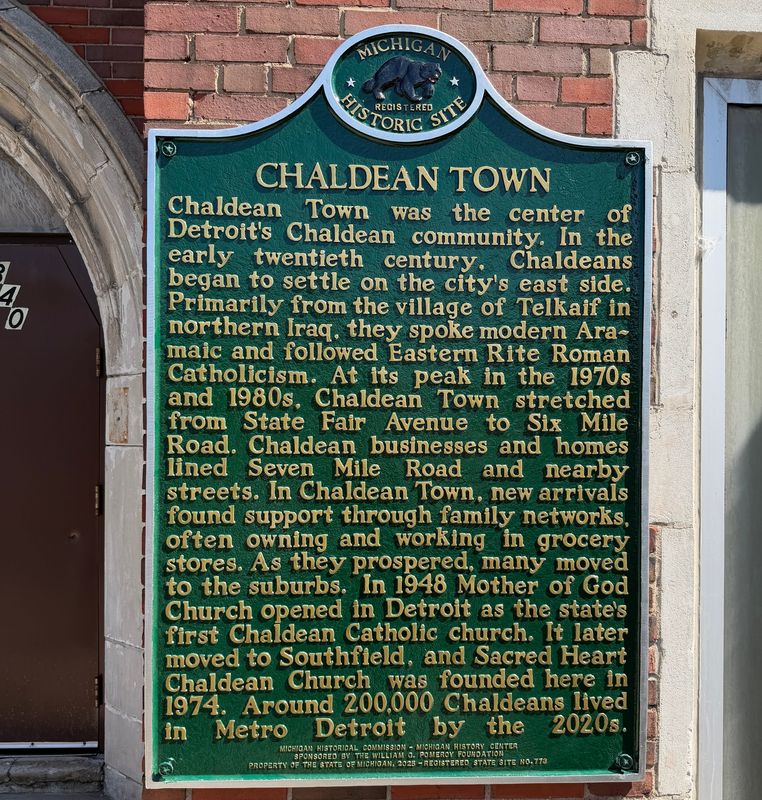
Their contributions were honored recently when a state historical marker recalling the history of the Chaldean community in Michigan was unveiled on 7 Mile in Detroit, celebrating the history of Iraqi Catholics, known as Chaldeans. At a time when the Chaldean population in Iraq is facing challenges, seeing its population plunge by more than 1 million since the start of the U.S. invasion of Iraq in 2003, they see the marker as a symbol of how Michigan has become a second home for the community.

The Michigan Historical Marker, which was approved by the state’s historical commission, is believed to be the first official state historical marker for any Middle Eastern community in Michigan, which has the highest percentage of residents of Middle Eastern descent among all states in the U.S.
“It’s very important because we’ve endured a lot,” said Weam Namou, an author and filmmaker in Sterling Heights who was previously the executive director of the Chaldean Cultural Center in West Bloomfield. “There’s always this attempt to erase our names.”
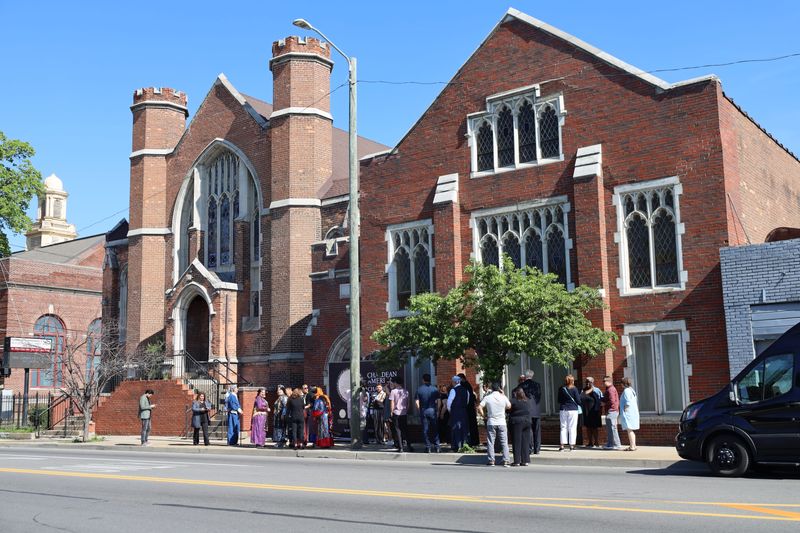
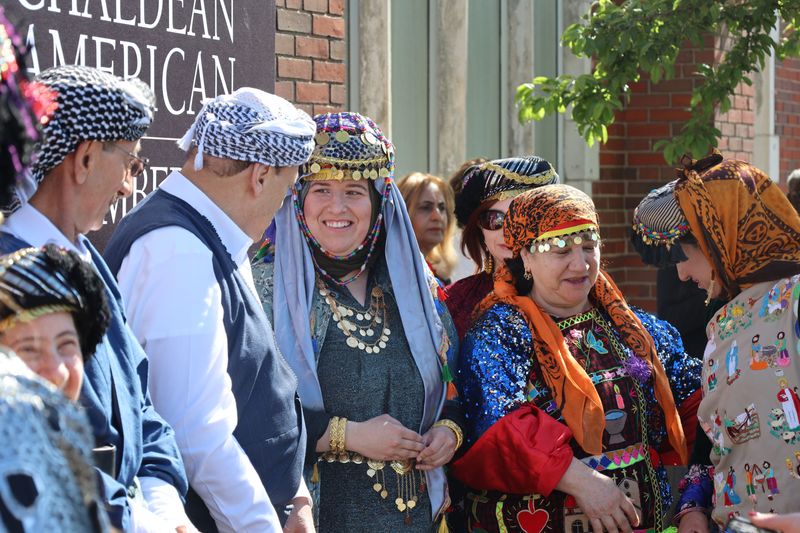
With some dressed up in traditional clothes reflecting their heritage, Chaldeans and supporters gathered on May 29 to unveil the sign, which is located on 7 Mile near Charleston Street, between Woodward Avenue and John R. The marker describes the history of the area, saying that Chaldeans arrived on Detroit’s east side in the early 20th century.
“Chaldean Town was the center of Detroit’s Chaldean community,” the sign reads. “Primarily from the village of Talkaif in northern Iraq, they spoke modern Aramaic and followed Eastern Rite Roman Catholicism. … Chaldean businesses and homes lined Seven Mile Road and nearby streets.”
The marker also describes the religious history of the community, noting that a Chaldean church, Mother of God, opened in Detroit in 1948, later moving to Southfield, and Sacred Heart Chaldean Church opened in 1974 on 7 Mile, closing about 40 years later.
“The marker for us is just trying to preserve our history here in Detroit, and the contributions we make,” said Martin Manna, president of the Chaldean American Chamber of Commerce and Chaldean Community Foundation, two Michigan groups. “If you don’t preserve your history, you’ll eventually lose your identity.”
More diversity needed in historical markers
There are more than 1,800 Michigan Historical Markers, but hardly any for minority groups such as Latinos, Asian Americans and Arab Americans, a review of the state list of historical markers shows. Until 2023, there weren’t any historical markers in Detroit for Mexican Americans, with only two statewide for Latinos. There doesn’t appear to be any for Asian American groups, such as Chinese Americans, who once established two Chinatown areas in Detroit. And there is still not a single state historical marker for Arab Americans in Dearborn, who have been part of the city for a century. In 2018, a historic mosque in Detroit that was the first center for the Nation of Islam became the first Islamic institution to get a state historical marker; no other Michigan mosques have a historical marker. Native American groups are also working to rectify some of the historical markers that are misleading and omit their history, reported Atlas Obscura. Advocates hope this new marker for Chaldeans can further promote diversity in recognizing the state’s history.
Census data from 2020 shows 46,846 residents in Michigan identify as Chaldean, 45,169 as Iraqi, 4,528 as Assyrian, and 477 as Syriac. Assyrian and Syriac people are also Iraqi Christians. The U.S. Census sometimes groups Chaldeans, Assyrians and Syriacs as one group. Some Chaldeans may identify as Iraqi when filling out census forms, and so the number of Chaldeans may be higher. The state historical marker says there are about 200,000 Chaldeans in metro Detroit.
The unveiling on May 29 came a few weeks after Gov. Gretchen Whitmer signed into law a bipartisan bill sponsored by State Representative Tom Kuhn, R-Troy, to designate May every year as “Chaldean American Month, recognizing the contributions of Chaldean, Assyrian, and Syriac Michiganders,” a state news release said. Kuhn attended the sign unveiling.
In 2003, there were about 1.3 million to 1.5 million Chaldeans and other Iraqi Christians living in Iraq, Namou said. Today, there are only about 150,000 at most. Militant groups such as ISIS targeted Christian areas of Iraq, and while those places were later liberated, the Chaldean villages and towns were heavily damaged; many Chaldeans are now reluctant to go back. Namou said the Chaldean population in Michigan may now be larger than in Iraq.
“We do feel like this is where we were able to retell our stories and to keep them alive,” she said. “That’s why it’s all the more important to preserve this. At least in Michigan, you can have a base here and a center here for the Chaldean community.”
Contact Niraj Warikoo: nwarikoo@freepress.com or X @nwarikoo.
This article originally appeared on Detroit Free Press: Chaldean historical marker recalls Iraqi Catholic community in Detroit
Reporting by Niraj Warikoo, Detroit Free Press / Detroit Free Press
USA TODAY Network via Reuters Connect
By Niraj Warikoo, Detroit Free Press | USA TODAY Network