How do you know if somebody actually intended to kill another person? How do you know for sure?
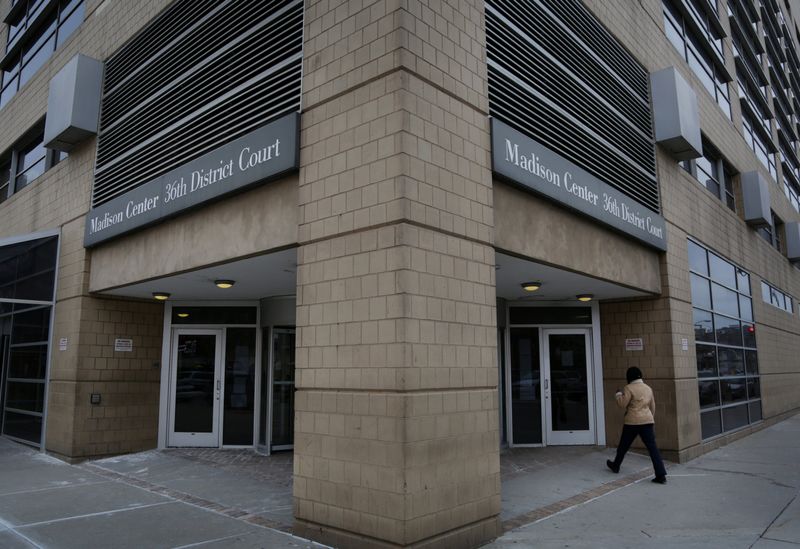
Last month when I was called to serve on a jury in 36th District Court, that was the question we had to decide: whether the well-dressed man who looked to be in his 30s, sitting with his lawyer on one side of the courtroom, intended to kill another man when he shot him multiple times with a handgun, or whether he was just trying to injure him.

Or was it self-defense?
Of all the six charges the defendant was facing, including four gun possession charges, the two very serious charges of assault with intent to commit murder and assault with intent to commit great bodily harm less than murder caused the most discussion at the conclusion of the trial. Because we knew a man’s liberty was at stake.
In the beginning, the judge instructed us jurors about a lot of things, from how to behave in court to how to best weigh the evidence we would hear once the case began. But one thing she said stuck out: “none of this works without you.” If jurors don’t take the job seriously, the consequences can be life-shattering for the person whose fate they hold in their hands.
That’s a sobering thought. Even more sobering is the thought that as a juror, you are expected to decide the fate of a total stranger, in a room with 11 other total strangers. But what’s encouraging is that most people are pretty decent human beings. We may all come from widely varying walks of life, as we did in the jury I served on, but closed off in a room for several hours after spending seven days witnessing a trial in which the fate of someone’s life was at stake, everyone recognized the seriousness of the assignment. Not one of the 12 chosen were in any rush to decide, just because they had somewhere else they’d rather be.
Inside Detroit’s 36th District Court
I should say that I have served on juries twice before in Wayne County, although that has been more than a decade ago and neither were quite this long. Still, I had an idea of what to expect, whereas most of the other jurors, new to the process, did not.
It all started when I received my summons in December letting me know that I was due to report to the Criminal Justice Center in February at 7:30 am.
Yes. You read it right. 7:30 a.m. And that’s what I said, too, when I saw I actually had to report, although such a word cannot be reprinted in a family newspaper. Was it really this early before…?
When my date to report came, I had to search a little for parking. Once at the building, after passing through security screening, the large crowd of folks was directed upstairs to the 2nd floor, where the line to enter the jury room stretched around the corner and waaaaay down the hall. Fortunately, there were benches to sit on. Plus, unlike at Frank Murphy, cell phones are now permitted, they just have to be kept on silent. That meant we were all free to not look at one another for the duration, and not feel guilty about it. I brought my ear pods, essentially for the same purpose.
Once the doors to the jury room opened, the line moved slowly, as each person eventually made it to what I guess you could call the customer service window up front (I’m quite sure they don’t call it that), where our names were checked off as present and accounted for and we were each given a red JUROR badge to stick visibly on our shirt, blouse, or wherever. After which we entered the crowded jury room, and sat there as employees issued instructions from the front.
Time ticked away as group after group was called, and I was starting to think maybe I wouldn’t have to serve. Even sent a text to my wife at 10:14 am saying “So far, so good.” Several minutes later, I texted a curse word as my name was called to join a group of other selectees chosen for a particular courtroom.
Weighing the evidence
Eventually we were called in, and the judge apologized for the long delay. She also explained the basic nature of the case that was being heard. We were introduced to the prosecuting attorney and the defense attorney.
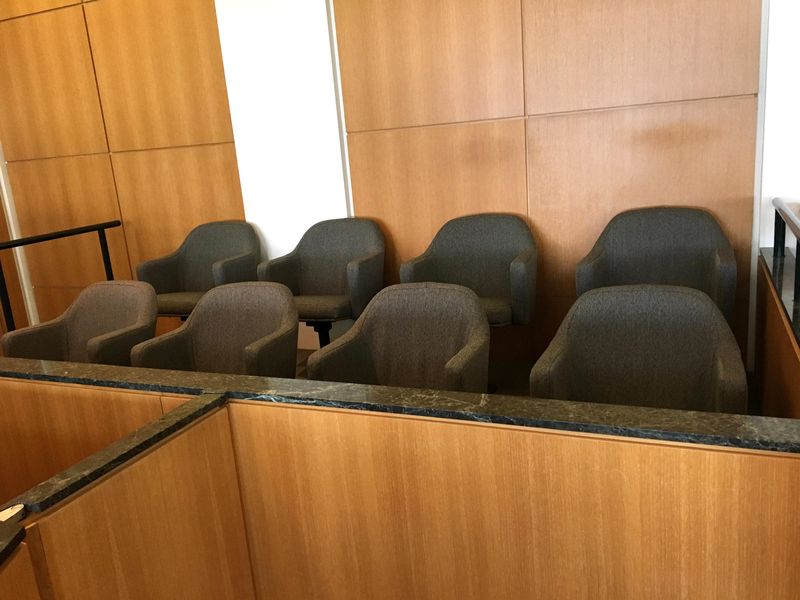
After that, 14 from our group were randomly called to the jury box, where each was questioned first by the judge and then by both sides to determine whether or not the potential juror would be a good fit for this particular trial. This process of elimination went on for quite a while, as some made it plain they did not want to be there. A few others had valid excuses. Others exhibited personal issues that might cause a problem, and some were excused by what’s known as a peremptory challenge, meaning the lawyer didn’t have to give a reason – although a few times it wasn’t hard to figure out what the reason was.
Late in the selection process, which took two days, I was eventually called to enter the jury box. I was asked a series of questions, some of them related to the nature of the case to determine if my personal life experiences might cause me to be prejudiced one way or the other. Ultimately, I made the cut, and by the end of the second day, the final 14 members of the jury (12 jurors and two alternates) had been selected.
When the trial began, the prosecuting attorney made his case for why he believed the defendant should be convicted of assault with intent to commit murder. A number of slides and videos were introduced showing the crime scene, a car wash parking lot. We saw videos of the gun being fired, of a physical altercation between the defendant and the victim, as well as a police interview of the defendant after he had been taken to the hospital for an injury to his hand that happened during the altercation.
We were shown videos of the defendant deliberately parking his car in front of the victim’s car, allegedly blocking him in from leaving, as he got out of his car and approached the victim’s car moments before the altercation began, with the defendant visibly throwing blows at the victim, who was inside the car at the time.
The gunshots occurred after the defendant fell – or was somehow pushed – backwards away from the victim’s car. That’s when he fired six shots at the victim, who was hit four times. Another video showed the victim stumbling out of his car after being shot, and then later on the pavement behind the car as paramedics arrived.
And, of course, the defense attorney made his case for why his client should be found not guilty.
A boost I needed
After nearly four hours of what I can honestly say was careful deliberation, our jury rendered the verdict, slightly before 12:30 p.m. on a Wednesday afternoon. After some lengthy discussion, we managed to agree on a verdict that we were all comfortable with: guilty of assault with intent to do great bodily harm less than murder, but not guilty of assault with intent to commit murder, because we could not reach a unanimous verdict on that charge. We also decided the defendant was guilty of two of the four related gun possession charges.
The jury comprised an Arab woman, a Black woman, three white men, two Black men, two white women and one Hispanic man. We had only been asked to confirm that we were residents of Wayne County, so let me offer that disclaimer before I say I’m pretty sure we were not all from Detroit.
After the trial was over, the judge came back to discuss how we had arrived at our decision.
We explained how as a group we were unable to reach unanimous agreement on the charge of assault with intent to commit murder because for some of us, intent was a hard thing to prove beyond a reasonable doubt.
But the discussion itself, in which everyone listened to one another, and no one’s views were dismissed, was one of those experiences that gives me faith in my fellow man, and I kinda feel like I need that right now.
In a time when it seems like the law is under such attack, here was evidence that the justice system could still work. That total strangers could work together in a civil and respectful manner when necessary to decide an important issue.
“Well,” said the judge after listening carefully to everything. “they certainly can’t say they didn’t get a fair trial.”
And that’s all we could have asked for.
Free Press contributing columnist Keith A. Owens is a local writer and co-founder of Detroit Stories Quarterly and the We Are Speaking Substack newsletter and podcast. Submit a letter to the editor at freep.com/letters, and we may publish it online and in print.
This article originally appeared on Detroit Free Press: A Detroit jury restored my faith in the justice system | Opinion
Reporting by Keith A. Owens, Contributing columnist / Detroit Free Press
USA TODAY Network via Reuters Connect