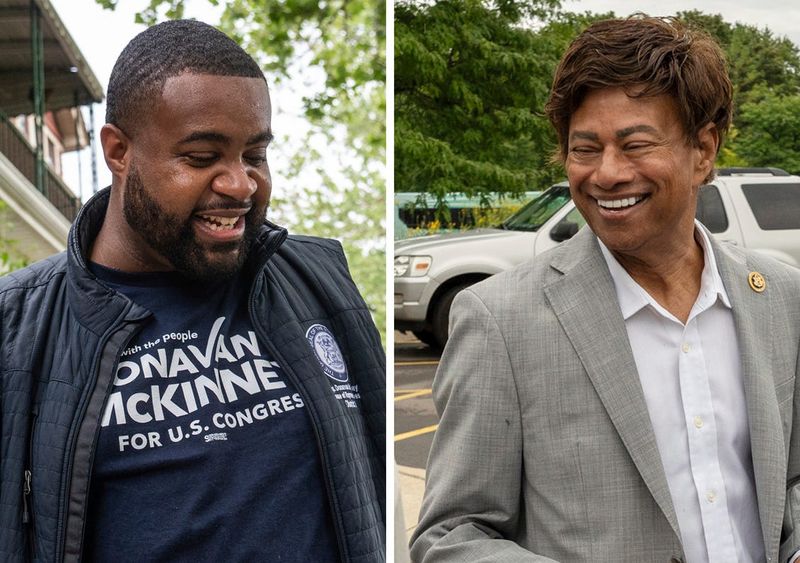
A crowded Democratic primary that divided Detroit voters four years ago led U.S. Rep. Shri Thanedar to Washington, D.C. But now a one-on-one race against state Rep. Donavan McKinney, political observers say, presents the greatest threat to Thanedar after the city’s political power brokers have tried for years to deny him a seat in Congress.
This time, they have help from the left flank of the Democratic Party. Detroit Democrat McKinney brings anti-establishment swagger to the race to represent Michigan’s 13th Congressional District – among the poorest in the U.S. He boasts support from U.S. Sen. Bernie Sanders, I-Vt. and Metro Detroit’s Democratic Socialists of America chapter.

In successful Democratic primary challenges across the U.S., McKinney, 34, sees voters unhappy with the status quo and clamoring for change. He echoed a common left refrain contrasting U.S. military spending abroad with cost of living challenges at home in excoriating President Donald Trump’s War in Iran, which he described as a costly foreign conflict against the backdrop of American suffering. “To me that’s (expletive) up,” he said. He said he defines politics as “the redistribution of resources” and also emphasized the importance of restoring Black representation to a congressional district with a long history of Black civil rights leadership.
As he seeks re-election, Thanedar, 71 of Detroit, has emphasized his fight against the Trump administration, noting his impeachment resolutions against the president, Secretary of Defense Pete Hegseth and former U.S. Attorney General Pam Bondi. An immigrant to the U.S. from India, Thanedar has also spoken out against the Trump administration’s immigration crackdown and introduced legislation to abolish the U.S. Immigration and Customs Enforcement agency.
Unlike some other Democratic Socialists’ fights to knock out incumbents, Thanedar once affiliated himself with the Democratic Socialists of America. He relinquished his membership following Hamas’ Oct. 7, 2023 attack in Israel, saying the group didn’t sufficiently condemn the violence. In both of his re-election bids, Thanedar has had the support of the pro-Israel American Israel Public Affairs Committee.
In contrast to McKinney, Thanedar, in an interview, did not describe Israel’s war in Gaza as a genocide. While Thanedar once called for halting U.S. military aid to Israel as a lawmaker in the Michigan House of Representatives, he recently rejected an amendment to a U.S. Department of State funding bill that would have done just that. McKinney, meanwhile, has said he wants to cut off military assistance for Israel.
“Everybody wants to make this about Israel,” Thanedar said. “It’s not,” he added later. When he talks to voters, he said, he hears them express concerns about affordability and corruption in the Trump administration.
In seeking to represent poor district, both share stories of poverty
In their campaigns, both McKinney and Thanedar have shared their own stories of growing up poor. In an ad, McKinney talks about the severe housing instability he experienced as a child in Detroit. Thanedar, in his own ad, discusses working as a janitor and sleeping in his car as a student in the U.S.
But McKinney’s ad attacks Thanedar as a self-funded millionaire who “bought his seat” in Congress and “has more in common with Donald Trump and Elon Musk than people like us.” Thanedar – who made his money as a pharmaceutical entrepreneur – first emerged on Michigan’s political scene in 2018 when he ran for governor and spent $10.3 million of his own money on his unsuccessful bid. In his current re-election race, Thanedar has given his campaign an $800,000 personal loan, according his July quarterly filing with the Federal Election Commission. He has also invested campaign funds in cryptocurrency. He has posted both massive investment gains and losses this cycle.
McKinney had about $264,000 cash on hand to Thanedar’s nearly $4.7 million, according to their July campaign finance reports. But McKinney has benefitted from nearly $1 million in spending by outside groups, per FEC data.
Branden Snyder – Michigan State Director of Working Families Party which has endorsed McKinney – described Thanedar as a “multimillionaire running for office disconnected from the issues and concerns of our community” in contrast to McKinney – a native Detroiter – whom he described as rooted in the 13th District and a fighter for the community.
Thanedar pushed back against the attack against his wealth.
“Look, when I became successful you know I achieved my American Dream, and I want every child in Detroit and my constituency to achieve his or her American Dream. Nobody should be condemned or demonized for succeeding and pulling themselves out of poverty,” he said.
McKinney cast the stakes of the race in personal terms, describing the U.S. Supreme Court’s gutting of the Voting Rights Act poised to impact Black congressional representation and Black participation in democracy. He vowed to “fight like hell not only for Black rights” but everyone impacted by the Trump administration, which he described as a “fascist regime.”
“If you help Black people, you’re helping everybody because we’re on the bottom of the totem pole in this country,” he said.
The Tuesday, Aug. 4 election is not the first time McKinney and Thanedar have faced off in a Democratic primary.
The path to the 2026 primary
Thanedar saw an electoral bright spot in his primary loss to Gov. Gretchen Whitmer in the 2018 governor’s race: He won the highest share of votes in Detroit.
Ahead of the next statewide election in 2020, Thanedar moved from Ann Arbor to Detroit and ran for a seat in the Michigan House. Thanedar won 35% of the vote in a Democratic primary that featured eight candidates, including McKinney, who came in second. Thanedar then breezed through the November election.
In 2022, Thanedar prevailed in another crowded intraparty contest for his current congressional district, winning 28% of the vote in a race against eight Black Detroiters. The primary election essentially decides the winner in the solid blue district which encompasses part of Detroit, along with all of Hamtramck and Highland Park, the Grosse Pointes and Harper Woods, several Downriver communities and a couple of communities in western Wayne County.
Thanedar’s victory marked the first time Detroit didn’t send a Black representative to Washington, D.C. since 1955. McKinney also made history in the same election when he won a seat in the Michigan House, becoming one of the first Black lawmakers to represent Macomb County in the chamber. McKinney’s district includes parts of northeast Detroit and Warren.
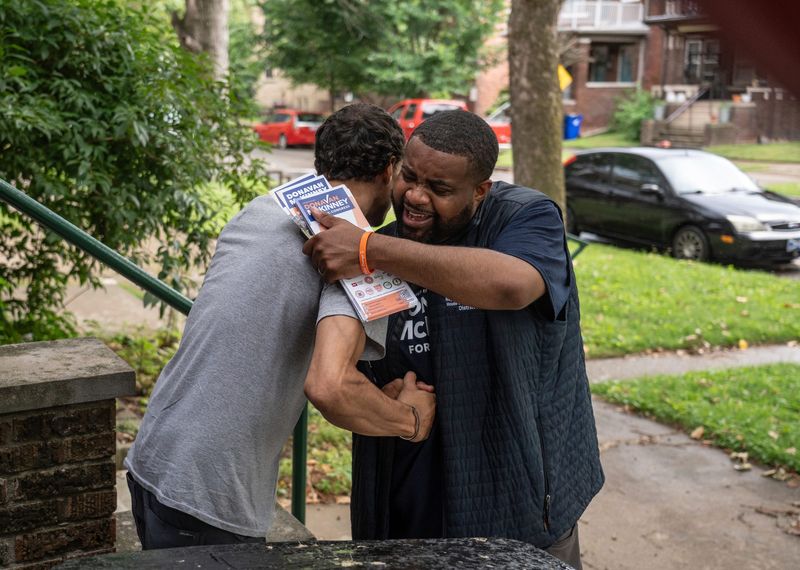
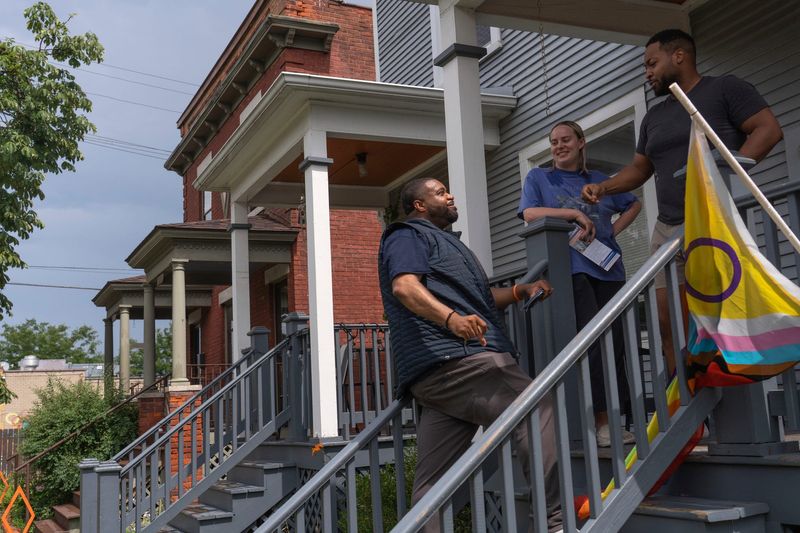
Mel Martin, 32, of Detroit, who said he has known McKinney since high school described his friend as a bridge builder. “And I just think that’s something that we really need,” Martin said after McKinney stopped by his porch on a recent door-knocking swing in Detroit.
While Thanedar’s political opponents had hoped to make him a one-term congressman, the 2024 election saw them fail to mount a successful challenge.
Former state Sen. Adam Hollier, D-Detroit, amassed the support of prominent Black political and faith leaders in his campaign against Thanedar but he was knocked off the ballot for failing to submit enough valid voter signatures to qualify. With 55% of the vote in the Democratic primary, Thanedar fended off challenges from At-Large City Councilmember Mary Waters and lawyer Shakira Lynn Hawkins.
Waters tried to run again in the upcoming primary, but she and Democrat John Goci were was disqualified for submitting an insufficient number of voter signatures.
“All I have to say is, God is great,” McKinney said.
Attacks fly in Detroit’s Democratic primary
A two-term incumbent like Thanedar should be hard to beat, said Michael Griffie, a Democrat who ran against Thanedar in 2022. But the one-on-one race, support from Justice Democrats (which has a history of ousting Democratic incumbents) and left populists who have notched election victories create headwinds for Thanedar, Griffie said.
“So in that regard, I feel like Shri – I’m not going to say he’s in trouble – but I think this is a toss-up right now,” he said.
Wayne County Commissioner Jonathan Kinloch who chairs the 13th Congressional District Democratic Party, which has endorsed Thanedar, said the congressman hasn’t done anything to warrant his ouster.
While Kinloch sees the potential for a closer primary race than in the past, he expressed confidence in Thanedar. “I think Shri is going to be able to make it through,” he said.
Thanedar has hit voters’ mailboxes with a flurry of attack ads, calling his opponent “Dirty Money McKinney.” Among the campaign contributions received by McKinney Thanedar blasts is a donation from Matthew Moroun, who owns the Ambassador Bridge and has also donated to pro-Trump PACs.
While knocking on voters’ doors in Detroit’s Woodbridge neighborhood, McKinney was approached by a woman who expressed her hatred for the Moroun family – the longtime owners of the span connecting Detroit and Canada’s Windsor. McKinney said that he used the money to pay for community events in his district.
“Promise?” asked the woman, who declined to provide her name to the Detroit Free Press.
“Promise” McKinney responded.
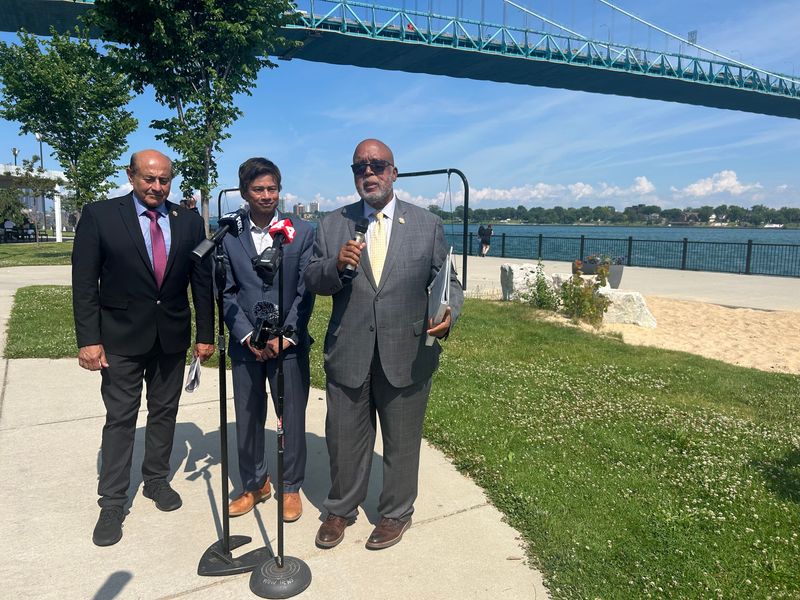
The foot of the privately-owned bridge at the center of Thanedar’s attack recently served as a stage for him to display his support from some congressional Democrats, even as his other colleague from Detroit – U.S. Rep. Rashida Tlaib – has endorsed his opponent.
In the summer heat, Thanedar held a news conference calling on Trump to open the Gordie Howe Bridge opposed by the Moroun family (Trump who previously stalled the new bridge’s opening has since agreed to a new deal). During Thanedar’s July 7 event, U.S. Rep. Bennie Thompson, D-Miss., spoke positively of the Detroit congressman.
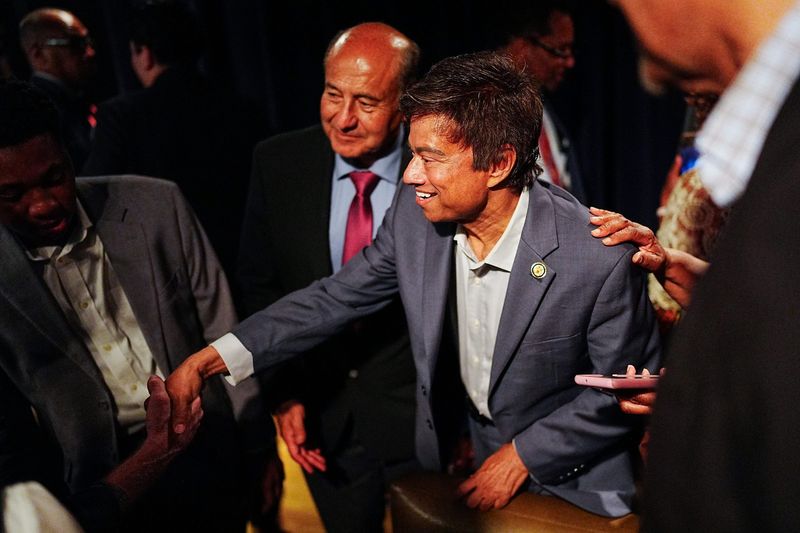
“He does work well. He comes to work. I don’t care what people say. The record speaks for itself,” Thompson said. “So I want the people in this area to know they have a good member, and that member is someone who cares for this community.” Thanedar beamed as Thompson complimented him. During a voting rights town hall later that day, Thanedar waved at the crowd and took selfies before calling for high voter turnout to combat what he described as efforts by the Trump administration to suppress the vote.
Thanedar has also attacked McKinney’s voting record in the Michigan House, but McKinney has pushed back, saying the claims lack context.
For instance, Thanedar claims that McKinney voted against Democratic priorities such as increasing the minimum wage and paid sick leave. But McKinney joined a majority of House Democrats in opposing legislation that raised the minimum wage more quickly than the original proposal but kept intact a lower minimum wage for workers who received tips. He also joined most House Democrats in opposing a watered down sick leave proposal.
McKinney’s allies have also zeroed in on Thanedar’s voting record, saying that he voted for a resolution thanking ICE. They’re referring to Thanedar’s vote on a resolution condemning a man who attacked demonstrators in Boulder showing support for Israeli hostages held by Hamas. The resolution became controversial among Democrats for expressing “gratitude to law enforcement officers, including U.S. Immigration and Customs Enforcement personnel, for protecting the homeland.”
Sanders is to hold a rally in Detroit Saturday, July 18 to stump for Democratic U.S. Senate candidate Abdul El-Sayed. McKinney is slated to appear at the event. Kinloch – the chair of the 13th District Democratic Party – noted that Sanders can draw large crowds. “But just because they’re loud, don’t mean they’re going to win,” Kinloch said.
Detroit Free Press Intern Tristan McFolley contributed to this report. Contact Clara Hendrickson at chendrickson@freepress.com or 313-296-5743.
This article originally appeared on Detroit Free Press: 2026 has seen ousters of Democratic incumbents. Could Shri Thanedar be next?
Reporting by Clara Hendrickson, Detroit Free Press / Detroit Free Press
USA TODAY Network via Reuters Connect
By Clara Hendrickson, Detroit Free Press | USA TODAY Network