

Clerk explains different sections on city water bills
By Barb Pert Templeton

The Marine City Commission approved Ordinance 26-001 to amend 51.35 related to water rates and 52.60 related to sewer rates and continuing debt service charges at a June 4 meeting. Commissioner Trish May was absent from the recent meeting.
The motion to approve the ordinance was made by Commissioner Jacob Bryson and a second was offered by Commissioner Sean O’Brien. There was no discussion on the issue last night.

A public hearing was held at the commission’s last meeting, prior to the first reading of the amended ordinance, on May 21 but nobody stepped to the microphone to be heard.
At that time Mayor Pro Tem Lisa Hendrick pointed out that the main increase for users was $4.86 per quarter and asked if users in Cottrellville would also pick up that new charge. Attorney Robert Davis replied that yes, and said those residents would pay no more or no less than citizens in Marine City.
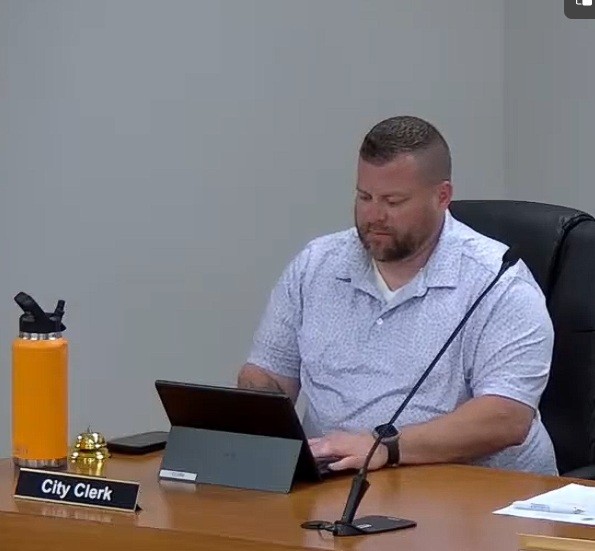
Marine City Clerk Jason Bell at the June 4 meeting of the city commission.
Former City Manager Michael Reaves also stated at that time that he wanted to point out once again that the increase comes from the $3 million Capital Improvement Project (CIP) bond taken for the sanitary and storm repairs in Phase 3 of the city’s ongoing water main project. He said doing that work the city determined 20% of the issues are sanitary and 80% are storm.
“The increase is based on that 20% percent increase that we are seeing at this point,” Reaves stated.
Blue Water Healthy Living sent a number of questions to Marine City Clerk Jason Bell seeking an explanation of the new ordinance and some of the specific charges for customers listed on each bill.
Blue Water Healthy Living: What exactly is a commodity charge? Does everyone get both water and sewer charges for this?
Marine City Clerk Jason Bell: The commodity charge is for usage per 1,000 gallons of water. So, 1 unit = 1,000 gallons. If residents use water, they get the commodity charge for water/sewer.
BWHL: What is the average amount of gallons for a house? What might drop or increase this?
Bell: I cannot provide an exact average usage but we have always been told it is about 2,000 gallons per person per month. Water conservation tips would drop this usage number or summer months would increase this.
BWHL: What the average size of a residential meter?
Bell: Most of our residential meters are 3/4″.
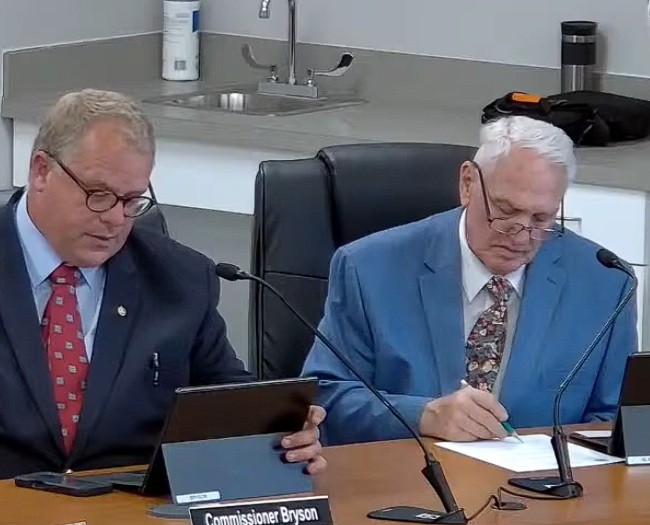
Commissioner Jacob Bryson made the motion to approve the amended water/sewer rate ordinance. Commissioner William Klaassen is pictured on the right in this photo.
BWHL: In comparison what might a business meter size be?
Bell: Business meters can range from 1″ to 6″ depending on the need for that particular business.
BWHL: What is a debt service collection water/sewer? So, everybody gets two fees for this based on meter size?
Bell: The debt service collection is for bonds the city took out for the Safe Drinking Water Project and capital improvements. Those bonds will be repaid over 40 years so these fees collect money for those payments.
BWHL: What are Ready to Serve fees? (Again, based on meter size)
Bell: From the ordinance: “A Ready to Serve Fee that will provide for the costs associated with the use, operation, maintenance and capital improvements of the water, sewer and storm water supply systems” These fees are based on the meter size as well.
BWHL: Sprinkler fee is noted as being $55 per quarter – is that for lawn sprinklers at homes? So, apartments won’t be charged this fee?
Bell: Sprinklers are for any account that has a sprinkler system. Most are separate from their regular household metered water. Apartments could have this fee if they have a sprinkler account.
BWHL: So, each billable customer is automatically charged for commodity, debt service & Ready to Serve?
Bell: Each billable customer is automatically charged for Ready to Serve Water and Sewer and the two debt service fees. Those are what the city considers the base bill without any usage at all. If the account has a meter, those fees are what they are charged. Commodity is if they only use water. I hope that makes sense as it does get a little confusing.
BWHL: What do you mean the only change in the ordinance is the debt service collection? (How come there’s been so much concern about the bills for water service soaring?)
Bell: Those other large increases were approved last fall and took effect in January 2026 based on the Water Rate Study we conducted. The only new change in the fee ordinance is for the new Capital Improvement Bond debt service. That large increase in January 2026 was an increase of $75 to the base bill and larger increases would be based on usage for the user.
To read this ordinance in full go to marinecity.gov.
