Get ready, California stargazers: Now is your chance to see a comet that takes more than five years to return to Earth’s cosmic neighborhood.
Dust off your telescopes and binoculars, as Comet 10P/Tempel 2 won’t be visible to the naked eye. The extra work to spot it may be worth it, though, to see the space object’s fuzzy glow and striking tail.

What’s more, astronomers believe tonight (July 14) may be the best time to spot the comet, as a new moon means our celestial neighbor won’t outshine it in the night sky.
Here’s everything to know about Comet 10P/Tempel 2, and how you can spot it in California and across the United States.
What is Comet 10P/Tempel 2?
Comets differ from asteroids in that, as opposed to the rocky counterparts, they are balls of frozen gases, dust and other materials. NASA even likens them to “cosmic snowballs.”
First spotted in 1873 by comet-hunter Wilhelm Tempel, Comet 10P/Tempel 2 is what’s known as a short-period comet due to its relatively brief orbit around the sun. In Tempel 2’s case, the comet returns to the inner solar system once about every 5½ years, making it briefly visible from Earth.
The comet is estimated to be roughly 10 kilometers wide, which is slightly smaller than the famed Halley’s comet that produces two annual meteor showers.
While asteroids appear as a point of light, comets are still active and can produce a glowing tail as its material starts to vaporize when it gets close to the sun, according to NASA.
When, where to see Comet 10P/Tempel 2
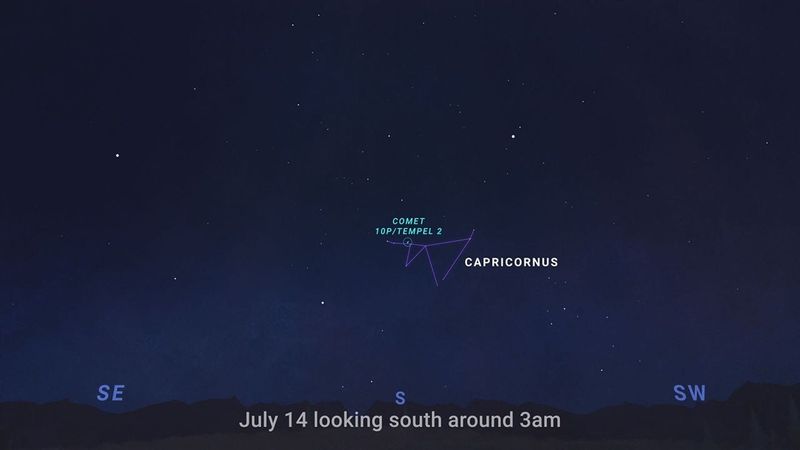
The comet should be easiest to spot about an hour after sunset Tuesday, July 14, NASA said in a monthly skywatching guide.
Look south to find the constellation Capricornus, and the comet shouldn’t be too far away.
How full will the moon be? What to know about new moon, lunar phase
The comet will be making its appearance as we get a new moon, according to the Old Farmer’s Almanac. That means Earth’s only natural satellite will be invisible to Earth as its illuminated side faces the moon, NASA explains.
That’s good news for stargazers, as the moon’s light won’t be an interference.
How to see the comet tonight. Do you need binoculars?
Unfortunately, though, Comet 10P/Tempel won’t exactly be a dramatic sight that anyone can see with the naked eye.
Optical aid like binoculars and telescopes will be required to spot it in the night sky, according to a video shared by NASA.
“Look for a small fuzzy glow nearby, possibly with a brighter central knot and a short, broad, fan-shaped tail,” the space agency advised.
Where are the dark sky locations in California?
Want to try to catch a glimpse of comet? Spectators will have the best luck at dark sky locations on cloud-free nights and away from city light pollution.
To find a dark area near you, turn to DarkSky International. The U.S nonprofit that maintains a list of designated dark sky communities around the world, including 176 in the United States.
That includes these locations in California:
Eric Lagatta is the Space Connect reporter for the USA TODAY Network. Reach him at elagatta@usatodayco.com
This article originally appeared on Palm Springs Desert Sun: A comet returns to Earth for 1st time in 5 years. Spot it in California
Reporting by Eric Lagatta, USA TODAY NETWORK / Palm Springs Desert Sun
USA TODAY Network via Reuters Connect
By Eric Lagatta, USA TODAY NETWORK | USA TODAY Network