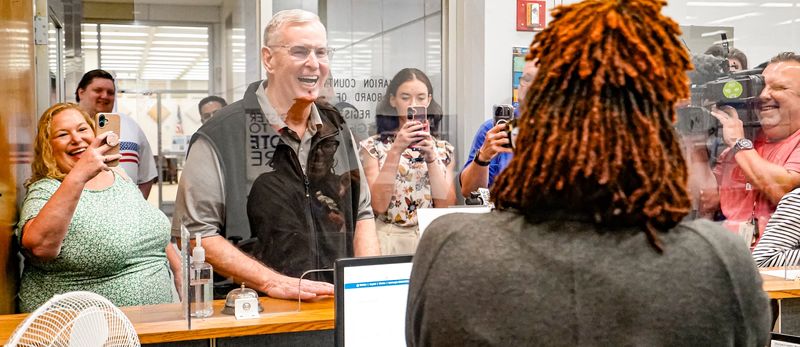
Greg Ballard is running for Indiana secretary of state as an independent to make it easier for other independents to run for office. He easily gathered enough certified signatures to get on the ballot. He will likely gather the 2% of the vote necessary to obtain major party status and automatic ballot access for his Lincoln Party.
That proves how easy it is for a small group with hundreds of thousands of dollars to gain the same power as generations-old, well-organized political parties. Indiana Republicans will likely respond to this problem by making it harder to qualify as a major party with automatic ballot access.

They need to realize, though, that Ballard’s campaign didn’t prove the existing rules aren’t strict enough. It proved the way Indiana recognizes who deserves a spot on the ballot and who qualifies as a major party is fundamentally flawed.
Ballard’s Lincoln Party is just an idea
Ballard is asking voters to trust him and hand over enormous power to an organization he will have a great deal of power over. It has no platform, no members and no county organizations that could stand in his way at this moment.
Assuming he gets 2% of the vote, his party will nominate candidates by a convention — in other words, by party insiders.
That’s not necessarily a bad thing. Indiana Republicans, Democrats and Libertarians all nominate some positions by convention. They all have an established identity, though, and opposing factions are willing to hold party leadership accountable. All three are decently well organized.
The Lincoln Party does not have a clear message outside of Ballard himself. Collecting 37,000 signatures doesn’t prove a party built around Ballard will be a worthwhile, accountable alternative.
Signatures are a weak proof of support
The ability to afford professional signature gatherers doesn’t mean a candidate is creating “a movement” that deserves to be on the ballot. These signature gatherers often hassle customers coming out of the grocery store or those attending a fun community event. It is relatively easy for people to sign a paper to get signature gatherers to stop bothering them.
Signing the signature form requires no commitment to Greg Ballard or the Lincoln Party. It doesn’t even require people to know what they are signing. A significant number of those signatures are challenged and thrown out anyway. One volunteer was accused of forging signatures.
Signature requirements should be scrapped altogether in favor of a donations requirement for independents to get on the ballot. Getting $1 donations from 37,000 separate Indiana residents is a much better indicator of support and commitment than a signature. It’s also apparently a lot cheaper. Ballard’s campaign spent $150,000 as of mid-May to hire a North Carolina-based firm to get those signatures.
Membership means more than losing an election
That fixes how a candidate gets on the ballot. The bigger problem is how a party earns lasting recognition.
An independent candidate obtaining 2% of the vote in the secretary of state’s race doesn’t mean a candidate is creating “a movement” that deserves automatic ballot access for four years.
A better sign is the number of members they can get to commit to a political party organization. Florida, for example, automatically grants major party status to minor parties with membership that equals at least 5% of the number of registered voters in the state. Indiana had 4.7 million registered voters as of January 2024, 5% of which is around 234,000 members.
That number is extremely high, though. In today’s anti-institutional era, it’s unlikely to find that many people willing to join a political party that can give them little in return.
The Libertarian Party of Indiana, for example, is considered a major party with just 700 dues-paying members. Yet 700 people who show up and pay dues every year say more about a party’s staying power than a single election result.
With that in mind, obtaining statewide major party status should also require the existence of a county organization with at least two members in all 92 counties. That would ensure all of Indiana is represented in the party and has a voice in the nomination process for candidates at the party convention. The Libertarian Party of Indiana only has 40 affiliated county parties, but this would be a great incentive for their leadership to focus on strengthening local chapters.
Obtaining statewide major party status should also require a track record of success. The Libertarian Party of Indiana has 12 elected officials who give statewide voters an example of how the party’s candidates will govern.
Members, organizational structure and local elected officials are more meaningfully connected to popular support for a political party than its ability to get a small minority of the vote in a low-profile statewide race.
Making those the minimum standards would obligate minor parties to build something worthwhile, connect to local voters and serve them directly. That’s better than encouraging them to waste their time and money running for a statewide office they have no chance of winning.
Contact Jacob Stewart at 317-444-4683 or jacob.stewart@indystar.com. Follow him on X, Instagram, Facebook and TikTok.
This article originally appeared on Indianapolis Star: It’s too easy to start a new political party in Indiana | Opinion
Reporting by Jacob Stewart, Indianapolis Star / Indianapolis Star
USA TODAY Network via Reuters Connect


By Jacob Stewart, Indianapolis Star | USA TODAY Network