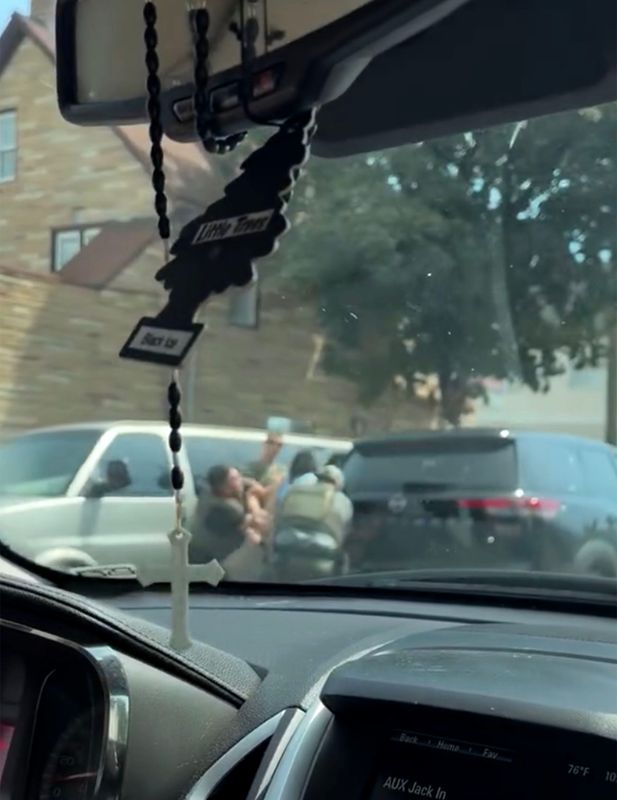
On a quiet residential street on Milwaukee’s near south side on June 27, immigration agents surrounded 31-year-old Estenderly Marte Polanco while she was sitting in her car.
They smashed the driver and passenger windows, pointed a Taser briefly at the father of her child sitting in the driver’s seat, then dragged her outside as she screamed, videos show – in front of their 7-year-old son in the backseat.

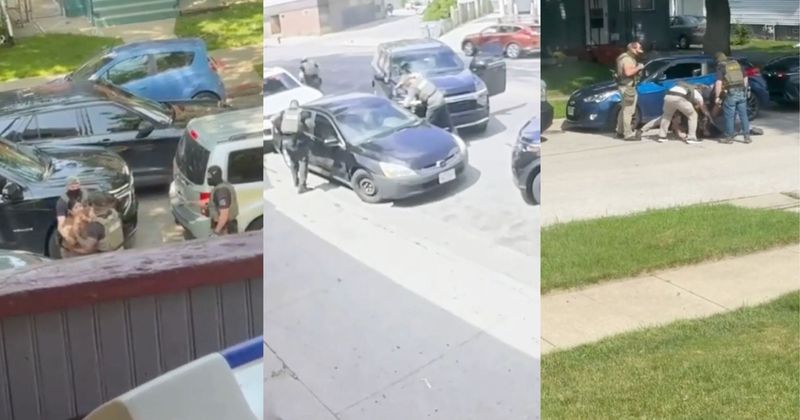
Marte Polanco’s arrest, which was recorded by bystanders, was one of the most visible examples of the forceful tactics used by U.S. Immigration and Customs Enforcement agents during a wave of arrests in southeast Wisconsin the last week of June.
The Milwaukee Journal Sentinel obtained and analyzed bystander video of 17 of the arrests from June 25 to July 1, verifying when and where they were taken using geolocation data and information provided by immigration advocacy groups.
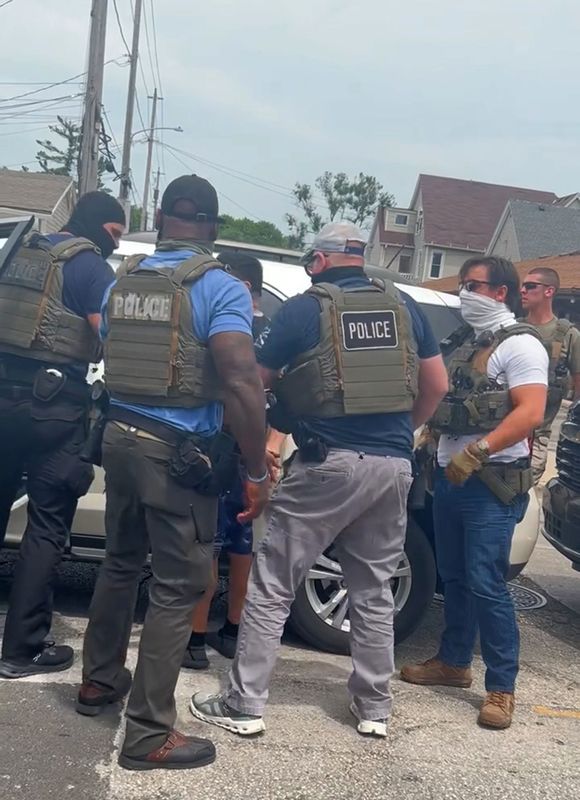
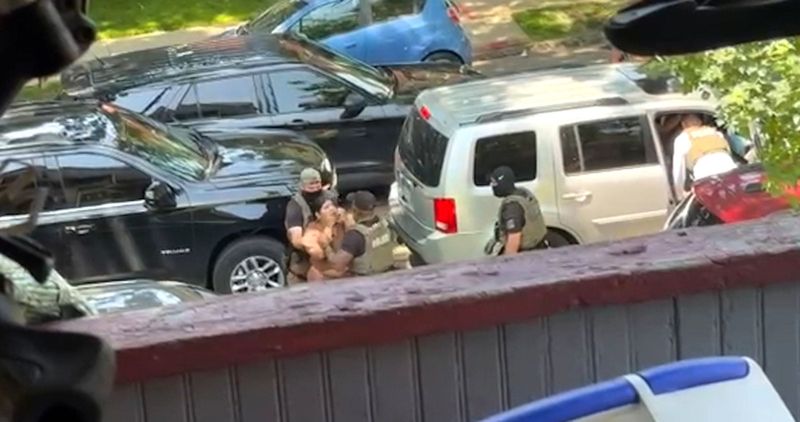
The videos showed ICE agents boxing in cars, pointing guns and Tasers at people, breaking car windows, and pinning people on the ground. Many drove in unmarked vehicles and wore face coverings. Most of the arrests took place in public areas, with witnesses.
The tactics mark a departure from the more discreet arrests that have taken place in Wisconsin over the past year, which often involved ICE agents picking up people directly from jails or prisons. Instead, policing experts said the techniques used appeared to align with the more high-profile operations over the past year in cities like Chicago and Minneapolis.
The Journal Sentinel’s video analysis found:
Law enforcement experts consulted by the Journal Sentinel differed in their viewpoints on the tactics used in the videos. One former police chief said many are standard in federal law enforcement.
But others said agents were using non-recommend practices and appeared to be escalating situations. Marc Brown, who used to teach ICE and Customs and Border Protection agents at the Federal Law Enforcement Training Centers, said the videos showed “chaos.”
“Force is an option,” Brown said. “But it’s usually not the first option.”
The flurry of arrests in southeast Wisconsin – in Milwaukee, Madison and Waukesha – came amid a surge of ICE activity nationally. ICE detained over 10,000 people in the last five days of June, with the White House setting a target of 2,000 arrests per day, the New York Times reported.
The U.S. Department of Homeland Security defended its tactics in an email July 6.
“ICE law enforcement officers are trained to use the minimum amount of force necessary to resolve dangerous situations to prioritize the safety of the public and our officers,” a spokesperson said.
Footage of one arrest shows agent pointing gun at man sitting in car
On Monday, June 29, in front of El Temo Domínguez Beauty Salón on Muskego Avenue and West Mitchell Street, a man got into to his car.
Then four unmarked cars surrounded him. Within seconds, videos show, two immigration agents got out and drew their guns. One aimed at the driver.
“Show me your hands,” the agent was heard saying in the video, as three more quickly circled the vehicle. The man was arrested without resistance.
The incident was captured from at least two angles. Brown and another former law enforcement officer viewed the videos and said the agents appear to be pointing handguns, not Tasers.
Patrick Solar, a professor of criminal justice at the University of Wisconsin-Platteville and a former police chief in Illinois, said many of the practices in the videos – including approaching the man with guns drawn – is standard in federal law enforcement, especially if people are non-compliant.
“In my agency, the less antagonism, the less resentment, the better, but that’s policing,” Solar said. “[Federal] law enforcement is different. In the back of their minds, they’re probably wanting to create a deterrent for this type of thing.”
But Brown, a former police officer who is now a public safety instructor at the University of South Carolina’s law school, teaches his students that a lot of consideration and coordination should go into drawing firearms.
“I don’t know if you’d have enough facts to support deadly force,” Brown said, of the incident. “And if it’s likely that you don’t have the facts to justify using your firearm, put it away.”
ICE’s training manual, issued in October 2023, outlines that an officer may use force only when there are no other “reasonably safe, effective, and feasible alternatives.” And, when feasible, the manual says that officers “must employ tactics to de-escalate by the use of communication or other techniques.”
However, ICE has faced criticism for the quality of its training, with one former ICE attorney testifying in front of Congress in February that the program is “deficient, defective, and broken.”
The identity of the man arrested in the video is unknown. DHS has not named any of those arrested but said “many” have criminal histories.
Advocacy groups Forward Latino and Voces de la Frontera have disputed that, saying that most of the cases they have verified involve people without criminal backgrounds. According to Voces de la Frontera, two of the people arrested were crime victims who were eligible for visas for cooperating with prosecutors and police.
Emily Gunston, a civil rights lawyer who worked for the U.S. Department of Justice investigating police misconduct, said law enforcement officers are trained to give people a chance to comply before using force.
Unless agents had prior knowledge that the man was violent or armed, Gunston said pointing a gun at him was an unnecessary escalation.
“There’s a lot about these stops that is really concerning,” she said. “Both in terms of the amount of force the officers are using, and also the ways in which they are approaching these stops.”
On a quiet residential street on Milwaukee’s near south side on June 27, immigration agents surrounded 31-year-old Estenderly Marte Polanco while she was sitting in her car.
Videos also show agents boxing in cars, pointing Tasers, breaking windows
Virtually all of the arrests involved immigration officers boxing in cars, often on busy streets.
In three of the 17 arrests reviewed by the Journal Sentinel, ICE agents appear to have shattered a vehicle window before making the arrest.
Marte Polanco, the woman who was dragged out of the passenger seat of her car in front of her child, was one of them.
Under previous administrations, breaking car windows was once a relatively rare tactic for immigration officers. Under the Trump administration, it has become far more frequent.
Brown said breaking a car window should be reserved for extreme situations, like if the person in question tried to flee.
“Before we start trying to break a window, are there other options – better options – before we cause property damage to a vehicle?” Brown asked.
Solar, of UW-Platteville, said breaking windows is justified if someone refuses to step out of a car, and especially if the windows are tinted, although he said the agents “absolutely could have done better.”
Both Solar and Brown said that boxing in cars is a valid and effective tactic because it prevents the target from driving away, avoiding the need for a chase that could injure bystanders.
Solar added that public outcry against ICE has pushed agents to conduct arrests in as little time as possible, by boxing in and quickly swarming their targets.
But Brown said the videos of the recent Milwaukee-area arrests concerned him.
Specifically, he said the cars needed to be boxed in more tightly, so there would be no way for the driver to escape. In multiple videos, he pointed out that the person being surrounded could have driven off onto the sidewalk, potentially hurting bystanders.
At a June 30 press conference hosted by Voces de la Frontera, Marte Polanco’s fiancée, who did not identify herself, said Marte Polanco fainted during the arrest and her children have not stopped crying since.
A background check by the Journal Sentinel showed no criminal history for Marte Polanco in Wisconsin. She is now in ICE custody in Chicago, according to Voces.
“This is a very devastating situation for our family,” the fiancée said.
Experts agree use of masks shows lack of professionalism, accountability
In all 17 incidents reviewed by the Journal Sentinel, the majority of agents covered their faces and wore vests that identified them only as “police.”
Both practices directly contradict Milwaukee’s no-mask ordinance, though the legal question of whether local jurisdictions can force a federal law enforcement agency to comply with its ordinances remains unsettled.
All three law enforcement experts criticized ICE agents’ use of masks. Solar said law enforcement officers who conceal their faces, even partially, can cause confusion and fear among the public.
Solar also pointed out that federal law enforcement agents typically don’t have relationships with community members like local police do. The agents who conducted the recent arrests were from Illinois, the Journal Sentinel previously reported, making it even less likely that they have local relationships here.
“I understand why they want to conceal their identity,” Solar said. “But that’s contrary to our values as Americans.”
The techniques used by ICE agents stand out from local Milwaukee Police Department policies in multiple ways.
For example, department policy forbids officers from wearing face coverings “for the purpose of concealing identity.”
Pointing a firearm is also reserved for situations where an officer’s or another person’s safety is at risk, according to MPD policies. Milwaukee officers are also instructed not to reach into vehicles during traffic stops.
ICE’s own training manual requires that officers identify themselves as immigration officers, state the reason for the arrest, and display their badges.
Christine Neumann-Ortiz, executive director at Voces de la Frontera, said some of the people who were arrested compared it to kidnapping and said agents did not identify which agency they were from or the reasons for the arrest.
Forward Latino president Darryl Morin said ICE’s actions have undermined trust in local law enforcement, which has tried for years to build bridges with Milwaukee’s immigrant and Latino communities.
Given the recent increase in ICE’s funding and hiring, Morin said he expects the agency to increase its operations in Milwaukee using similar tactics, though perhaps not at the same level as the last few weeks.
“Legitimate law enforcement agencies are trained and practice de-escalation techniques,” Morin said. “Sadly, the way ICE is continuing to operate is quite the opposite.”
Eva Wen is an investigative data reporter at the Milwaukee Journal Sentinel. Reach her at qwen@usatodayco.com. David Clarey is a public safety reporter at the Milwaukee Journal Sentinel. Reach him at dclarey@usatodayco.com. Isabella Russomanno is an investigative intern for the Milwaukee Journal Sentinel. Reach her at irussomanno@usatodayco.com.
Milwaukee Journal Sentinel intern Zachary Suri contributed to this story.
This article originally appeared on Milwaukee Journal Sentinel: Videos show shift in Milwaukee ICE tactics to forceful, public arrests
Reporting by Eva Wen, David Clarey and Isabella Russomanno, Milwaukee Journal Sentinel / Milwaukee Journal Sentinel
USA TODAY Network via Reuters Connect

By Eva Wen, David Clarey and Isabella Russomanno, Milwaukee Journal Sentinel | USA TODAY Network