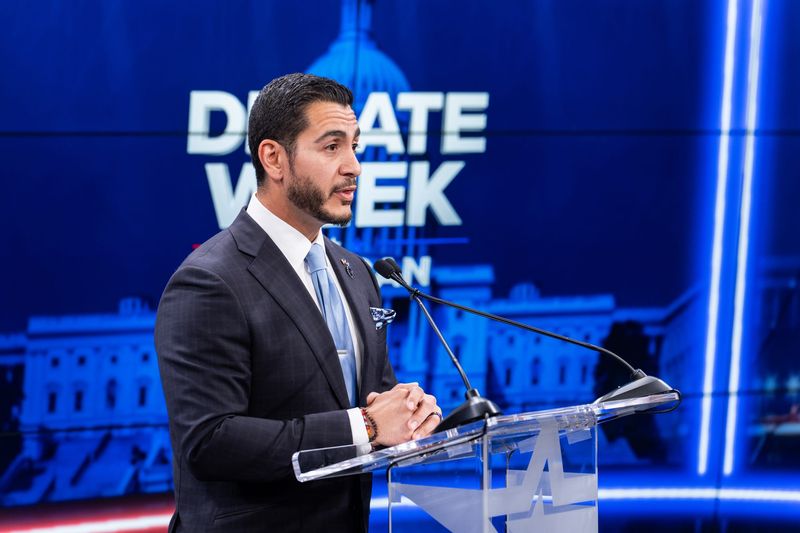
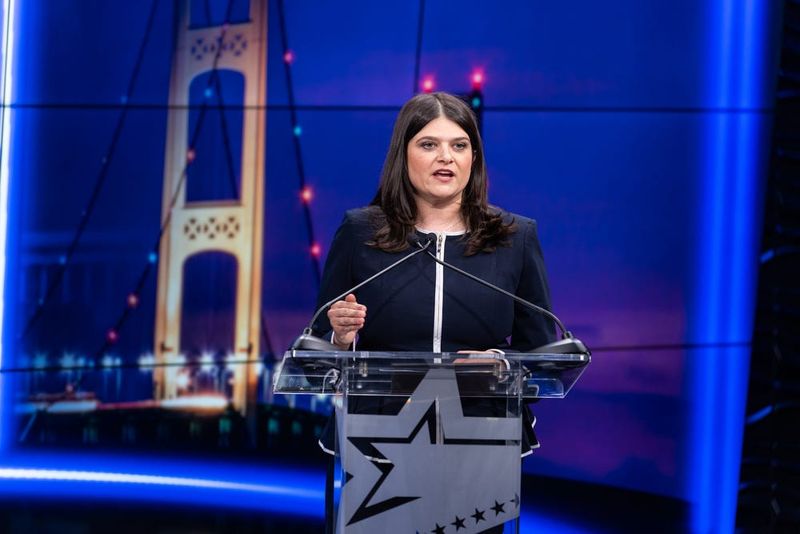
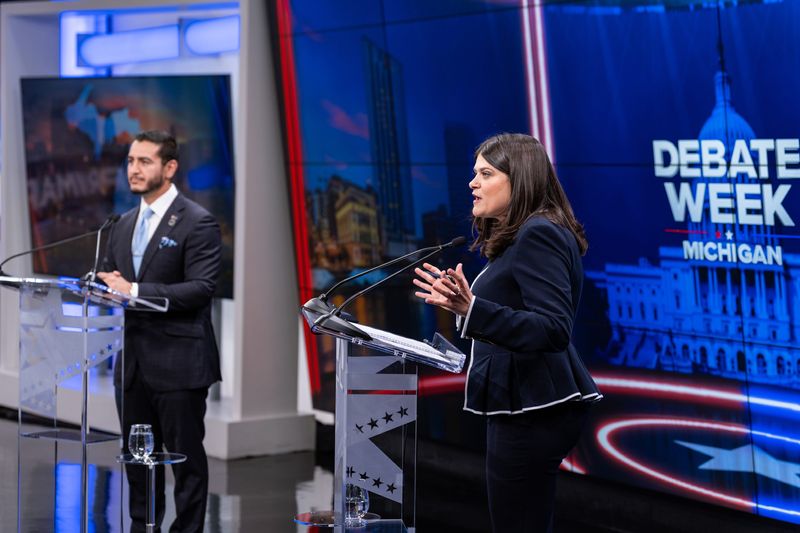
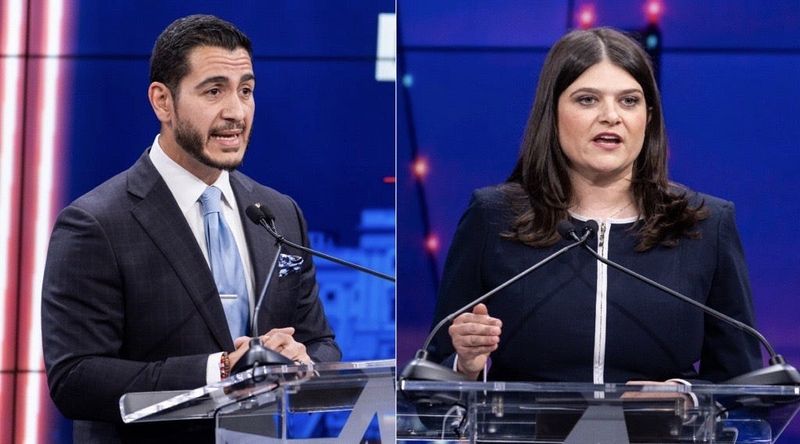
Grand Rapids — Democratic U.S. Senate hopefuls Abdul El-Sayed and Haley Stevens got aggressive in their attacks from the start of Tuesday night’s debate, and the zingers never let up, with each candidate landing blows.
In a wide-ranging exchange that demonstrated the pair’s differences in both style and policy, the candidates met at WOOD-TV in Grand Rapids for their first televised debate since state Sen. Mallory McMorrow ended her campaign on Sunday, creating a two-person contest for the final four weeks before the Aug. 4 primary.

The debate could have implications for the outcome of the heated race, which is considered one of the most competitive in the country. It pits a progressive firebrand who has never held office, El-Sayed of Ann Arbor, against Stevens, a moderate suburban Detroit lawmaker who is in her sixth term in Congress.
The winner of the primary is expected to face presumptive Republican nominee Mike Rogers, a former seven-term congressman, in the November general election.
Here are eight key moments and distinctions that El-Sayed and Stevens drew for Democratic primary voters mulling the two hopefuls:
Workhorse vs. ‘celebrity senator’
Stevens debuted a number of new attacks at the debate on Tuesday and sought to define El-Sayed as a closet millionaire who’s “trying to sell a book or a podcast” and hiding his tax return.
“I’m the only one on this stage who doesn’t have a talent agent trying to pitch me for paid speeches, and unlike my opponent, I’m not running at the first mic or camera I see,” Stevens said.“We do not need a celebrity senator. We need a workhorse, and as the most effective lawmaker for Michigan in the House of Representatives, if you want a fighter and an effective leader for our state, that’s me.”
El-Sayed fired back, saying, “We also don’t need politicians bought off by corporations in this race.”
El-Sayed said the groups funding millions of dollars in TV advertisements promoting Stevens wanted a politician “who’s going to do their bidding instead of yours.”
“The question is not whether or not you’re a millionaire. The question is whether or not you are bowing down to billionaires. And for too long in our politics, we’ve watched politicians beg for those dollars only to do that bidding when they actually get to office,” El-Sayed said.
“That has been the story of my opponent. … I’m the only one who’s never taken a dime from a corporation.”
In rebuttal, Stevens accused El-Sayed of failing to disclose his tax return for 2025 as she has. El-Sayed got an extension until October, though previously provided a redacted copy of his 2024 return to the News.
“You talk about getting money out of politics and putting money in people’s pockets, but who is putting money in yours?” Stevens said.
Is Benjamin Netanyahu helping Haley Stevens or attacking?
Stevens, who is generally a staunch supporter of Israel, took a swipe at its leader in suggesting that Israeli Prime Minister Benjamin Netanyahu had “failed” in securing long-term peace and in providing humanitarian aid.
“I can say that Israel has a right to peacefully exist alongside the people of Palestine and in Gaza,” she said.
“It is very clear to me that Mr. Netanyahu has not made us safer, has not brought us closer to peace, and he’s endangered Jews here in America and around the world. This is why he was just trashing me today on CNN. I am not afraid of bullies.”
El-Sayed said the question that Stevens needs to answer is why she has allowed $40 million of outside spending — including millions from the super PAC of the American Israel Public Affairs Committee (AIPAC) — to flow into the race.
El-Sayed said he believes Netanyahu was just giving Stevens cover during the Israeli leader’s appearance Tuesday on CNN.
“I don’t think Benjamin Netanyahu is attacking her to actually attack her; I think he’s attacking her to try and steer away the stink of how staunchly she stands for their policy, so let’s take that opportunity,” he said. “Explain what you’ve given away for AIPAC support in this race.”
Stevens shot back that “no one owns my vote.”
“No one owns my policies,” Stevens said. “Anyone who is contributing to my Senate campaign is doing so because of my proven record of fighting for Michigan.”
Claims of Republican help for El-Sayed
In addition to demanding El-Sayed release his tax return, Stevens accused El-Sayed’s candidacy of being funded by the GOP during the debate Tuesday night, claiming they’d rather run against the former Wayne County health chief.
Stevens also said El-Sayed was bragging about “false polls” that people were circulating, claiming he was the best candidate to take on the GOP’s Rogers in the general election.
Asked after the debate how the GOP was funding El-Sayed’s operation, Stevens said Republicans were funding his message through a committee on the internet.
“I think that the GOP is giving props to Abdul’s campaign,” she added.
The two Democratic contenders have been clashing for months over who would be the best opponent against Rogers in the November general election.
“I’m sure everybody out there thinks that Republicans really want me to win this race,” El-Sayed retorted.
Stevens pulls El-Sayed’s father-in-law into the fray
El-Sayed repeatedly pointed out that he doesn’t take corporate PAC money as Stevens does, and that she hasn’t disavowed any of the millions of dollars being spent by outside groups to boost her candidacy.
“You want to talk about transparency? Why are there $40 million flowing into our politics right now in support of my opponent?” El-Sayed asked.
“Notice ― none of (her) answers actually speak to any of the points I’m making about the money that is being spent in these races to corrupt our politics,” he added.
Stevens jumped in: “Because I have receipts,” she said. “I am not someone who is trying to go viral and shouting into a bullhorn about problems. I am delivering. That is not something my opponent can say.”
Stevens cast El-Sayed as a hypocrite, noting his father-in-law is funding a super PAC that’s spent millions on his behalf.
El-Sayed sidestepped the attack about his father-in-law’s support by running down a list of labor unions, like the United Auto Workers, that have endorsed him, saying they are, “not my father-in-law.”
El-Sayed hits Stevens over ICE contractor money
Stevens and El-Sayed split on how to address the controversial U.S. Immigration and Customs Enforcement agency, with El-Sayed pushing to abolish it and Stevens calling for reform.
“ICE is about normalizing a paramilitary force in our streets. I’ve been clear that you can’t reform ICE, you can’t re-train ICE. You have to abolish ICE,” El-Sayed said.
Stevens noted that she pushed for the resignation of former Homeland Security Secretary Kristi Noem, calling ICE completely out of control and abusing their power with a $70 billion “slush fund.”
“A temple in my district was blown up. It wasn’t ICE that stood up, it was state and local law enforcement,” Stevens said.
El-Sayed charged that Stevens had changed her tone on the agency, calling it a “bob and weave” and noting that she took money from lobbyists and PACs for ICE contractors and also voted to thank ICE.
“That seems to me to be very different than what we’re hearing now,” he said.
Stevens accused El-Sayed of pursuing Republican tactics. She said GOP lawmakers inserted a “cynical” line thanking ICE into a resolution condemning antisemitism after a terror attack in Boulder, Colorado, last year.
“I am always going to stand up to violence, and I just wish my opponent wouldn’t pursue the cynical approaches of Republicans when we do need to be united,” Stevens said.
Contrasting proposals for artificial intelligence rules
When the candidates were asked about regulating artificial intelligence, El-Sayed said that “absolutely” needs to happen, while Stevens gave a murkier answer.
El-Sayed said he wants artificial intelligence companies to be spun off as public-interest corporations, with at least half of their board members publicly appointed through a democratic process.
“I also want real, clear guardrails on what AI can and can’t do,” El-Sayed said, adding that he wanted the policies to be similar to the Food and Drug Administration, which is in charge of protecting public health.
Stevens initially used the artificial-intelligence question to criticize El-Sayed for a political committee that’s been spending in the campaign to his benefit.
Then, Stevens said she had supported protecting the privacy of consumers and aiding small businesses.
“I want to make sure that resources are coming into our communities and that jobs are protected and maintained,” Stevens said.
Debating Chuck Schumer, ‘insider deals’ and electability
Asked if he’d continue the leftward trajectory of the Democratic Party, El-Sayed said he would presume his own path of leadership “educated by the countless days that I’ve spent talking to Michiganders across 110 cities, 450 public events.”
“I’ll tell you this: (The party) won’t shift if we continue to elect leaders who take money from the same corporations who have broken with the interests of the American public,” El-Sayed said.
“[Senate Democratic Leader] Chuck Schumer desperately wants one of us to be the next senator, and it’s not me.”
Stevens sidestepped El-Sayed’s dig and dismissed those who “want to make this run for U.S. Senate about Washington, D.C. insider deals and what’s going on with our party leadership.”
“Friends, this is about the future of Michigan. Who is going to be the workhorse?” she said. “Look, I’ve got the receipts. I have passed big pieces of legislation.”
El-Sayed later contended again that he’s the most electable Democrat in November.
“Why? Because you got to actually fight for something. It’s not enough to offer people two options that kind of look the same on the issues that matter the most,” he said. “If you’re taking money from corporations, the same corporations — Democrat or Republican — how different are things really going to be?”
In her retort, Stevens appeared to suggest the difference between her and El-Sayed going up against Rogers was one of gender.
“With all due respect to Abdul, I think he looks a lot more like Mike Rogers than I do,” Stevens said.
How the candidates both jockeyed for auto worker support
Stevens pitched herself as Michigan’s “manufacturing geek,” touted her work on the auto rescue and her legislation to ban Chinese-connected vehicles to protect the U.S. auto sector.
“Nothing is motivating me more than standing up for our manufacturing sector and our jobs and that means taking on China,” she said.
El-Sayed hit back by underscoring his endorsement by the UAW over Stevens.
“They endorsed me in this race because I understand that the biggest challenge we have right now, the thing that is throttling our ingenuity, is the fact that our corporations are a lot more interested in a quarterly bottom line than they are in the long-term sustainability of manufacturing,” El-Sayed said.
“I think we need to think differently. That means standing up to Wall Street, not taking their money to run your campaigns.”
mburke@detroitnews.com
cmauger@detroitnews.com
This article originally appeared on The Detroit News: 8 key moments from Michigan Senate debate between Stevens, El-Sayed
Reporting by Melissa Nann Burke and Craig Mauger, The Detroit News / The Detroit News
USA TODAY Network via Reuters Connect
By Melissa Nann Burke and Craig Mauger, The Detroit News | USA TODAY Network